
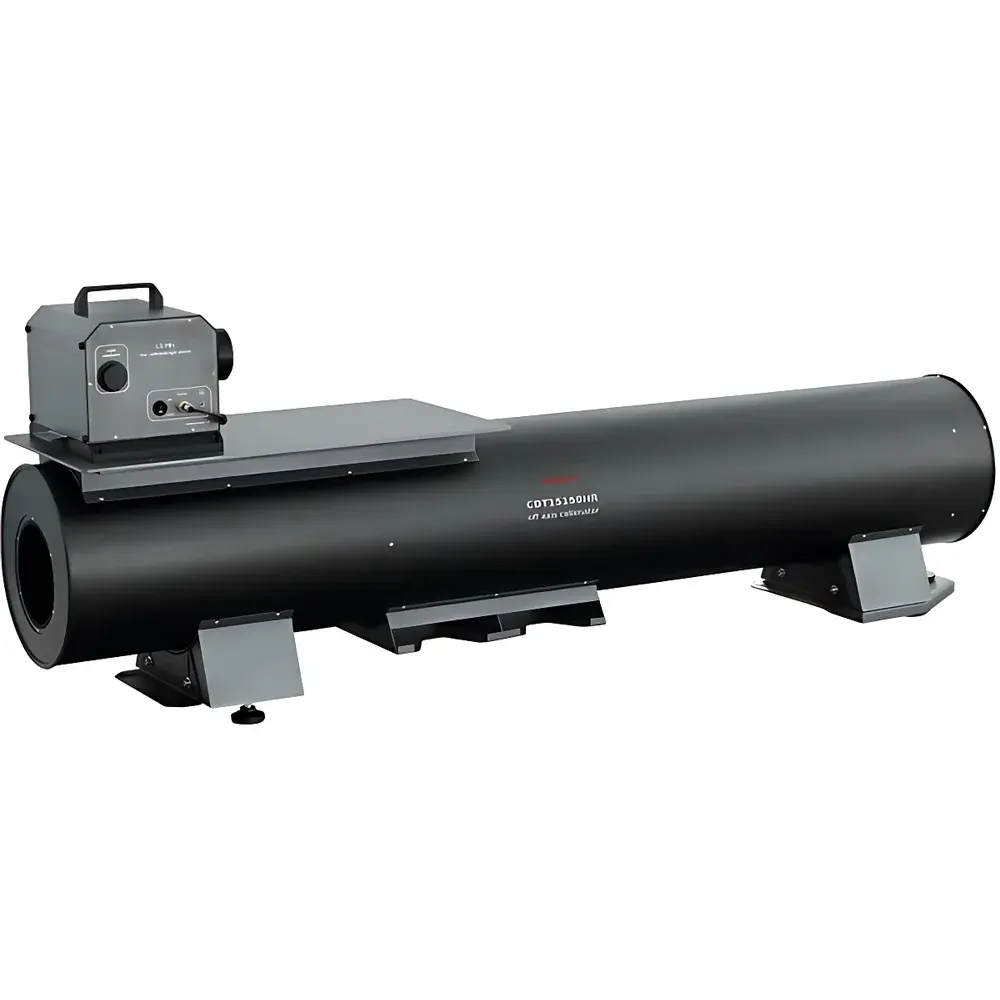
Inframet VINIS Visible-Near-Infrared Camera Test System
| Brand | Inframet |
|---|---|
| Origin | Poland |
| Model | VINIS |
| Light Source | LS-MAH Halogen Lamp (Uncalibrated, Manual Attenuation) |
| Optical Tube | CDT Series Off-Axis Reflective Collimator (Selectable Aperture & Focal Length) |
| Target Mount | Manual Target Holder (TAMAH Ring) |
| Compliance | Not NIST-traceable |
| Operating Temperature | +5°C to +35°C |
| Storage Temperature | −5°C to +55°C |
| Humidity | ≤90% RH (non-condensing) |
| Dimensions | 280 × 260 × 230 mm |
| Weight | 8 kg |
| Spectral Range | 400–2000 nm |
| Luminance Range | 60 mcd/m² to 6 kcd/m² (base configuration) |
| Dynamic Range | ≥10⁵ |
| Emission Profile | Lambertian (≤15° full angle) |
| Color Temperature | 2856 K (400–1100 nm) |
| Calibration Status | Uncalibrated (optional calibration add-ons available) |
Overview
The Inframet VINIS Visible-Near-Infrared Camera Test System is a purpose-engineered optical evaluation platform designed for rapid, cost-effective functional verification of imaging sensors and camera modules operating across the 400–2000 nm spectral band. Unlike full-featured TVT (Television Test) systems—typically deployed in production QA or metrology-grade validation—the VINIS system adopts a simplified, hardware-centric architecture optimized for early-stage development labs, academic imaging research, and pre-compliance screening. Its core principle relies on collimated projection of high-contrast, spatially defined targets onto the device under test (DUT), using an off-axis reflective collimator (CDT series) paired with a manually adjustable halogen source (LS-MAH). This approach eliminates motorized components, automated software control, and factory calibration traceability—thereby reducing both acquisition cost and operational complexity—while preserving sufficient geometric fidelity and radiometric repeatability for qualitative and semi-quantitative assessment of resolution, contrast transfer, field uniformity, and spectral response trends.
Key Features
- Modular collimator design: Three interchangeable CDT off-axis reflective tubes (CDT660HR, CDT11100HR, CDT15150) offering apertures from 60 mm to 150 mm and focal lengths from 600 mm to 1500 mm—enabling scalable working distance and angular resolution tuning (60–130 lp/mrad).
- Manually operated LS-MAH halogen source: 40 mm diameter emitter with continuous spectral coverage from 400 nm to 2000 nm and stable 2856 K color temperature in the visible–NIR range; luminance adjusted via precision mechanical attenuator (60 mcd/m² to 6 kcd/m²).
- Target handling flexibility: TAMAH mechanical adapter ring accommodates standard ISO 12233-style slanted-edge, Siemens star, and multi-bar targets; manual insertion supports rapid target swaps without actuation hardware.
- Compact and benchtop-ready: Fully self-contained unit (280 × 260 × 230 mm, 8 kg) with integrated thermal management and robust aluminum housing—designed for stable operation in ambient lab environments (+5°C to +35°C).
- Configurable spectral filtering: Base model includes manual filter slot for user-installed bandpass, longpass, or neutral density filters; optional upgrade path supports motorized filter wheel integration and calibrated spectral irradiance modules.
Sample Compatibility & Compliance
The VINIS system supports evaluation of monochrome and color CMOS/CCD imagers, uncooled microbolometers (with appropriate NIR-transmissive windowing), SWIR InGaAs sensors (up to 1700 nm), and hybrid visible–NIR fused-camera assemblies. It is not intended for ISO 16505 or MIL-STD-810G photometric certification, nor does it meet ASTM E308 or CIE 15:2018 absolute radiance traceability requirements out-of-the-box. However, its repeatable mechanical alignment, low-distortion collimation, and stable thermal output make it suitable for internal method development, comparative sensor benchmarking, and GLP-aligned lab protocols where relative performance metrics (e.g., MTF roll-off vs. spatial frequency, SNR vs. irradiance level) are prioritized over absolute calibration. Optional NIST-traceable calibration kits—including luminance standards and spectral irradiance references—are available as post-purchase add-ons for users requiring documented uncertainty budgets.
Software & Data Management
The VINIS system operates as a standalone optical projector: no embedded controller, no bundled PC, and no proprietary test software is included. Users integrate it into existing imaging test workflows by pairing it with third-party acquisition platforms (e.g., MATLAB Image Acquisition Toolbox, Python OpenCV + Aravis, or commercial machine vision SDKs such as Basler pylon or FLIR Spinnaker). Target images are captured using the DUT’s native interface; subsequent analysis—including modulation transfer function (MTF) extraction, contrast measurement, and non-uniformity mapping—is performed externally. The system’s mechanical reproducibility (sub-arcminute collimator alignment stability, <0.5% luminance drift over 30 min at constant attenuation setting) ensures consistent input conditions across sequential test sessions—facilitating longitudinal data comparison and audit-ready documentation when combined with user-defined metadata logging practices.
Applications
- Pre-production evaluation of automotive surround-view and driver-monitoring cameras (visible + NIR)
- Academic research on multispectral imaging system design and lens–sensor co-optimization
- Rapid prototyping of thermal/NIR fusion architectures using uncooled detector arrays
- Verification of anti-reflection coating performance across 400–1700 nm bands
- Internal validation of auto-exposure and HDR algorithms under controlled luminance gradients
- Training and demonstration setups for optical engineering curricula focusing on collimation, target projection, and sensor response modeling
FAQ
Is the VINIS system supplied with calibration certificates?
No. The base VINIS configuration uses an uncalibrated LS-MAH source and non-traceable collimators. NIST-traceable calibration reports for luminance, spectral irradiance, and MTF reference targets are available as optional accessories.
Can the VINIS be used for SWIR camera testing beyond 1100 nm?
Yes—provided the DUT’s quantum efficiency extends into the SWIR band and appropriate optical materials (e.g., CaF₂ or ZnSe windows, if required) are used in the light path. The LS-MAH source emits up to 2000 nm, though radiant intensity declines above 1700 nm.
Does Inframet provide technical support for integrating VINIS with custom software?
Yes—Inframet offers application engineering consultation, mechanical interface drawings (STEP/IGES), and radiometric characterization data sheets to support third-party software integration and test protocol development.
What is the expected lifetime of the LS-MAH halogen lamp?
Rated average life is 2,000 hours at nominal voltage; lifetime is extended under reduced filament voltage operation, which also improves color temperature stability over time.
Is the CDT collimator compatible with other Inframet sources?
Yes—the CDT series uses standardized mechanical and optical interfaces; it can be coupled with Inframet’s calibrated DAL series sources or third-party collimated sources meeting the specified entrance pupil and beam divergence constraints.




