
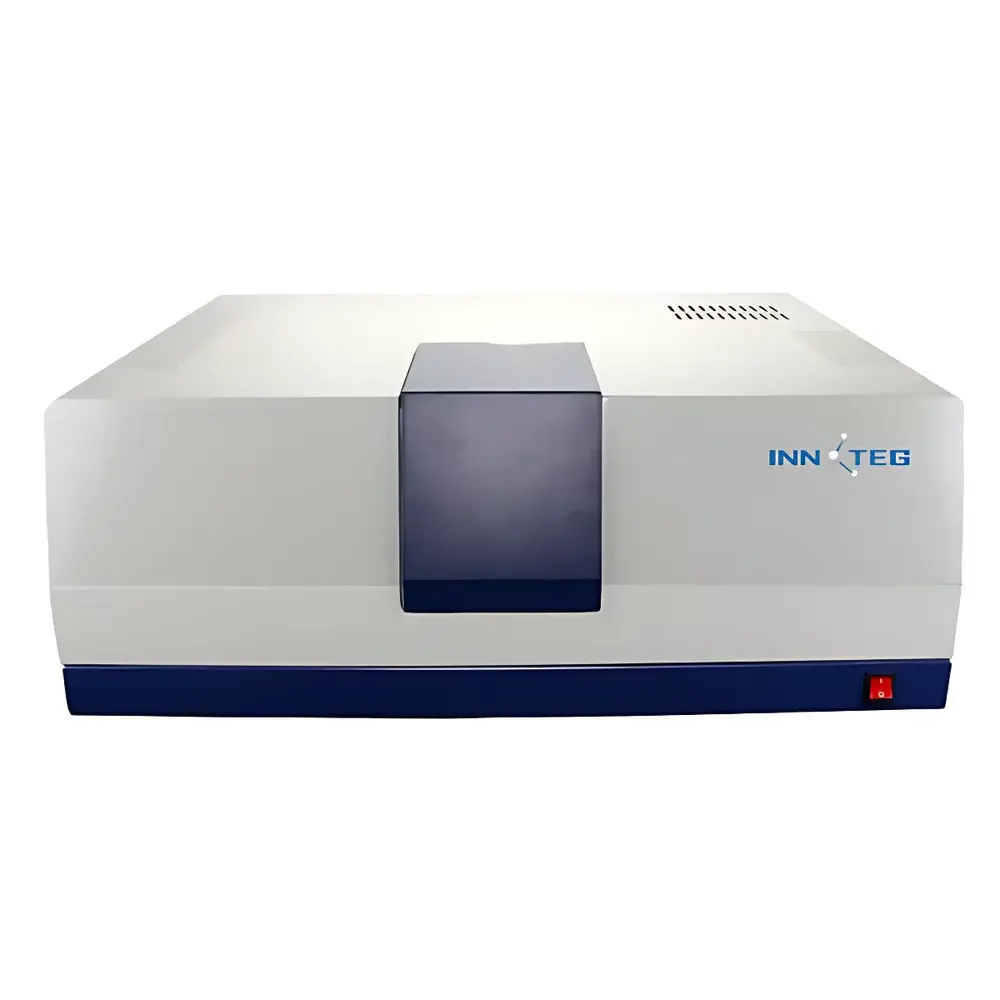
INNOTEG IUS-190 UV-Vis-NIR Spectrophotometer
| Spectral Range | 190–3200 nm |
|---|---|
| Bandwidth (UV-VIS) | 0.2, 0.5, 1, 2, 3, 5 nm |
| Bandwidth (NIR) | 0.8, 2, 4, 8, 12, 20 nm |
| Wavelength Accuracy | ±0.5 nm (UV/VIS), ±2.0 nm (NIR) |
| Wavelength Repeatability | ≤0.3 nm (UV/VIS), ≤1.0 nm (NIR) |
Overview
The INNOTEG IUS-190 UV-Vis-NIR Spectrophotometer is a dual-beam, double-grating, dual-detector optical instrument engineered for high-fidelity spectral characterization across an exceptionally broad wavelength range—from deep ultraviolet (190 nm) through the visible spectrum and into the near-infrared (3200 nm). It operates on the principle of dispersive absorption spectroscopy, utilizing precision diffraction gratings to resolve incident polychromatic light, followed by simultaneous detection using optimized photodiode arrays or InGaAs detectors for UV-VIS and NIR regions respectively. This architecture enables quantitative measurement of transmittance, absorbance, reflectance, and diffuse reflectance with high photometric linearity and low stray light contribution. Designed for laboratory-based analytical workflows in regulated and research-intensive environments, the IUS-190 delivers traceable performance suitable for method development, quality control, and materials characterization where spectral fidelity across three optical domains is essential.
Key Features
- Dual-beam optical path with real-time reference compensation, minimizing drift due to source instability or environmental fluctuations
- Double-grating monochromator system: separate UV-VIS and NIR gratings ensure optimal resolution and throughput in each spectral region
- Hybrid detector configuration: silicon photodiode array for UV-VIS (190–1100 nm) and thermoelectrically cooled InGaAs detector for NIR (900–3200 nm), enabling low-noise signal acquisition across the full range
- Variable slit-controlled spectral bandwidth: six selectable bandwidths in UV-VIS (0.2–5 nm) and six in NIR (0.8–20 nm), supporting both high-resolution identification and high-sensitivity quantitation
- Automated self-calibration at startup, including wavelength and photometric verification using internal holmium oxide and neutral density standards
- USB 2.0 high-speed interface enabling full-range spectral scans in under 5 minutes with 1 nm data interval resolution
Sample Compatibility & Compliance
The IUS-190 accommodates solid, liquid, and powder samples via interchangeable accessories—including integrating spheres (for diffuse reflectance), variable-pathlength cuvette holders (1 mm to 100 mm), and custom sample stages for architectural glass and coated substrates. Its optical design conforms to core requirements of international test standards referenced in its application scope, including ISO 9050:2003 (optical properties of glazing), GB/T 2680–2021 (determination of solar heat gain coefficient for building glass), and GB/T 36261–2018 (spectral transmittance and reflectance measurements for functional coatings). While not pre-certified to FDA 21 CFR Part 11, the instrument’s software architecture supports audit-trail-enabling configurations and user-access controls required for GLP/GMP-aligned laboratories when deployed with validated IT infrastructure.
Software & Data Management
The proprietary INNOTEG SpectraSuite software runs natively on Windows 7 and Windows 10 platforms and provides comprehensive instrument control, spectral acquisition, and post-processing capabilities. It supports real-time spectral overlay, baseline correction, derivative analysis, peak integration, and multi-curve mathematical operations (e.g., ratio, subtraction, normalization). Data export is available in ASCII text (.txt), CSV, and native Excel (.xlsx) formats; imported datasets (e.g., reference spectra or calibration files) can be loaded for comparative analysis. Preconfigured application modules include Building Glass Solar Performance Analysis (per ISO 9050 and JGJ/T 151–2008), Coating Optical Characterization (reflectance/transmittance mapping), and Paint & Pigment Spectral Fingerprinting. All reports—containing metadata (date/time, operator ID, instrument serial number, measurement parameters)—are printable with embedded spectral plots and tabular results.
Applications
- Architectural glazing evaluation: determination of solar transmittance, UV blocking efficiency, and shading coefficient for low-emissivity, sputtered, ion-plated, and magnetron-coated glasses
- Coatings and thin-film analysis: quantification of optical constants (n, k), thickness estimation via interference fringe analysis, and batch-to-batch consistency monitoring
- Automotive glass testing: spectral transmission profiling for driver visibility compliance, UV protection rating, and IR rejection validation
- Materials science research: bandgap estimation of semiconductors, ligand-field transitions in transition-metal complexes, and polymer degradation kinetics via time-resolved UV-Vis-NIR
- Environmental and industrial QA/QC: water quality assessment (COD, nitrate, phosphate), pigment dispersion homogeneity, and pharmaceutical excipient identity verification
FAQ
What is the wavelength accuracy specification across the full 190–3200 nm range?
Wavelength accuracy is ±0.5 nm from 190 to 1100 nm (UV-VIS region) and ±2.0 nm from 1100 to 3200 nm (NIR region), verified against NIST-traceable holmium oxide and didymium reference filters.
Does the IUS-190 support GMP-compliant data integrity practices?
The base software does not include electronic signatures or audit trail logging by default; however, it is compatible with third-party LIMS or ELN systems that enforce 21 CFR Part 11 requirements when integrated via standardized data export protocols.
Can the instrument measure absolute reflectance of opaque solids?
Yes—when equipped with a 60 mm integrating sphere accessory (optional), the IUS-190 performs calibrated absolute reflectance measurements from 250 to 2500 nm using BaSO₄ or Spectralon® reference standards.
Is spectral bandwidth selection automated or manual?
Bandwidth is manually selected prior to scan initiation via software interface; each setting corresponds to a fixed mechanical slit width and grating configuration optimized for resolution/sensitivity trade-offs in respective spectral zones.
What maintenance is required for long-term wavelength stability?
Annual recalibration using certified reference materials is recommended; the dual-beam design and internal auto-alignment routine minimize daily drift, and no user-serviceable optical alignment components are present in the sealed optical bench.
Related Products





