
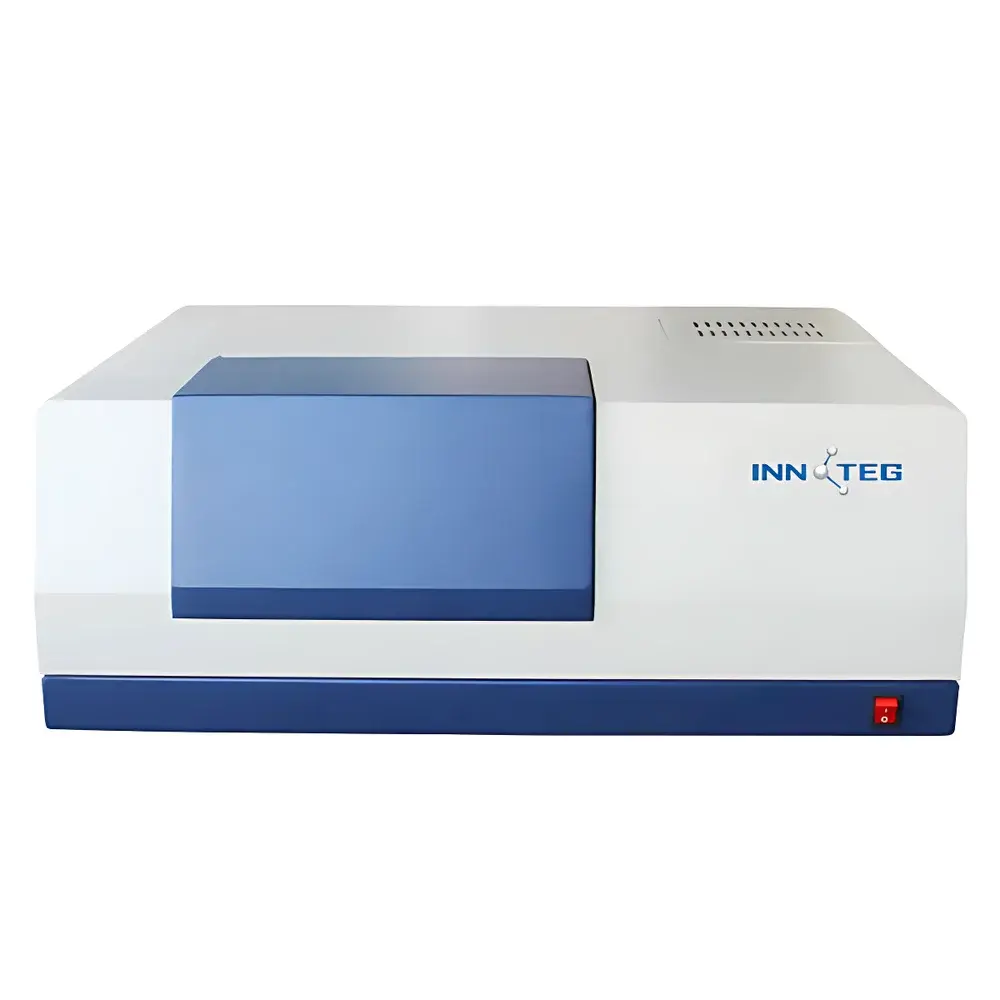
INNOTEG IUS-200-6 UV-Vis-NIR Spectrophotometer
| Brand | INNOTEG |
|---|---|
| Origin | Guangdong, China |
| Manufacturer Type | Authorized Distributor |
| Product Origin | Domestic (China) |
| Model | IUS-200-6 |
| Spectral Range | 280–2500 nm |
| Slit Bandwidth | [UV-VIS] 0.2, 0.5, 1, 2, 3, 5 nm |
| Wavelength Accuracy | ±0.5 nm (UV/VIS), ±2.0 nm (NIR) |
| Wavelength Repeatability | ≤0.3 nm (UV/VIS), ≤1.0 nm (NIR) |
Overview
The INNOTEG IUS-200-6 UV-Vis-NIR Spectrophotometer is a dual-beam, double-grating, dual-detector optical instrument engineered for high-fidelity spectral characterization across the ultraviolet, visible, and near-infrared regions (280–2500 nm). Its core measurement principle relies on dispersive spectroscopy using precision diffraction gratings and thermoelectrically stabilized silicon (UV-VIS) and InGaAs (NIR) detectors, enabling simultaneous high-sensitivity detection with minimized dark current and signal drift. The integrated 60-mm diameter integrating sphere module allows direct, traceable acquisition of transmittance, specular reflectance, and diffuse reflectance spectra without manual reconfiguration—critical for materials with complex surface scattering behavior. Designed specifically for optical and thermal performance evaluation of architectural glazing, functional textiles, and optically active organic liquids (e.g., fructose, glucose, sucrose solutions), the system supports quantitative determination of key photometric and radiometric parameters including solar transmittance, UV rejection, visible light transmittance (VLT), and solar heat gain coefficient (SHGC)-related spectral integrals.
Key Features
- Dual-beam optical architecture with real-time reference beam compensation, ensuring long-term photometric stability under variable ambient conditions.
- Double-grating monochromator system: separate optimized gratings for UV-VIS and NIR spectral ranges, minimizing stray light and improving resolution fidelity across the full 280–2500 nm span.
- Co-located dual-detector configuration: Hamamatsu silicon photodiode (280–1000 nm) and extended-range InGaAs detector (900–2500 nm), both TE-cooled to reduce thermal noise and enhance signal-to-noise ratio at low irradiance levels.
- Integrated 60-mm PTFE-coated integrating sphere with baffle-controlled port geometry, compliant with ASTM E1331 and ISO 13468 for diffuse transmittance/reflectance measurements.
- Automated wavelength calibration routine executed at power-on using internal holmium oxide and didymium reference filters—traceable to NIST SRM standards.
- Motorized slit width selection (0.2–5 nm in UV-VIS; 0.8–20 nm in NIR) enables user-defined trade-offs between spectral resolution and radiant throughput for application-specific optimization.
Sample Compatibility & Compliance
The IUS-200-6 accommodates flat, rigid, and semi-flexible samples up to 100 × 100 mm in dimension and 25 mm in thickness—including monolithic glass, laminated safety glass, sputter-coated low-emissivity (low-E) substrates, magnetron-sputtered spectrally selective coatings, ion-plated interference filters, and float-glass derivatives. Liquid cuvettes (10-mm pathlength standard) are supported via dedicated holder inserts. The system is fully aligned with regulatory and industry-standard test methodologies: GB/T 2680-2021 (optical properties of building glass), JGJ/T 151-2008 (energy performance calculation), ISO 9050-2003 (determination of luminous and solar photometric properties), GB/T 22476-2008 (spectral transmittance of daylighting materials), and GJB 798-90 (military-grade optical material qualification). All spectral data acquisition workflows support audit-ready metadata tagging per GLP/GMP requirements, including operator ID, timestamp, calibration certificate ID, and environmental sensor logs (optional ambient temperature/humidity input).
Software & Data Management
Control and analysis are performed via INNOTEG SpectraSuite v4.x—a Windows 7/10 native application developed in accordance with FDA 21 CFR Part 11 principles for electronic records and signatures. The software provides role-based access control, configurable audit trails, and immutable raw-data archiving (binary .isd format with embedded header metadata). Measurement modes include transmittance (%T), absorbance (A), reflectance (%R), and radiant flux (mW/nm). Preconfigured application modules include “Architectural Glass Analysis” (automated SHGC, U-value, and g-value derivation per ISO 52022-1), “Coating Characterization” (peak identification, bandgap estimation, layer thickness modeling via envelope method), and “Liquid Quantification” (multi-wavelength regression against certified reference standards). Export options include CSV, XLSX, TXT, and vector-based PDF reports with customizable templates compliant with internal QA documentation protocols.
Applications
- Quantitative spectral evaluation of solar control glazing for LEED and BREEAM certification submissions.
- In-process quality assurance of vacuum-deposited optical coatings on architectural and automotive substrates.
- Development and validation of NIR-transparent polymer films for agricultural greenhouse applications.
- Concentration profiling of carbohydrate solutions in food science and fermentation process monitoring.
- Optical property mapping of smart windows (electrochromic, thermochromic) across operational voltage/temperature states.
- Material aging studies: UV-induced degradation kinetics assessed via time-resolved spectral shift analysis in the 280–400 nm region.
FAQ
Does the IUS-200-6 comply with ISO/IEC 17025 requirements for accredited testing laboratories?
Yes—the instrument’s calibration hierarchy, documented uncertainty budgets (available upon request), and software audit trail functionality meet clause 6.4 and 7.7 of ISO/IEC 17025:2017 for measurement equipment used in accredited scope testing.
Can the system be upgraded to support fiber-optic sampling or external accessory integration?
The optical bench includes standardized SMA-905 ports and TTL-triggered shutter synchronization, enabling third-party fiber probes, temperature-controlled sample stages, or liquid chromatography coupling with minimal hardware modification.
What is the typical recalibration interval recommended for routine QC use?
Annual factory recalibration is advised; however, daily verification using built-in reference filters and quarterly NIST-traceable lamp intensity checks satisfy most ISO 9001 and internal QA policies.
Is spectral data export compatible with MATLAB or Python-based analysis pipelines?
Raw spectra are exported as ASCII tab-delimited files with wavelength and intensity columns, directly ingestible by SciPy, Pandas, or custom spectral processing scripts without proprietary codec dependencies.





