
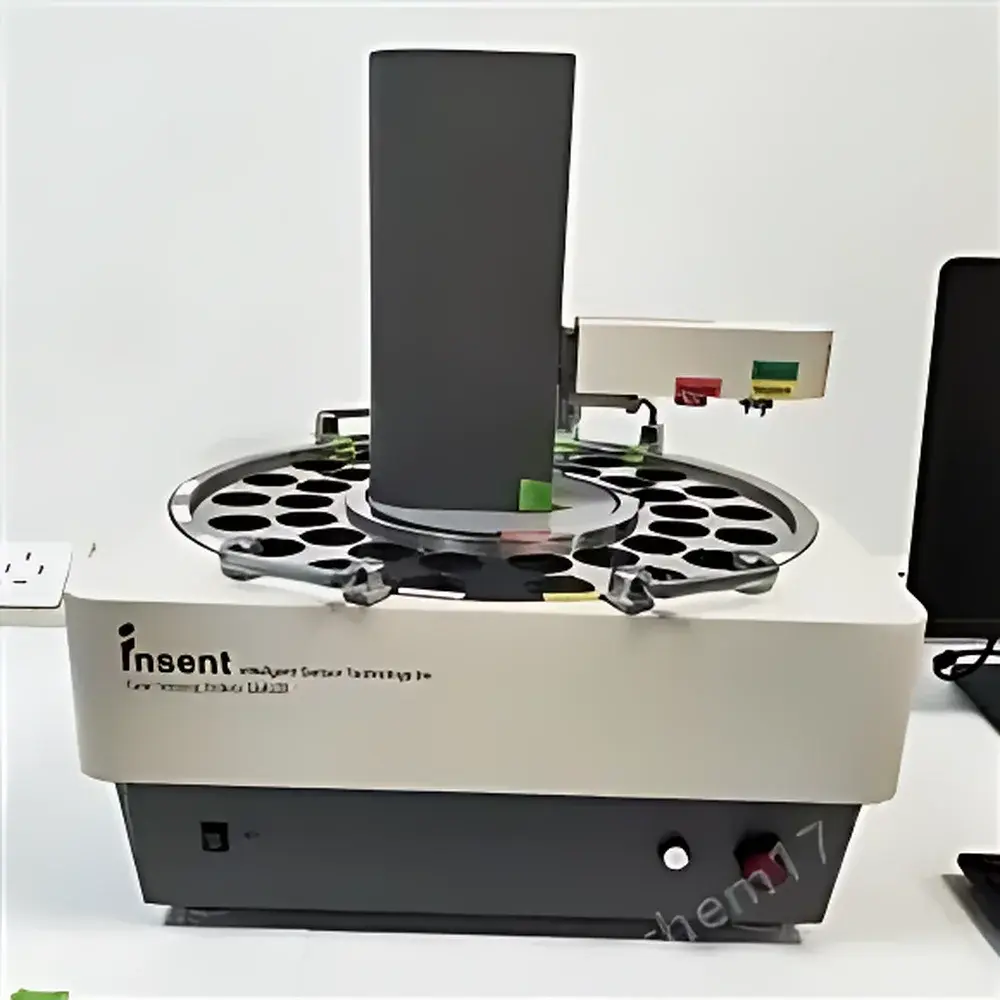
Insent TS-5000Z Electronic Tongue System
| Brand | Insent |
|---|---|
| Origin | Japan |
| Type | Taste Sensing System (Electronic Tongue) |
| Core Technology | Artificial Lipid Membrane Sensor Array |
| Measurable Tastes | Sour, Sweet, Bitter, Salty, Umami, Astringent |
| Aftertaste Analysis | Bitterness, Astringency, and Umami Persistence (Richness) |
| Compliance | Designed for GLP/GMP-aligned sensory evaluation workflows |
| Software Interface | Touchscreen-guided operation with macro scripting support |
| EMI Shielding | Integrated electromagnetic interference suppression architecture |
| Category | Sensory Intelligent Analysis System |
Overview
The Insent TS-5000Z Electronic Tongue System is a high-fidelity taste sensing platform engineered for objective, quantitative assessment of gustatory profiles in food, pharmaceuticals, and consumer health products. Unlike conventional chemical assays or subjective panel testing, the TS-5000Z operates on a biomimetic principle: its sensor array employs artificial lipid membrane technology—structurally and functionally analogous to human taste receptor cells—to transduce molecular interactions at the taste bud level into reproducible electrical signals. Each sensor responds selectively yet cross-sensitively to ionic, hydrophobic, and hydrogen-bonding compounds present in aqueous or semi-aqueous samples, enabling multivariate discrimination of primary taste modalities (sour, sweet, bitter, salty, umami, astringent) as well as temporal response dynamics—including aftertaste persistence and richness. The system delivers dimensionless, normalized taste intensity values (0–100 scale) calibrated against reference standards traceable to ISO 8586:2014 (Sensory analysis — General guidelines for the selection, training and monitoring of assessors), making it suitable for regulatory-compliant sensory data generation in R&D, QC, and stability testing environments.
Key Features
- Biomimetic lipid membrane sensor array with six dedicated taste-selective electrodes plus reference electrode, ensuring physiological relevance in signal transduction
- Real-time temporal profiling capability: captures initial taste response, plateau phase, and decay kinetics—enabling quantification of bitterness linger, astringency build-up, and umami richness
- Integrated electromagnetic interference (EMI) shielding across sensor chamber, signal conditioning circuitry, and data acquisition module to maintain baseline stability under industrial lab conditions
- Intuitive 10.1-inch capacitive touchscreen interface with guided workflow navigation, multilingual UI (English, Japanese, Chinese), and context-sensitive help prompts
- Macro scripting functionality allows automation of repetitive test sequences—e.g., sequential dilution series, batch calibration, or multi-sample comparative analysis—with user-defined parameter recall
- Modular sample handling design compatible with standard 15-mL conical tubes and 96-well microplate formats; optional autosampler integration available for high-throughput screening
Sample Compatibility & Compliance
The TS-5000Z accepts liquid, semi-liquid, and extract-based samples—including beverages, sauces, dairy formulations, oral suspensions, herbal decoctions, and lyophilized reconstitutes—provided they are filtered (≤0.45 µm) and pH-adjusted within operational range (pH 3.0–7.5). Viscosity tolerance extends up to 500 mPa·s without flow obstruction. All hardware and software components comply with IEC 61000-4-3 (EMC immunity) and IEC 61010-1 (safety requirements for electrical equipment). Data integrity adheres to ALCOA+ principles (Attributable, Legible, Contemporaneous, Original, Accurate, Complete, Consistent, Enduring, Available); audit trail functionality supports 21 CFR Part 11 readiness when deployed with validated network configuration and electronic signature modules.
Software & Data Management
The proprietary TS-5000Z Analysis Suite (v5.2+) provides comprehensive data processing: principal component analysis (PCA), discriminant factor analysis (DFA), hierarchical cluster analysis (HCA), and radar plot visualization. Raw sensor response curves are stored in HDF5 format with embedded metadata (timestamp, operator ID, sample ID, environmental temperature/humidity). Export options include CSV, PDF reports (with customizable templates), and direct integration with LIMS via RESTful API. All analysis parameters—including baseline correction method, normalization algorithm, and PCA rotation criteria—are version-controlled and logged in the immutable audit trail.
Applications
- Accelerated development of palatable pediatric and geriatric drug formulations through systematic bitterness masking evaluation
- Objective shelf-life determination based on time-dependent evolution of sour/bitter/umami balance in fermented foods and functional beverages
- Competitive benchmarking of commercial products via taste fingerprint mapping—generating “taste space” visualizations aligned with consumer preference clusters
- Root-cause analysis of off-taste complaints by correlating electronic tongue profiles with HPLC-MS metabolite data
- Validation of taste-modifying excipients in generic drug bioequivalence studies per ICH Q5C and WHO TRS 1010 Annex 9 guidelines
- Supporting sensory claim substantiation for clean-label product launches under EU Regulation (EC) No 1924/2006
FAQ
How does the TS-5000Z differ from conventional e-tongue systems using metal oxide or polymer sensors?
It employs biologically inspired lipid membranes that replicate ion-channel–mediated transduction mechanisms, yielding higher specificity for taste-active compounds and improved correlation with human sensory panels (r ≥ 0.89 vs. trained panel consensus, n = 127 validation samples).
Can the system quantify taste intensity independently of concentration?
Yes—the platform applies response saturation modeling and reference standard referencing to decouple perceived intensity from absolute analyte concentration, enabling cross-formulation comparison.
Is method validation support available for regulatory submissions?
Insent provides IQ/OQ/PQ protocols, system suitability test procedures, and full validation documentation packages compliant with ISO/IEC 17025 and ASTM E3052-16 (Standard Guide for Electronic Tongue Method Validation).



