
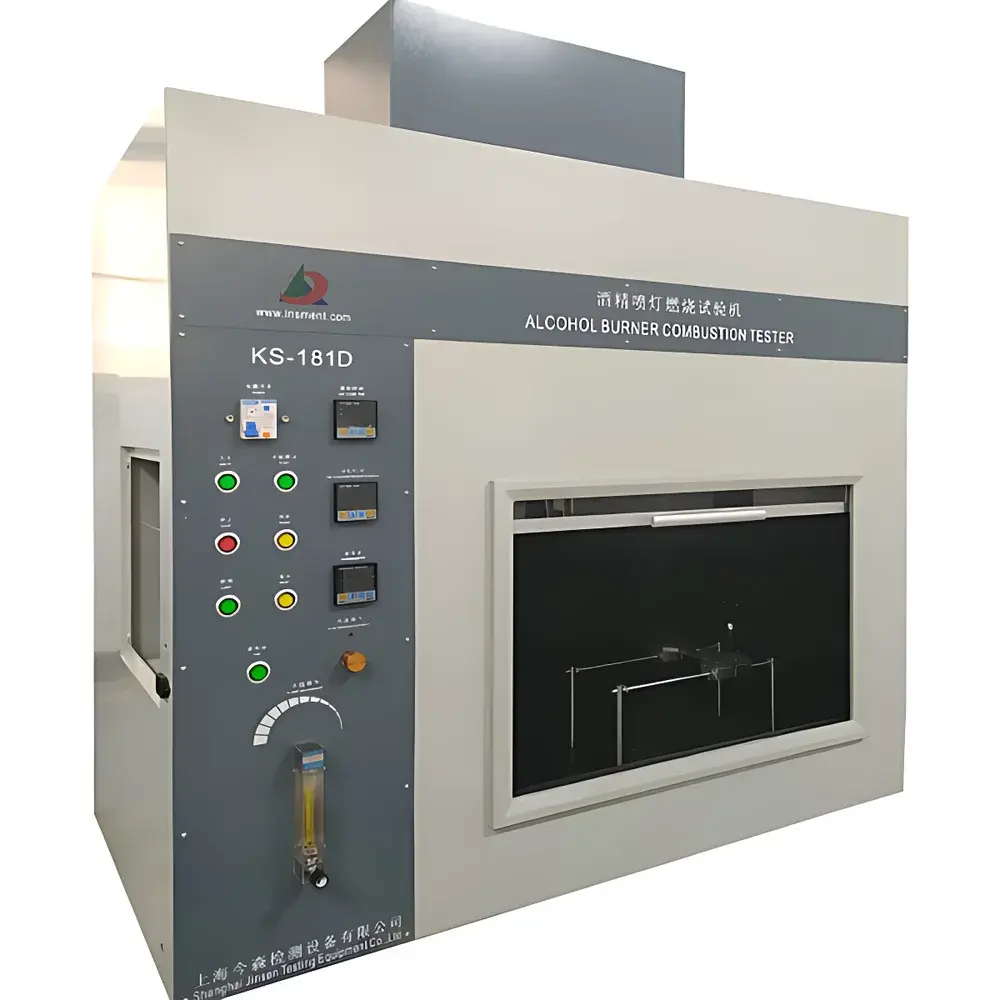
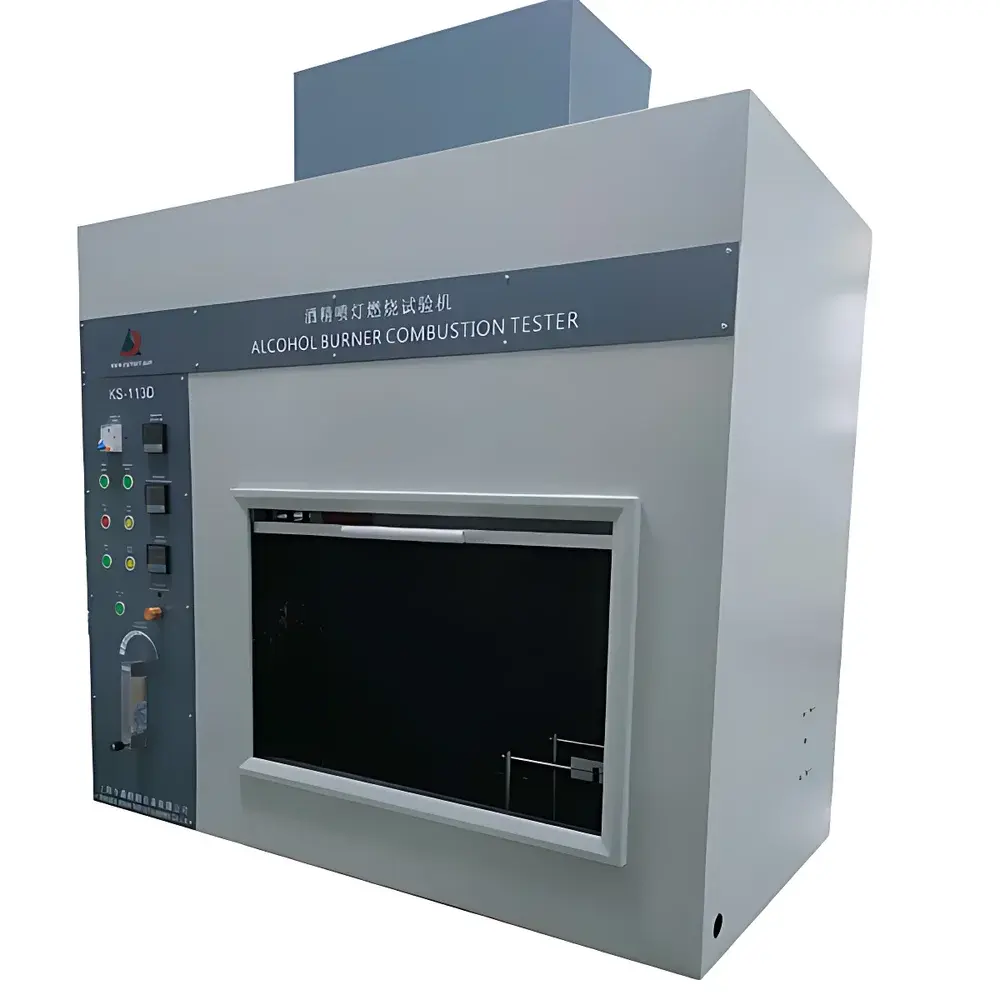
INSMENT KS-181D Alcohol Burner Combustion Test Chamber for Flame Retardancy Evaluation of Plastic Pipes in Underground Coal Mines
| Brand | INSMENT (Shanghai Jinsen) |
|---|---|
| Origin | Shanghai, China |
| Model | KS-181D |
| Compliance | MT181, MT113, GB/T 3685–1996, GB 16413–1996 |
| Fuel | 95% industrial ethanol + 5% methanol mixture |
| Flame temperature | 960 ± 60 °C |
| Flame length | 150–180 mm |
| Burn time range | 0–999.9 s (±0.01 s accuracy) |
| Specimen dimensions | 25-mm-wide ring cut from 600-mm-long plastic pipe (≥50 mm diameter) |
| Power supply | AC 220 V |
| Chamber dimensions | 1120 mm (W) × 580 mm (D) × 1350 mm (H) |
| Exhaust port | Φ100 mm |
| Weight | ~50 kg |
Overview
The INSMENT KS-181D Alcohol Burner Combustion Test Chamber is a purpose-built apparatus engineered for standardized flame retardancy evaluation of polymer-based plastic pipes intended for material transport in underground coal mine environments. It implements the controlled combustion principle using a calibrated alcohol-fueled burner to generate a stable, reproducible thermal flux—simulating real-world ignition conditions encountered during operational hazards. The system operates on the fundamental premise of quantifying post-ignition behavior: specifically, flame persistence (afterflame time) and glowing ember persistence (afterglow time) following removal of the ignition source. This methodology aligns with established fire safety engineering practices for low-heat-release, self-extinguishing materials, where rapid flame suppression and minimal residual smoldering are critical performance indicators. Designed for compliance-driven testing laboratories, the KS-181D integrates precise thermal control, high-resolution timing instrumentation, and enclosed chamber operation to ensure operator safety and measurement repeatability under defined ambient conditions.
Key Features
- Alcohol burner assembly delivering a stable flame at 960 ± 60 °C, verified via thermocouple or standardized copper wire melt test (0.7 mm diameter, 100 mm length, positioned 50 mm from burner tip)
- Dual independent digital timers with 0.01 s resolution: one for total burn duration (default 30 s), another for afterflame and afterglow measurement
- Enclosed test chamber with black interior finish to minimize ambient light interference and support visual observation under low-illumination conditions
- Adjustable vertical burner mount and horizontal specimen holder ensuring strict adherence to MT181-specified geometry: 50 mm vertical clearance between burner tip and specimen lower edge
- Fuel delivery system featuring transparent PVC tubing and gravity-fed reservoir with liquid level control (600 ± 20 mm height differential relative to burner tip)
- Integrated exhaust port (Φ100 mm) compatible with standard laboratory fume hood ducting for safe venting of combustion byproducts
- Robust steel frame construction with non-combustible internal lining; total mass ~50 kg ensures mechanical stability during thermal cycling
Sample Compatibility & Compliance
The KS-181D is validated exclusively for ring-shaped specimens (25 mm width) cut from rigid plastic pipes ≥50 mm in outer diameter and 600 mm in length—representative of conveyor, pneumatic, or hydraulic transport systems deployed in coal mining infrastructure. It fully supports mandatory regulatory verification per Chinese national and industry standards: MT181 (“Safety Performance Testing Specifications for Plastic Pipes Used in Underground Coal Mines”), MT113 (“General Test Methods and Acceptance Criteria for Flame Retardancy and Antistatic Properties of Polymer Products in Coal Mines”), GB/T 3685–1996 (“Alcohol Burner Flame Resistance Test Method for Conveyor Belts”), and GB 16413–1996 (“Safety Performance Testing Specifications for Fiberglass Reinforced Plastic Products in Underground Coal Mines”). The instrument enables full execution of Clause 3 of MT181, including statistical evaluation of six-specimen sets: arithmetic mean afterflame time ≤3 s (individual ≤10 s); mean afterglow time ≤20 s (individual ≤60 s). Re-test protocols per MT181 are operationally supported through sequential specimen loading and independent timing capture.
Software & Data Management
The KS-181D operates as a hardware-controlled analog-digital hybrid system with no embedded microprocessor or proprietary software. Timing data is captured via front-panel digital displays with manual transcription into laboratory notebooks or LIMS-compatible spreadsheets. All measurements comply with GLP documentation requirements: timestamps, operator ID, environmental conditions (temperature, humidity, airflow status), specimen identification, and raw timing values (afterflame/afterglow per specimen) must be recorded contemporaneously. While the unit itself does not provide electronic audit trails or 21 CFR Part 11 compliance features, its design facilitates integration into regulated quality systems when paired with validated electronic lab notebooks (ELN) or paper-based SOPs aligned with ISO/IEC 17025 accreditation criteria for fire testing laboratories.
Applications
Primary application domains include R&D validation and QC release testing of polyvinyl chloride (PVC), polyethylene (PE), and cross-linked polyethylene (PEX) pipes manufactured for underground coal mine conveyance systems. Secondary use cases extend to flame resistance screening of polymer composites used in mine ventilation ducting, cable sheathing, and structural reinforcement profiles. The apparatus serves as a reference method for verifying conformance to flame spread index (FSI) and smoke developed index (SDI) thresholds indirectly correlated with MT181 pass/fail criteria. It is routinely employed by third-party certification bodies (e.g., CNAS-accredited labs), mining equipment OEMs, and raw material suppliers engaged in coal industry supply chain qualification.
FAQ
What fuel composition is required for KS-181D operation?
A mixture of 95% industrial-grade ethanol and 5% methanol, delivered at a controlled flow rate of 2.55 ± 0.15 mL/min.
Is the KS-181D suitable for testing flat-sheet polymers or only tubular specimens?
No—it is dimensionally and geometrically configured exclusively for ring-cut specimens derived from cylindrical plastic pipes meeting MT181 dimensional tolerances.
Does the chamber meet international fire test standards such as ASTM D635 or ISO 5657?
No—the KS-181D is designed and validated solely against Chinese coal mining-specific standards (MT181, MT113, GB series); it is not configured for horizontal burning, oxygen index, or radiant panel test methodologies.
Can the flame temperature be adjusted beyond the 960 ± 60 °C specification?
No—temperature calibration is fixed per MT181; deviation invalidates test compliance. Adjustment is limited to burner air intake fine-tuning to maintain nominal setpoint.
What maintenance intervals are recommended for long-term reliability?
Fuel line inspection and cleaning every 50 test cycles; burner nozzle descaling monthly; thermocouple calibration verification prior to each test batch; structural fastener torque check semiannually.



