
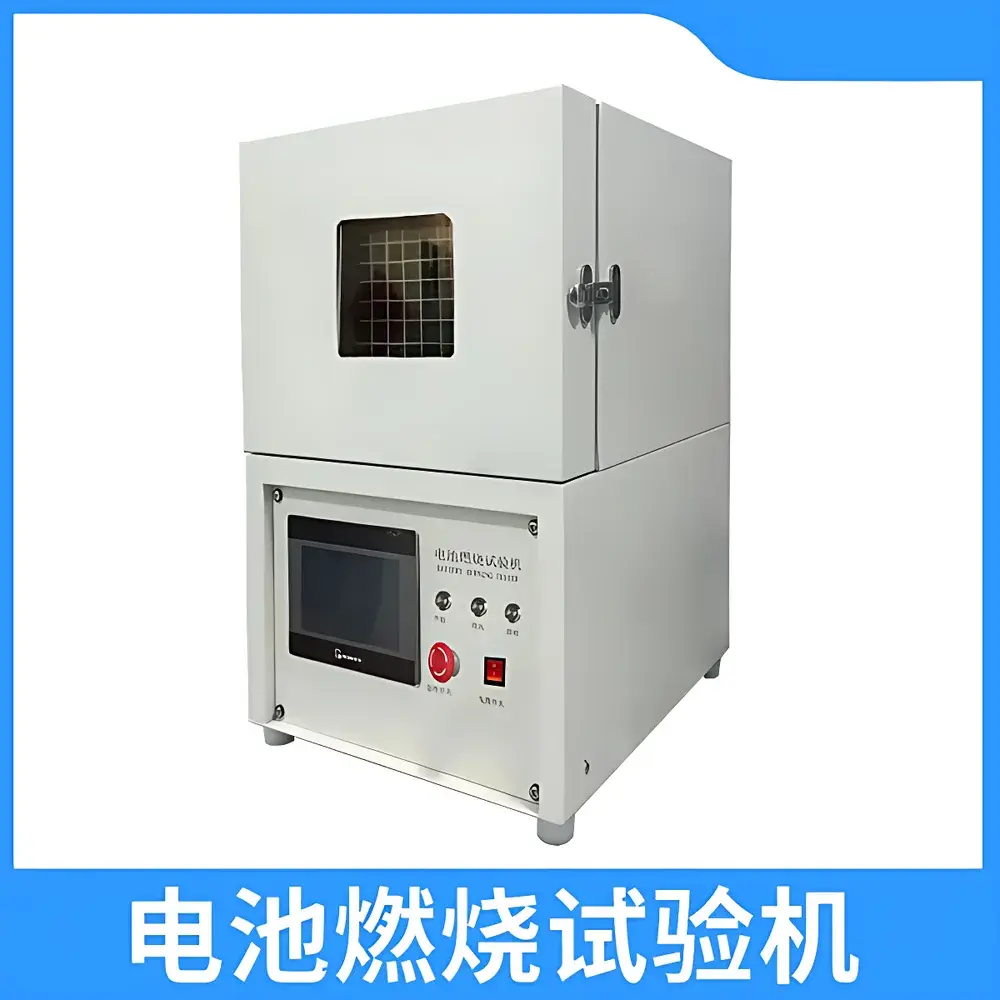
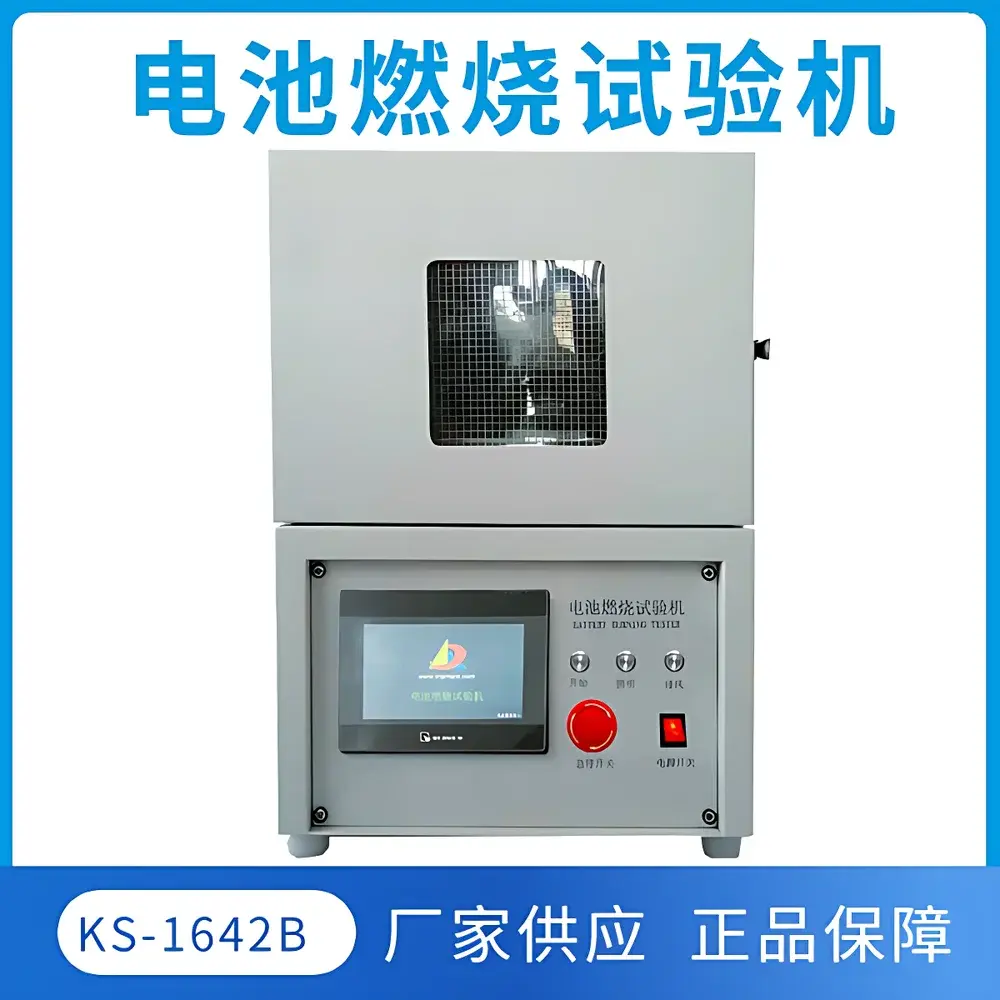
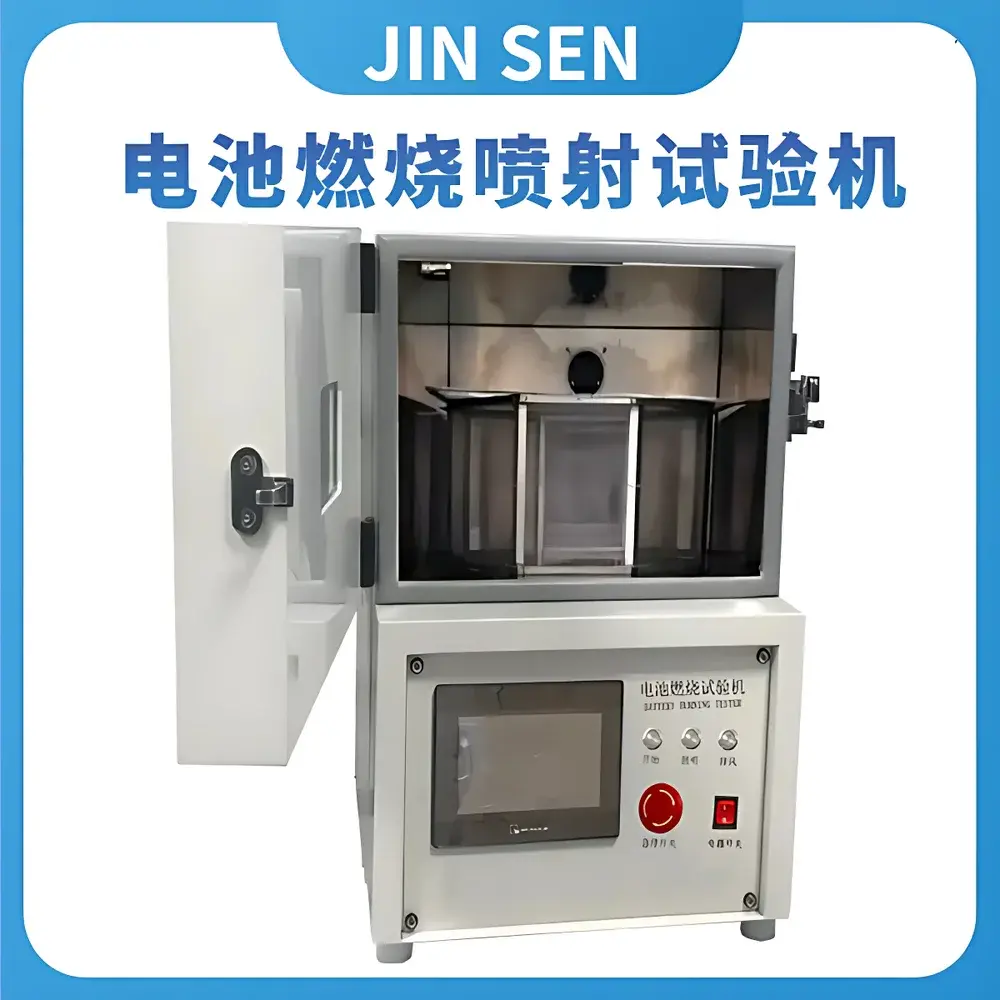
INSMENT KS-2054A Battery Combustion Test Chamber
| Brand | INSMENT (Shanghai Jinsen) |
|---|---|
| Origin | Shanghai, China |
| Model | KS-2054A |
| Compliance Standards | GB 31241–2014, UL 1642, UL 2054, SJ/T 11170–1998, SJ/T 11169–1998, GB 18282–2013, GB 8897.4 |
| Burner | Imported ED&D Bunsen burner (ID 9.5 mm, length 100 mm) |
| Flame Application Time | 0–999.9 s ±0.1 s |
| Flame Afterburn Time | 0–999.9 s ±0.1 s |
| Adjustable Flame Height | 10–75 mm ±2 mm |
| Test Rod | 6.35 mm × 355.6 mm |
| Octagonal Test Enclosure | 305 mm (W) × 355 mm (D) × 610 mm (H) |
| Control System | PLC + TFT true-color LCD interface with remote ignition (≤8 m range) |
| Fuel Requirement | Methane ≥98% purity (user-supplied) |
| Power Supply | AC 220 V / 50 Hz |
| Dimensions (L×W×H) | 1200 × 800 × 1250 mm |
| Sample Capacity | Single-cell to large-format Li-ion batteries and battery modules |
| Safety Enclosure | Perforated stainless-steel mesh screen (20 holes per 25.4 mm, wire diameter 0.43 mm), mounted over 102 mm aperture in test platform |
Overview
The INSMENT KS-2054A Battery Combustion Test Chamber is an engineered safety evaluation system designed for standardized thermal abuse testing of lithium-based electrochemical cells and battery packs. It operates on the principle of controlled open-flame exposure under defined geometric and temporal constraints, simulating worst-case thermal runaway initiation scenarios. The apparatus conforms to internationally recognized safety standards including GB 31241–2014 (Chinese national standard for portable battery safety), UL 1642 and UL 2054 (Underwriters Laboratories requirements for primary and secondary lithium batteries), SJ/T 11169–1998 and SJ/T 11170–1998 (Chinese industry standards for lithium battery safety), as well as GB 18282–2013 and GB 8897.4 (IEC 60086-4 harmonized requirements). Its core function is to assess whether a battery or module—when subjected to direct flame impingement—exhibits containment integrity (i.e., no ejection of flaming or molten material through the specified test screen), structural disintegration, or explosive rupture within defined observation limits.
Key Features
- Imported ED&D Bunsen burner with precision-machined 9.5 mm inner-diameter tube and stable laminar flame profile, ensuring reproducible heat flux delivery.
- Adjustable flame height (10–75 mm ±2 mm) calibrated via reference gauge, enabling compliance with multiple standard-specified flame geometries.
- Octagonal stainless-steel test enclosure (305 mm × 355 mm × 610 mm) with integrated viewing window and forced ventilation ducting to manage smoke and combustion byproducts safely.
- Standardized 20-mesh stainless-steel support screen (0.43 mm wire diameter, 20 openings per 25.4 mm) mounted over a 102 mm central aperture in the horizontal test platform—directly traceable to UL and GB test fixture requirements.
- PLC-based automation with TFT true-color LCD interface providing real-time display of flame application time, afterburn duration, and system status; all timing functions certified to ±0.1 s accuracy.
- Remote-controlled ignition system (effective range ≤8 m) minimizing operator proximity during hazardous phases of testing.
- Dedicated methane gas inlet with pressure regulation capability, compatible with ≥98% purity fuel supply as mandated by UL and IEC protocols.
Sample Compatibility & Compliance
The KS-2054A accommodates a broad range of lithium battery formats: cylindrical (e.g., 18650, 21700), prismatic, pouch, and modular assemblies up to 355.6 mm in length. All sample positioning follows strict dimensional alignment per UL 1642 Section 10.2 and GB 31241 Clause 7.4—ensuring the cell’s centerline coincides with the burner axis and that no portion extends beyond the perimeter of the support screen. The test chamber satisfies mechanical and spatial requirements for third-party certification audits under ISO/IEC 17025-accredited laboratories. While not intrinsically explosion-proof, its design incorporates passive venting pathways and fire-rated enclosure materials consistent with laboratory-scale thermal hazard mitigation practices. Documentation supports traceability to calibration records for timing circuits and burner geometry verification.
Software & Data Management
This model employs embedded PLC firmware without external PC dependency, prioritizing operational robustness and electromagnetic immunity in industrial lab environments. All test parameters—including start/stop timestamps, flame-on duration, and observed failure mode annotations—are logged internally with non-volatile memory retention. Audit trails include operator ID (via keypad entry), date/time stamps, and event flags for ignition success/failure, flame extinction, or thermal cutoff. Though not FDA 21 CFR Part 11-compliant out-of-the-box, the system supports manual export of CSV-formatted logs for integration into LIMS or QA documentation workflows. Firmware updates are performed via secure USB interface with version-locking to maintain regulatory consistency across validation cycles.
Applications
The KS-2054A serves critical roles in R&D validation, incoming QC screening, and regulatory submission preparation for battery manufacturers, contract electronics producers, and certification bodies. Typical use cases include: pre-qualification of new cell chemistries (e.g., NMC, LFP, solid-state prototypes) against thermal runaway thresholds; verification of separator shutdown efficacy and electrolyte flame retardancy; assessment of module-level fire propagation resistance in multi-cell configurations; and generation of evidence for UN 38.3 Section 5.2 (fire exposure test) compliance packages. It is routinely deployed in Tier-1 automotive supplier labs, consumer electronics ODM validation centers, and national metrology institutes conducting interlaboratory comparison studies.
FAQ
What safety certifications does the KS-2054A itself hold?
The chamber is constructed per CE machinery directive principles and includes CE-marked electrical components; however, final installation compliance depends on site-specific risk assessment and local fire code adherence.
Is methane the only acceptable fuel gas?
Yes—UL, GB, and IEC standards explicitly require ≥98% purity methane to ensure consistent stoichiometric combustion behavior and radiant heat output; propane or butane introduce uncontrolled variables in flame temperature and soot formation.
Can the test enclosure be modified for larger battery modules?
Custom enclosure dimensions are available upon request, subject to recalibration of flame geometry, screen placement, and ventilation balance to maintain standard-conformance.
Does the system include flame temperature monitoring?
No—standards define acceptance criteria based on flame height and visual observation, not thermocouple-based temperature measurement; optional IR pyrometry integration is available as an engineering add-on.
How often must the support screen be replaced?
Stainless-steel mesh should be inspected before each test series and replaced if deformation, oxidation, or hole distortion exceeds ±0.1 mm tolerance—typically after 20–30 full-duration tests depending on battery energy content.
Related Products



