
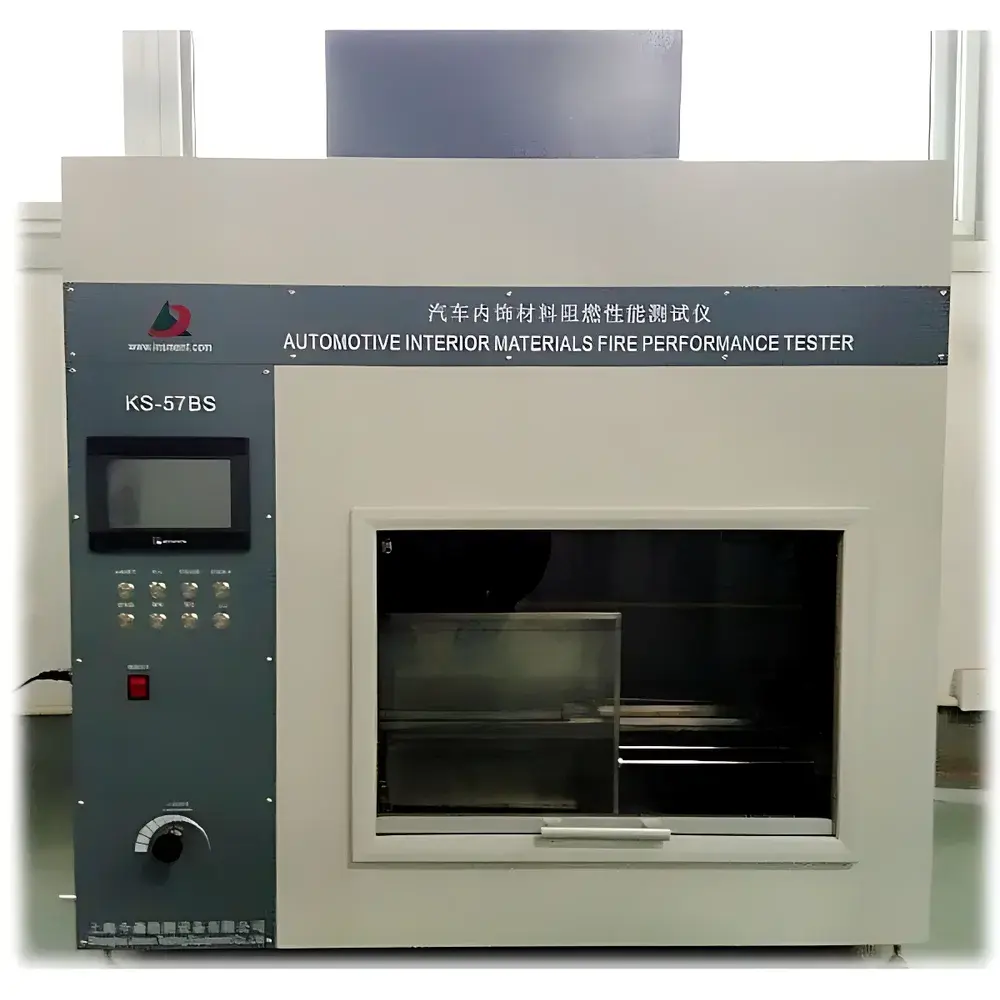
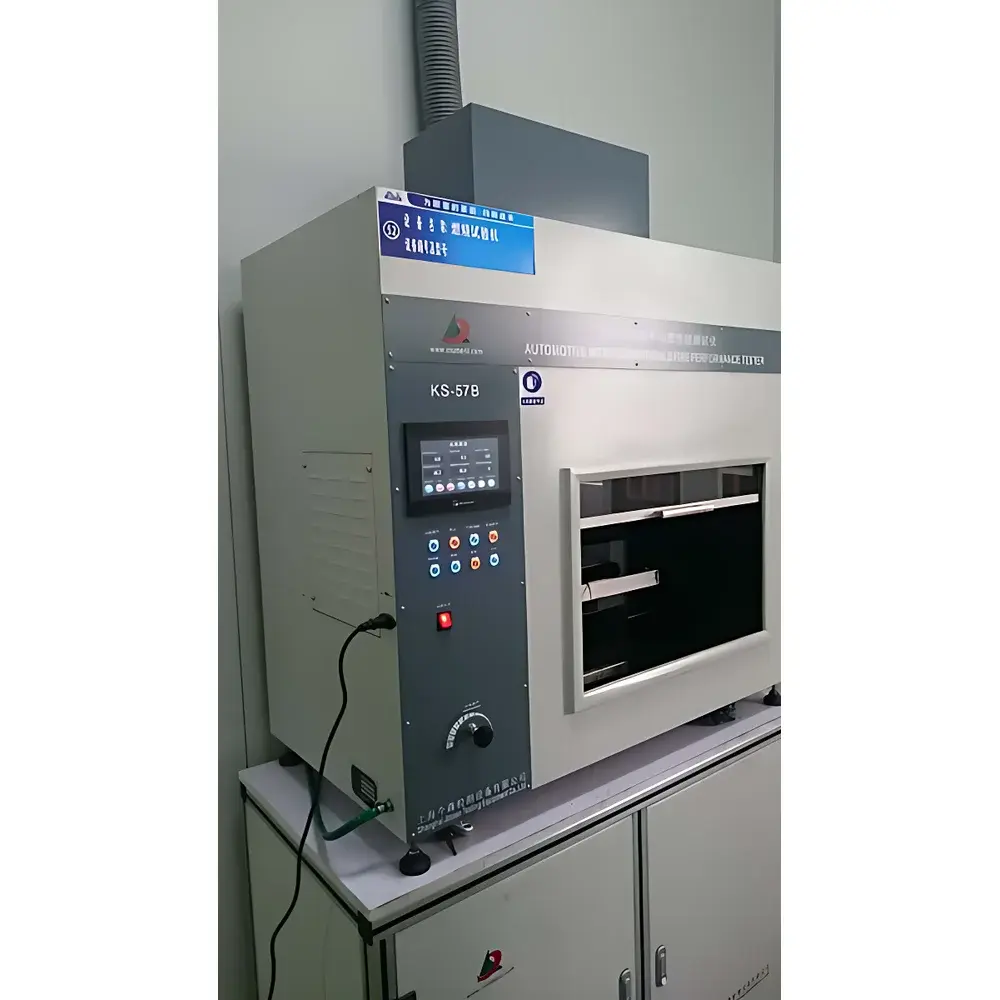
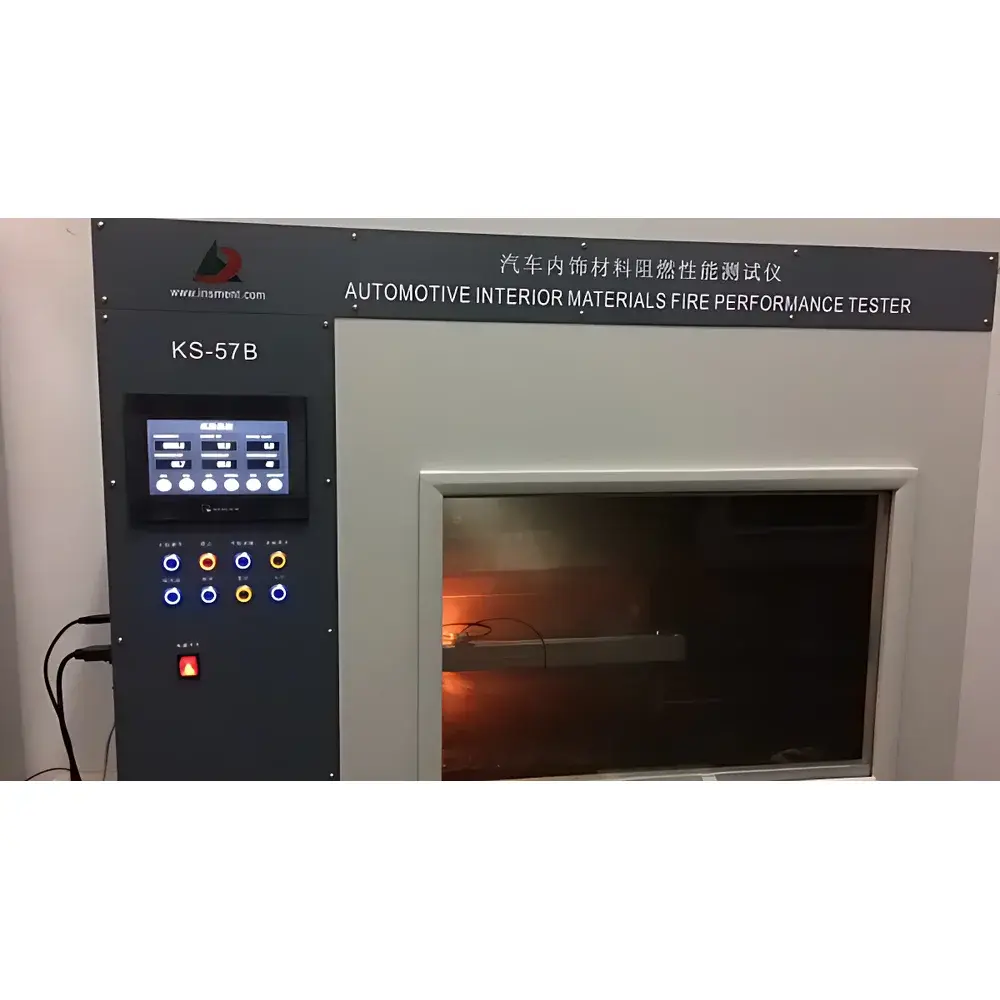
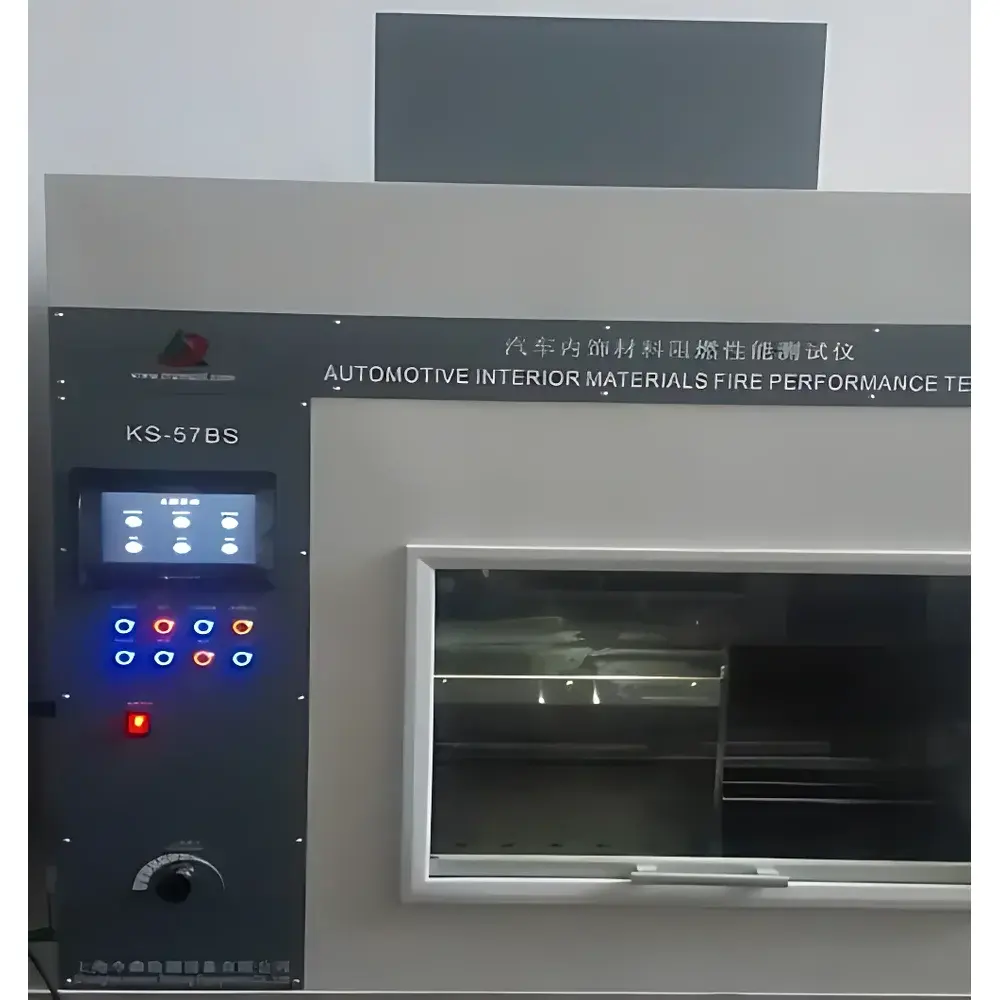
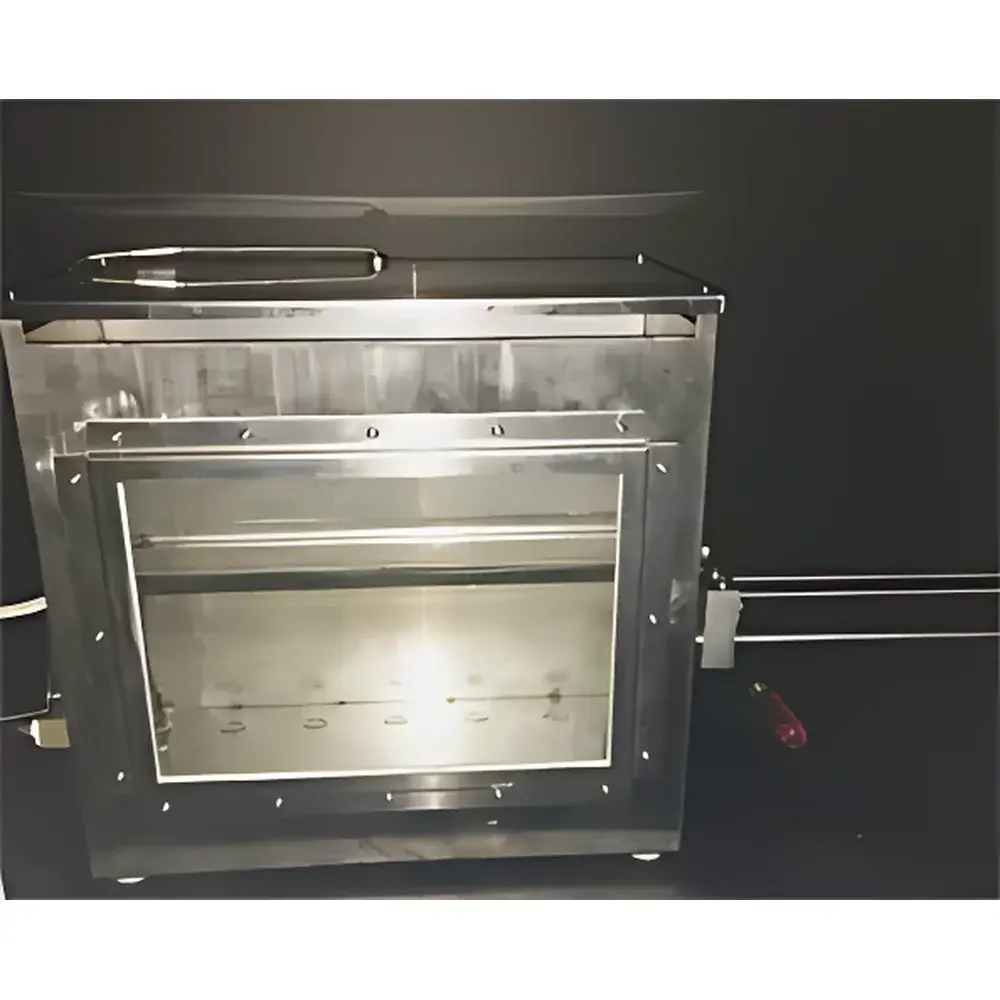
INSMENT KS-57BS Automotive Interior Materials Horizontal Burning Tester
| Brand | INSMENT (Shanghai Jinsen) |
|---|---|
| Origin | Shanghai, China |
| Model | KS-57BS |
| Control System | PLC-based intelligent control |
| Display | 7-inch Widescreen TFT color touchscreen (16:9, Weinview) |
| Ignition | Automatic piezoelectric ignition |
| Burner | 9.5 mm inner diameter stainless steel gas burner |
| Flame height adjustment | 20 ± 1 mm (calibrated with copper plate) |
| Specimen support | Dual U-shaped corrosion-resistant metal frames with 6-pin alignment and 0.25 mm diameter heat-resistant support wires spaced at 25 mm intervals |
| Specimen mounting height | 178 mm above combustion chamber base |
| Flame application time | 0–999.9 s ± 0.1 s (adjustable and programmable) |
| Afterflame time measurement | 0–999.9 s ± 0.1 s (auto-recorded, manual pause enabled) |
| Gas supply | Liquefied petroleum gas (LPG) or alternative fuel gas with calorific value 35–38 MJ/m³ (e.g., natural gas, town gas) |
| Chamber dimensions | 1200 mm (L) × 650 mm (W) × 1500 mm (H) |
| Exhaust port | Φ100 mm |
| Compliance | GB 8410–2006, FMVSS 302, ISO 3795, ASTM D5132, DIN 75200, TL 1010, GM 6090M, GM 9070P, JIS D 1201, JASO M403, QB/T 2729–2005 |
| Reporting | Auto-pass/fail judgment, report generation, sequential numbering, local storage, and thermal printing via PC software |
Overview
The INSMENT KS-57BS Automotive Interior Materials Horizontal Burning Tester is a precision-engineered instrument designed to evaluate the horizontal flame propagation behavior of polymeric, fibrous, and composite materials used in automotive cabin interiors. It operates on the principle of controlled radiant and convective heating under standardized horizontal orientation, where a calibrated Bunsen-type flame is applied to the free end of a horizontally clamped specimen for a defined duration. The device measures critical fire performance parameters—including afterflame time, afterglow time, char length, and flame spread rate—under strictly regulated environmental conditions (e.g., ambient temperature 15–30 °C, relative humidity ≤ 80 %, draft-free enclosure). Its architecture complies with the fundamental test geometry and procedural requirements specified in major global automotive safety standards, ensuring metrological traceability and inter-laboratory reproducibility. The system is not intended for vertical flame testing or oxygen index determination; it is exclusively configured for horizontal burning assessment per regulatory test protocols.
Key Features
- PLC-based embedded control system with deterministic real-time response, supporting full automation of flame timing, data acquisition, pass/fail logic, and report generation
- 7-inch high-resolution TFT color touchscreen interface (Weinview HMI) with customizable layout, multilingual menu support (English, German, Japanese, Chinese), and intuitive drag-and-drop parameter configuration
- Dual U-shaped specimen holders fabricated from high-purity stainless steel (AISI 316), featuring precision-machined 6-pin alignment system and thermally stable 0.25 mm diameter Inconel® support wires spaced at exact 25 mm intervals
- Gas burner assembly with fixed 9.5 mm inner diameter nozzle, vertically adjustable positioning mechanism (±2 mm resolution), and integrated piezoelectric auto-ignition with fail-safe flame supervision
- Integrated exhaust management system with 100 mm diameter duct, passive flow regulation, and optional connection to laboratory fume hood infrastructure
- Comprehensive safety interlocks including door-open detection, gas leak monitoring, overtemperature cutoff, and emergency flame shutoff
Sample Compatibility & Compliance
The KS-57BS accommodates flat, rigid or semi-rigid specimens up to 356 mm × 100 mm × ≤13 mm (L × W × T), including monolithic polymers (e.g., PP, ABS, PVC), laminated composites (e.g., PU foam-backed fabric, TPO/foam/skin tri-layers), nonwovens, leather substitutes, and textile blends. Specimens must be conditioned per ISO 291 (23 °C ± 2 °C, 50 % RH ± 5 %) for minimum 48 h prior to testing. The instrument satisfies the mechanical, dimensional, and procedural fidelity requirements of GB 8410–2006 (China), FMVSS 302 (US DOT), ISO 3795:2016 (International), ASTM D5132–22 (Standard Test Method for Surface Flammability of Automotive Interior Trim Materials), and OEM-specific specifications including General Motors GMW3287, Ford CETP 00.00-L-469, and Volkswagen PV 3345. All test sequences are fully auditable and support GLP/GMP-aligned documentation practices.
Software & Data Management
The KS-57BS includes Windows-compatible desktop software (INSMENT BurnTest Suite v3.2) enabling remote operation, batch test scheduling, digital signature integration, and 21 CFR Part 11-compliant electronic records. Each test generates a timestamped PDF report containing operator ID, environmental log, raw timing data (t₁–t₆ per ISO 3795 Annex A), char length measurement, pass/fail status, and digital image capture (optional USB camera module). Data files are stored in encrypted SQLite format with SHA-256 hash verification, supporting automated backup to network drives or cloud repositories. Audit trails record all user actions—including parameter edits, report exports, and calibration events—with immutable timestamps and role-based access controls.
Applications
This tester serves quality assurance laboratories within Tier-1 automotive suppliers (e.g., Faurecia, Lear, Adient), OEM R&D centers, and third-party certification bodies (e.g., SGS, TÜV Rheinland, CATARC). Typical use cases include incoming material qualification of headliner substrates, door panel laminates, seat foams, floor carpets, and airbag cover fabrics; pre-validation of flame-retardant additive formulations; root-cause analysis of field-reported burn-through incidents; and compliance verification for homologation dossiers submitted to national type-approval authorities. It also supports development of UL 94 HB-equivalent screening protocols and supports research into halogen-free FR systems under evolving EU REACH and ELV Directive constraints.
FAQ
Does the KS-57BS support automatic calibration verification?
Yes—the system includes built-in reference checks for flame height (copper plate method), timer accuracy (NIST-traceable stopwatch emulation), and burner position repeatability (laser displacement sensor validation mode).
Can test data be exported to LIMS platforms?
Yes—CSV and XML export formats are natively supported, with configurable field mapping and REST API endpoints for direct LIMS integration.
Is the gas burner compatible with hydrogen-enriched natural gas blends?
No—only fuels within the specified calorific range (35–38 MJ/m³) and laminar flow characteristics are permitted; hydrogen admixtures alter flame stoichiometry and invalidate standard correlation curves.
What maintenance intervals are recommended?
Weekly visual inspection of burner tip and support wires; quarterly cleaning of gas filter and solenoid valve; annual verification of PLC I/O latency and touchscreen calibration per manufacturer’s service manual.
Does the system meet ISO/IEC 17025 accreditation requirements for testing laboratories?
Yes—when operated within documented procedures, with traceable calibration certificates for timing modules and thermal sensors, and with validated software configuration, the KS-57BS meets technical competence criteria for Clause 6.4 and 6.6 of ISO/IEC 17025:2017.
Related Products



