
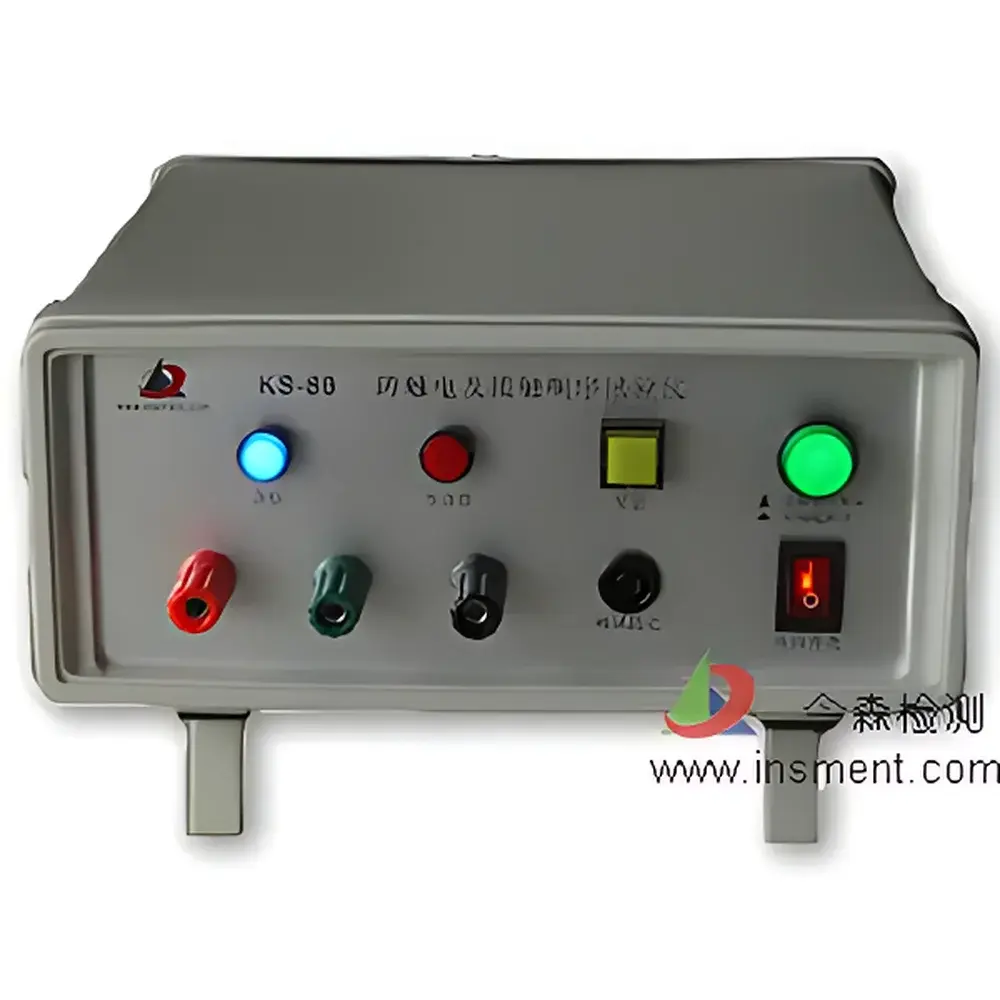
Insment KS-86 Electric Shock Protection and Contact Sequence Tester
| Brand | Insment |
|---|---|
| Model | KS-86 |
| Origin | Shanghai, China |
| Compliance | IEC 60335-1, GB 4706.1–1998 Clauses 27.3 & 8.1 |
| Contact Sequence Test Voltage | 4–5 V (live/neutral), 4–5 V (earth) |
| Contact Resistance Range | 6–9 kΩ (live/neutral), 6–9 Ω (earth) |
| Electric Shock Protection Test Voltage | 50–70 V |
| Resistance Threshold | 9–20 kΩ |
| Rated Input Power | ≤8 W |
| Continuous Operation Time | 8 h |
Overview
The Insment KS-86 Electric Shock Protection and Contact Sequence Tester is a dedicated safety compliance verification instrument engineered for the functional evaluation of power cord connectors and plug/socket assemblies in household and similar electrical appliances. It operates on the principle of low-voltage continuity verification and controlled resistance threshold detection to assess two critical safety attributes defined in international and national standards: (1) correct contact sequence during mating—ensuring earth (ground) contacts engage before live and neutral conductors—and (2) effective electric shock protection via accessible part isolation, verified through simulated finger probe contact under defined voltage and resistance conditions. Designed for laboratory and production-line use in accredited testing facilities, the KS-86 supports objective, repeatable pass/fail determination per Clause 8.1 (contact sequence) and Clause 27.3 (protection against electric shock) of IEC 60335-1 and its national adoption GB 4706.1–1998. Its architecture prioritizes operator safety, measurement stability, and long-term calibration integrity under continuous 8-hour operation.
Key Features
- Dual-mode test capability: independent circuits for contact sequence verification and electric shock protection assessment, each with dedicated voltage sources and resistance monitoring logic
- Precision low-voltage sourcing: regulated 4–5 V DC output for contact sequence testing, minimizing thermal drift and ensuring consistent contact resistance interpretation
- Configurable resistance thresholds: user-selectable upper/lower limits for live/neutral (6–9 kΩ) and earth (6–9 Ω) paths, aligned with standard-defined tolerances
- Shock protection test circuit: stable 50–70 V DC output with real-time resistance monitoring across 9–20 kΩ range, simulating human body impedance under fault conditions
- Low-power design: rated input power ≤8 W enables deployment in shared lab environments without thermal or electrical load concerns
- Robust mechanical interface: standardized fixture mounts compatible with common plug types (single-phase and three-phase four-wire configurations), supporting rapid sample changeover
Sample Compatibility & Compliance
The KS-86 accommodates a wide range of plug and socket geometries used in Class I appliances—including but not limited to IEC 60320 C13/C14, C15/C16, Schuko (Type F), UK BS 1363, and Chinese GB 2099.1 configurations. It is validated for use with appliances having detachable or non-detachable power cords, such as electric kettles, irons, rice cookers, and countertop cooking devices. Regulatory alignment includes full technical conformance to IEC 60335-1:2012+AMD1:2016 Ed. 6.0 Annex BB (Contact Sequence Verification) and Annex CC (Electric Shock Protection Testing), as well as GB 4706.1–1998 Clauses 8.1 and 27.3. The device supports documentation traceability required under ISO/IEC 17025-accredited laboratory practices and facilitates audit readiness for GLP and GMP-aligned quality systems.
Software & Data Management
The KS-86 operates as a standalone hardware tester with front-panel LED indicators and tactile push-button controls—no embedded software or PC dependency. All test outcomes are displayed via discrete status LEDs (PASS/FAIL per channel) and logged manually or integrated into external LIMS via optional dry-contact relay outputs (available upon request). For laboratories requiring electronic records, the unit’s analog output signals (0–5 V proportional to measured resistance) can be interfaced with third-party DAQ systems compliant with FDA 21 CFR Part 11 requirements when paired with validated acquisition software and audit-trail-enabled hardware. Calibration certificates follow ISO/IEC 17025 traceable procedures, with documented uncertainty budgets for voltage and resistance channels.
Applications
- Pre-certification verification of plug/socket assemblies prior to submission to CB Scheme or national certification bodies (e.g., UL, TÜV Rheinland, CCC)
- In-process quality control on appliance manufacturing lines to prevent non-conforming units from reaching final assembly
- Root cause analysis of contact failure modes—e.g., bent pins, plating degradation, or housing misalignment—by correlating resistance deviations with physical inspection
- Training and competency assessment for laboratory technicians performing routine safety inspections per IEC 60335 series standards
- Technical support for regulatory audits where demonstrable test repeatability and equipment validation are mandatory
FAQ
Does the KS-86 support automated data logging?
No—the KS-86 is a hardware-only verification instrument. Data recording requires manual entry or integration with external DAQ systems.
Can it test three-phase five-wire (TN-S) configurations?
Yes—its contact sequence module supports three-phase four-wire (L1/L2/L3/N) and may be adapted for TN-S via custom fixture design; consult technical support for pinout mapping.
What is the recommended calibration interval?
Annual calibration is advised per ISO/IEC 17025 requirements; calibration must include verification of open-circuit voltage, loaded voltage drop, and resistance threshold accuracy at defined points.
Is the unit suitable for use in an ISO 17025-accredited laboratory?
Yes—when operated within its specified environmental conditions (15–30 °C, <75% RH) and supported by documented calibration, maintenance, and uncertainty statements.
Does it comply with IEC 62368-1 requirements?
The KS-86 was designed specifically for IEC 60335-1 and GB 4706.1. While some contact sequence principles overlap, direct applicability to IEC 62368-1 Annex G requires supplementary assessment per Clause G.12.3.



