
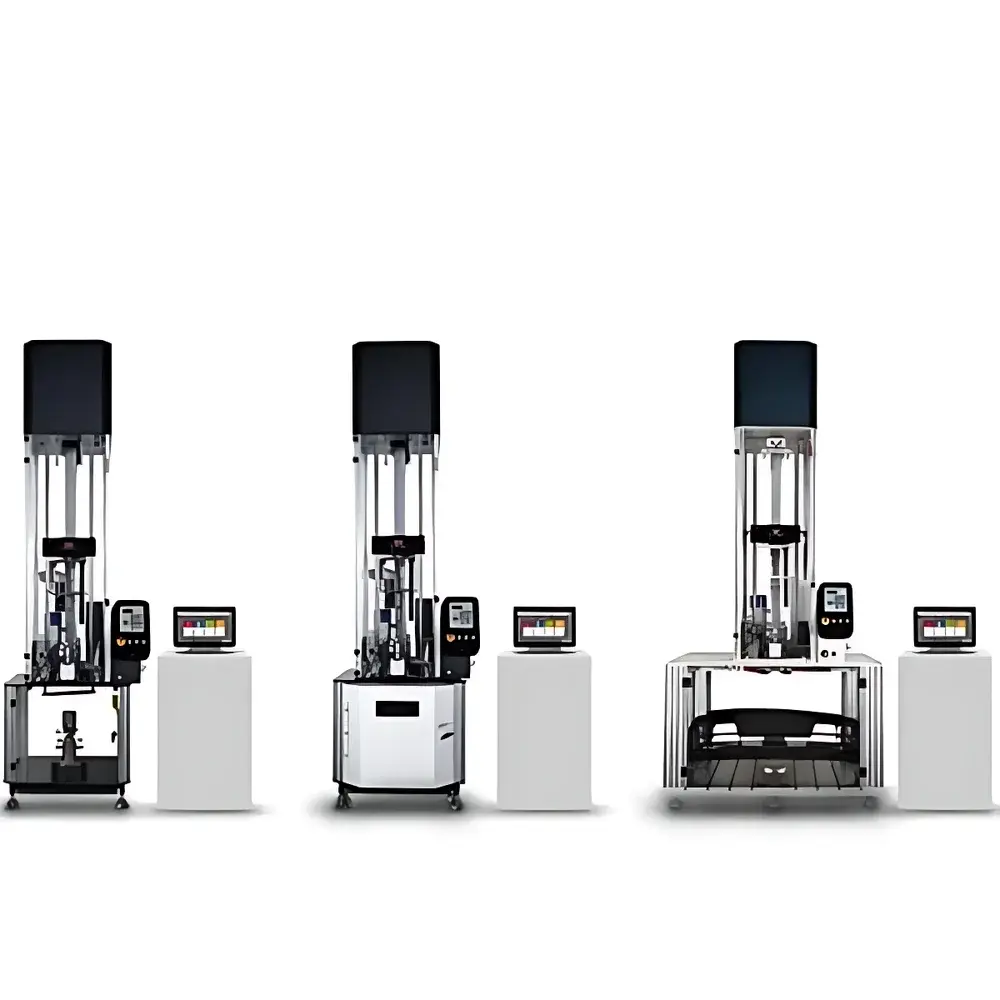
Instron 9400 Series Dynatup Drop Tower Impact Testing System
| Brand | Instron |
|---|---|
| Origin | USA |
| Manufacturer Type | Authorized Distributor |
| Origin Category | Imported |
| Model | 9400 Series Dynatup |
| Instrument Type | Drop Tower Impact Tester |
| Energy Range | 0.3 J to 1800 J |
| Max Impact Velocity | 24 m/s |
| Compliance | ASTM D3763, ASTM D7136, ISO 6603, ISO 11343, ISO 8256 |
| Software | Bluehill® Impact |
| Safety | Fully Enclosed Cabinet with Interlocked Safety Circuit |
| Data Acquisition | High-Resolution Force Measurement Chain (Factory-Calibrated & Field-Verifiable) |
Overview
The Instron 9400 Series Dynatup Drop Tower Impact Testing System is an engineered solution for quantitative assessment of dynamic mechanical behavior under high-strain-rate loading conditions. Based on the fundamental principle of gravitational potential energy conversion—where a calibrated mass is elevated to a defined height and released to impact a specimen at controlled velocity—the system delivers precise, repeatable impact energy across a broad range (0.3 J to 1800 J). Designed for materials science laboratories, R&D centers, and quality control facilities in aerospace, automotive, defense, and polymer manufacturing sectors, this system enables standardized evaluation of fracture initiation, energy absorption, load–deflection response, and post-impact structural integrity. Its modular architecture supports both small-scale specimen testing (e.g., ISO 6603 puncture) and full-component validation (e.g., aircraft panel impact per ASTM D7136), making it integral to material qualification, failure mode analysis, and regulatory compliance workflows.
Key Features
- Modular Energy & Velocity Scalability: Configurable drop mass and height enable precise energy delivery from 0.3 J to 1800 J, with maximum impact velocities up to 24 m/s—suitable for low-energy polymer puncture and high-velocity composite impact simulation.
- Full-Safety Enclosure: Integrated interlocked safety circuit automatically de-energizes the release mechanism when the cabinet door is opened, complying with ISO 13857 and OSHA 1910.212 requirements for operator protection during high-energy impact events.
- High-Fidelity Data Acquisition: Proprietary force measurement chain—including load cell, signal conditioning, and 1 MHz sampling—ensures traceable, high-resolution force-time data acquisition. Factory calibration is NIST-traceable and field-verifiable per ASTM E4.
- Expandable Test Envelope: Spacious test chamber accommodates large specimens and optional high-speed imaging systems (e.g., Phantom v2512) for synchronized visual capture of deformation dynamics and crack propagation.
- Automated Workflow Integration: Supports unattended sequential testing via programmable test sequences, reducing manual intervention and enabling accelerated material screening for product development cycles.
Sample Compatibility & Compliance
The 9400 Series accommodates diverse specimen geometries—from thin films and injection-molded tensile bars to structural composites and assembled components—via interchangeable fixtures including puncture anvils, three-point bend supports, wedge peel jigs, and custom compression platens. It fully complies with internationally recognized standards governing impact performance evaluation: ASTM D3763 (multiaxial impact of plastics), ASTM D7136/D7137 (impact resistance and residual compression strength of composite laminates), ISO 6603-2 (puncture impact of plastics), ISO 11343 (wedge peel impact of adhesive bonds), and ISO 8256 (impact tensile testing). All configurations support GLP/GMP-aligned audit trails when used with Bluehill Impact software, satisfying FDA 21 CFR Part 11 requirements for electronic records and signatures in regulated environments.
Software & Data Management
Bluehill Impact software provides a validated, touch-enabled interface optimized for impact testing protocols. Its guided workflow engine walks operators through setup, calibration, test execution, and reporting—minimizing procedural errors and ensuring method consistency across shifts and sites. The embedded file management system allows secure version-controlled storage of test methods, raw data (.tdms), processed curves (force–time, force–displacement), and annotated video clips. Data export options include CSV, PDF reports (with configurable templates), and direct integration into LIMS or enterprise QA databases via API or OPC UA connectivity. Audit logs record user actions, parameter changes, and calibration events—supporting ISO/IEC 17025 accreditation and internal quality audits.
Applications
- Quantification of fracture toughness and energy absorption capacity in thermoplastics, thermosets, and fiber-reinforced composites
- Evaluation of impact-induced delamination and matrix cracking in aerospace-grade carbon fiber laminates
- Validation of crashworthiness performance for automotive interior trim and battery enclosure components
- Assessment of adhesive bond durability under dynamic peel and shear loading (ISO 11343)
- Characterization of ductile-to-brittle transition behavior in engineering polymers per ASTM D7136 IPC
- Residual strength testing following impact damage (CAI—Compression After Impact)
- Development and verification of impact-modified polymer formulations for medical device housings
FAQ
What standards does the Instron 9400 Series support for composite impact testing?
ASTM D7136 (impact resistance), ASTM D7137 (residual compression strength after impact), and ISO 12578 (drop-weight impact on sandwich structures) are fully supported with appropriate fixtures and software configurations.
Can the system be upgraded for higher energy testing beyond 1800 J?
The base 9400 platform is rated to 1800 J; however, Instron offers engineered custom solutions—including reinforced tower structures and hydraulic release mechanisms—for specialized applications requiring energies up to 5000 J, subject to site-specific risk assessment and safety certification.
Is Bluehill Impact software 21 CFR Part 11 compliant?
Yes—when deployed with enabled electronic signature, audit trail, and role-based access controls, Bluehill Impact meets FDA 21 CFR Part 11 requirements for electronic records and signatures in pharmaceutical, biotech, and medical device testing environments.
How is force sensor accuracy maintained over thousands of impacts?
All load cells undergo accelerated life-cycle validation (≥100,000 impacts at rated capacity) and feature self-diagnostic firmware. Annual recalibration against deadweight standards per ASTM E74 is recommended, with optional in-situ verification using Instron’s Traceable Verification Kit.
Does the system support real-time synchronization with high-speed cameras?
Yes—dedicated TTL trigger outputs and GenICam-compliant camera interfaces enable hardware-synchronized capture at up to 1 MHz frame rates, ensuring temporal alignment between force data and visual event markers.



