
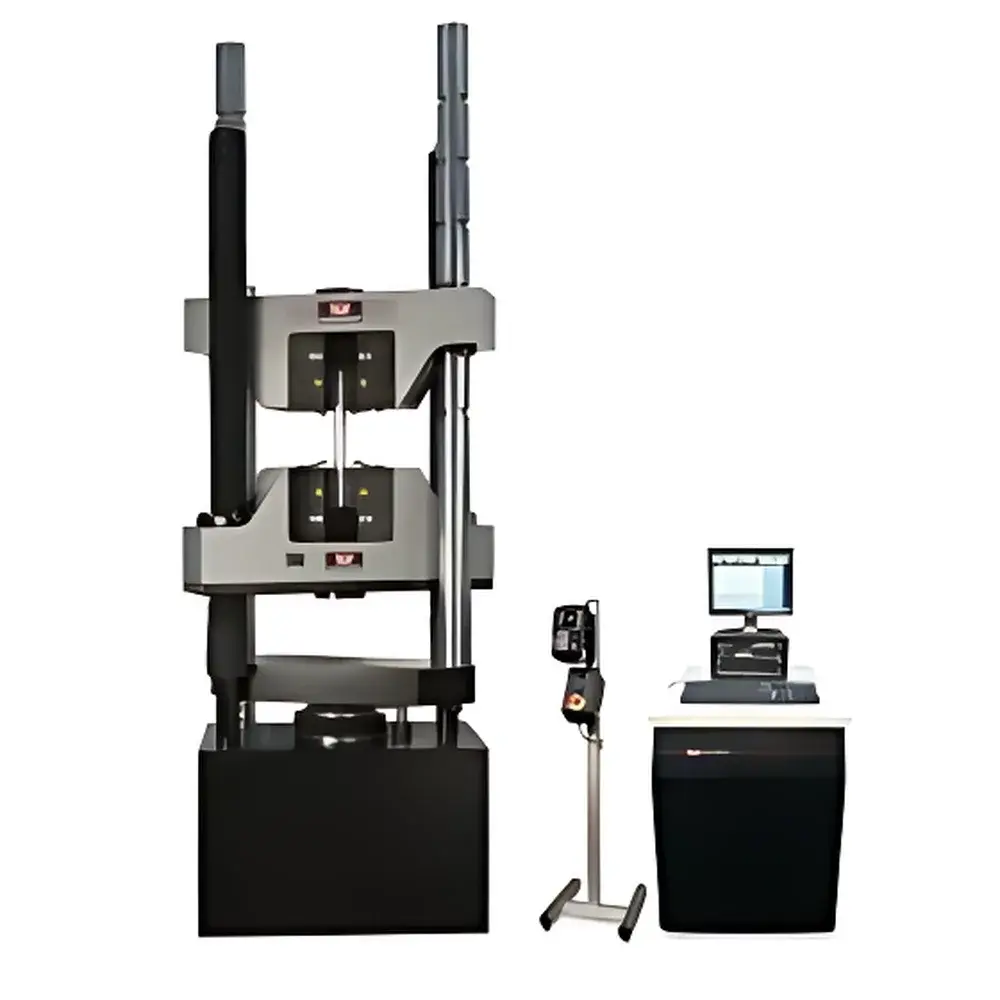
Instron MDX Series High-Load Hydraulic Universal Testing Machine
| Brand | Instron |
|---|---|
| Origin | USA |
| Model | MDX Series (600MDX / 1000MDX / 1500MDX) |
| Load Capacity | 600 kN / 1000 kN / 1500 kN |
| Controller | Instron 59-Series Digital Controller, 1000 Hz Closed-Loop Control Rate |
| Hydraulic Power Unit | Instron V11b Variable-Displacement Pump System |
| Servo Valve Bandwidth | Up to 200 Hz |
| Clamp Integration | Integrated Hydraulic Wedge Grips in Crosshead |
| Software | Instron Partner™ |
| Compliance | ASTM E4, E8, E9, E21, ISO 6892-1, ISO 7500-1, EN 10002-1, USP <1041>, FDA 21 CFR Part 11 Ready |
Overview
The Instron MDX Series High-Load Hydraulic Universal Testing Machine is engineered for precision mechanical testing of high-strength structural materials—including advanced composites, high-tensile steels, aerospace alloys, and reinforced concrete—under static and quasi-static loading conditions. Based on the fundamental principles of force-controlled and displacement-controlled servo-hydraulic actuation, the MDX platform delivers exceptional load frame stiffness, thermal stability, and signal fidelity across its full rated capacity range (600 kN to 1500 kN). Its core architecture integrates a rigid, two-column monolithic frame with an open crosshead design, enabling unobstructed access and rapid specimen setup while maintaining axial alignment accuracy within ±0.01 mm/m per ASTM E4. The system operates under closed-loop digital control at up to 1000 Hz, ensuring dynamic responsiveness required for capturing transient phenomena such as internal composite resonance (up to 30 Hz) without signal aliasing or phase lag.
Key Features
- Integrated hydraulic wedge grips housed directly within the crosshead—eliminating external levers or manual tightening mechanisms and maintaining constant initial clamping force throughout test duration.
- V11b variable-displacement hydraulic pump system that modulates pressure output in real time based on instantaneous load demand; reduces oil temperature rise by up to 40%, extends fluid service life beyond 5,000 operating hours, and eliminates the need for external cooling water circuits.
- High-bandwidth servo valve (200 Hz response) synchronized with the 59-series digital controller to ensure faithful reproduction of complex waveforms, including ramp-hold, cyclic, and creep protocols.
- Modular grip interface accommodating interchangeable jaw faces—single jaw set covers specimen widths from 10 mm to 120 mm and thicknesses up to 60 mm—minimizing changeover time between test standards.
- Oil-lubrication ports integrated into each grip assembly for routine maintenance without disassembly; accessible via standardized SAE J1926 fittings.
- Dual-test-space configuration (upper tensile zone + lower compression/bending zone) optimized for concurrent method validation and throughput acceleration in QA/QC laboratories.
Sample Compatibility & Compliance
The MDX Series accommodates specimens conforming to ASTM, ISO, EN, and GB standards—including flat sheet, round bar, notched Charpy specimens, threaded fasteners, and molded polymer coupons. Its hydraulic wedge grip design ensures uniform stress distribution across heterogeneous surfaces (e.g., carbon fiber laminates with resin-rich edges), mitigating premature slippage or localized crushing. All load cells are traceable to NIST standards and certified to ISO 7500-1 Class 0.5 accuracy. The system supports GLP/GMP audit readiness through built-in electronic signature, user-level permission tiers, and full 21 CFR Part 11–compliant audit trails in Partner™ software. Calibration certificates include uncertainty budgets per ISO/IEC 17025 requirements.
Software & Data Management
Instron Partner™ software provides deterministic real-time data acquisition at 10 kHz sampling rate, synchronized with machine control signals. It includes preconfigured test methods for ASTM E8/E8M (tensile), E9 (compression), E21 (high-temperature), and ISO 6892-1 (metallic materials), with customizable pass/fail logic, automatic yield point detection (0.2% offset, tangent, or maximum slope), and multi-curve overlay for comparative analysis. Raw data exports comply with ASTM E1434 (ASCII) and HDF5 formats for third-party integration with MATLAB, Python-based analytics pipelines, or LIMS platforms. Audit logs record operator ID, timestamp, parameter modifications, and calibration events with immutable hashing.
Applications
- Mechanical characterization of carbon-fiber-reinforced polymer (CFRP) laminates and hybrid metal-composite joints under tensile, compressive, and interlaminar shear loading.
- Structural validation of welded joints and additive-manufactured titanium components per AWS D17.1 and ASTM F3122.
- Creep rupture testing of high-performance elastomers and thermoplastics at elevated temperatures (with environmental chamber integration).
- Fastener proof-load and torque-tension verification per ISO 898-1 and ASTM F606.
- Bending fatigue pre-screening of wind turbine blade root sections using four-point bending fixtures.
- Concrete cylinder compression and splitting tensile tests compliant with ASTM C39 and C496.
FAQ
What is the maximum recommended operating frequency for cyclic testing on the MDX platform?
The system supports sinusoidal waveform generation up to 5 Hz at full load (1500 kN) and up to 20 Hz at 20% of rated capacity, limited by hydraulic power unit response and frame resonance characteristics. For higher-frequency applications, refer to Instron’s Electromechanical eXpert™ series.
Can the MDX be upgraded with extensometry for strain-controlled testing?
Yes—compatible with Instron’s AutoX 750 automatic video extensometer, 2630 series clip-on extensometers, and non-contact laser extensometers. All are auto-recognized and calibrated within Partner™ software.
Is remote diagnostics supported for predictive maintenance?
The MDX includes embedded Ethernet connectivity and Instron Remote Assist (IRA) capability, enabling secure technician-led troubleshooting, firmware updates, and health monitoring of pump pressure profiles, valve current draw, and thermal sensor readings.
How does the V11b pump reduce energy consumption compared to fixed-displacement systems?
By dynamically adjusting flow output to match instantaneous load demand—not just peak requirement—the V11b achieves typical energy savings of 35–50% during low-load phases (e.g., preload, hold segments) and eliminates continuous idling losses.
Are custom fixture designs validated for traceable force application?
All customer-specific tooling undergoes finite element analysis (FEA)-guided load path verification and physical validation per ASTM E2309 before delivery. Documentation includes stress maps, deflection curves, and uncertainty propagation reports.



