
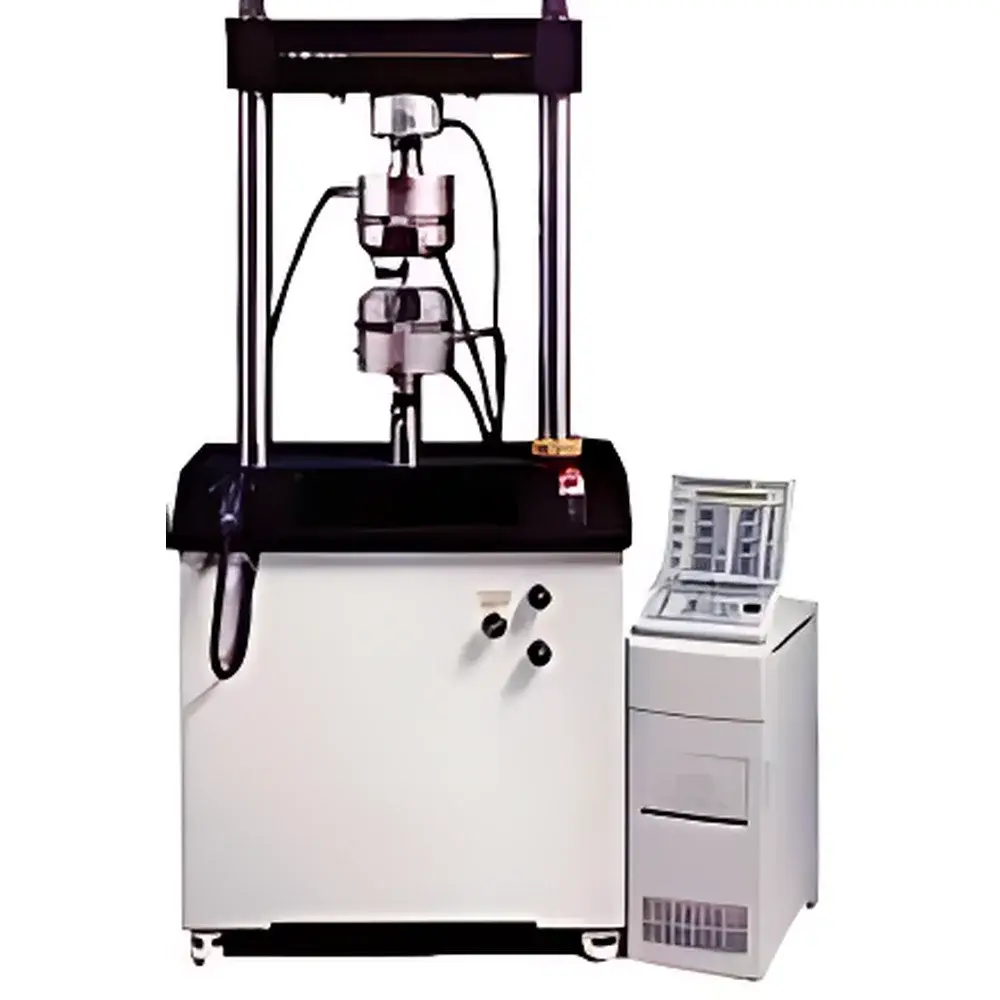
Fatigue Testing Services
| Brand | INSTRON |
|---|---|
| Model | 8800 |
| Origin | Shandong, China |
| Supplier Type | Authorized Distributor |
| Compliance | ISO 13003, ASTM E467/E606/E647/E739/E399, GB/T 3075/16779/228/13816/15111/6395, ISO 12737/12135/4965, BS 7448-1/-2/-4 |
Overview
Fatigue Testing Services delivered on the INSTRON 8800 Electromechanical Fatigue Testing System provide rigorously standardized mechanical characterization of metallic and composite materials under cyclic loading conditions. Engineered for precision and high reproducibility, this system implements servo-controlled axial loading to execute controlled-stress or controlled-strain fatigue protocols across a broad frequency range (typically 0.001–100 Hz), enabling high-cycle fatigue (HCF), low-cycle fatigue (LCF), crack growth rate (da/dN) analysis, and fracture toughness evaluation. The platform supports both ambient and elevated-temperature testing—up to 1500 °C—via integrated three-point and four-point bending fixtures compatible with ceramic and advanced composite specimens. Its modular architecture integrates calibrated load cells, extensometry, and thermal management subsystems to ensure traceable force control per ISO 4965 and ASTM E467, forming the physical foundation for generating statistically valid S–N (stress–life) and ε–N (strain–life) curves in compliance with international standards.
Key Features
- INSTRON 8800 electromechanical test frame with dual-column rigid structure, rated capacity up to 100 kN (configurable), optimized for dynamic stability and minimal frame deflection during long-duration cycling.
- High-fidelity closed-loop control using INSTRON’s WaveMatrix™ software, supporting real-time waveform generation (sine, triangle, trapezoidal, user-defined) and adaptive feedback compensation for load/stroke accuracy within ±0.5% of full scale.
- Integrated high-temperature furnace systems (up to 1500 °C) with inert atmosphere capability (Ar/N₂), compliant with ISO 13003 for ceramic and CMC fatigue testing under thermal-mechanical coupling.
- Comprehensive fixture ecosystem: axial tensile-compressive grips, rotating-bending adapters, compact tension (CT) and middle-crack tension (M(T)) fixtures for ASTM E647/E399 fracture mechanics testing.
- Traceable calibration documentation aligned with ISO/IEC 17025 requirements; dynamic force verification performed per ASTM E467 and ISO 4965 using certified reference strain-gauge-based transducers.
Sample Compatibility & Compliance
The service accommodates diverse specimen geometries and material classes—including ferrous/nonferrous metals, fiber-reinforced polymer (FRP) and metal matrix composites (MMC), structural ceramics, and welded joints—across standardized configurations defined by GB/T, ASTM, ISO, and BS specifications. All fatigue data reporting adheres to GLP principles: raw load/displacement/strain/time series are archived with full metadata (test ID, operator, environmental conditions, calibration status). Test reports include statistical treatment per ASTM E739 (linear regression of log S–log N data), confidence intervals at 95% probability, and outlier identification using Grubbs’ test. Full audit trails satisfy FDA 21 CFR Part 11 requirements when paired with INSTRON Bluehill® Universal software configured for electronic signatures and version-controlled report templates.
Software & Data Management
Data acquisition and analysis are executed via INSTRON Bluehill® Universal v4.x, a validated platform supporting automated test sequencing, real-time pass/fail logic, and post-test curve fitting. Raw time-series datasets (≥10 kHz sampling) are stored in vendor-neutral .csv and HDF5 formats. Statistical processing modules implement ASTM E739-compliant linearized stress–life regression, Paris law fitting (da/dN = C(ΔK)n) per ASTM E647, and J-integral computation per ASTM E1820. Exported reports embed digital signatures, calibration certificates, and instrument configuration logs—enabling seamless integration into LIMS or QMS environments operating under ISO 9001 or IATF 16949 frameworks.
Applications
- Metallic component qualification: HCF life prediction for aerospace turbine disks per ASTM E466; LCF assessment of automotive crankshafts under thermomechanical loading.
- Composite airframe certification: S–N curve generation for carbon-fiber laminates per ISO 13003 and GB/T 16779, including off-axis tension–tension fatigue and interlaminar shear fatigue.
- Fracture-critical infrastructure: CTOD (crack-tip opening displacement) and JIC evaluation of pipeline girth welds per BS 7448-1/-2 and GB/T 13816.
- Ceramic armor development: Three- and four-point bend fatigue at 1200–1500 °C to quantify strength degradation kinetics under thermal cycling.
- Battery enclosure validation: Cyclic compression fatigue of aluminum alloy housings under simulated vibration spectra per SAE J2380.
FAQ
What standards govern the fatigue testing services offered?
Testing strictly follows ASTM E466 (constant-amplitude axial fatigue), ASTM E647 (fracture toughness), ISO 13003 (composite fatigue), GB/T 3075 (metal axial fatigue), and BS 7448 series (fracture mechanics), with full traceability to national metrology institutes.
Can you perform fatigue tests at elevated temperatures?
Yes—specimens are tested from ambient up to 1500 °C using vacuum/inert-atmosphere furnaces, with temperature uniformity maintained within ±3 °C over the gauge length per ISO 13003 Annex B.
Do you provide raw data files and uncertainty budgets?
All clients receive unprocessed .csv/.hdf5 datasets, calibration certificates, GUM-compliant measurement uncertainty statements (k=2), and MSA (measurement systems analysis) reports per AIAG MSA-4 guidelines.
Is your facility accredited to ISO/IEC 17025?
Our testing laboratory is accredited by CNAS (China National Accreditation Service) to ISO/IEC 17025:2017 for mechanical testing of metals and composites (Certificate No. CNAS LXXXXX), with scope covering all listed standards.
How are S–N curves statistically validated?
Each curve is derived from ≥12 specimens per stress level; linear regression is applied to log-transformed data per ASTM E739, with R² ≥ 0.95 required and residual analysis performed to confirm homoscedasticity and normality assumptions.



