
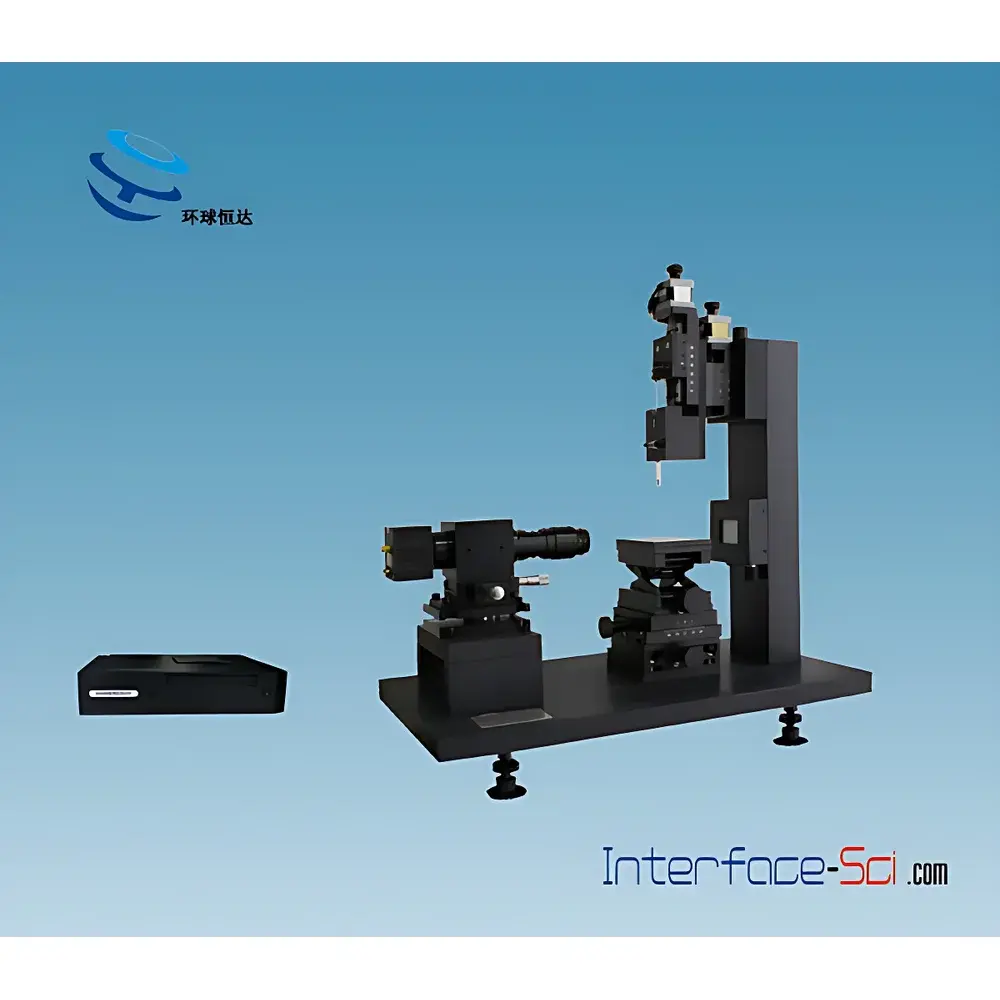
Interface SCI2000C Automated Video-Based Contact Angle Goniometer
| Brand | Interface |
|---|---|
| Origin | Beijing, China |
| Manufacturer Type | Authorized Distributor |
| Instrument Type | Benchtop Video Optical Contact Angle Analyzer |
| Contact Angle Range | 0–180° |
| Contact Angle Accuracy | ±0.1° |
| Sample Stage Dimensions | 120 × 100 mm |
| Minimum Image Resolution | 1280 × 1024 |
| Surface/Interfacial Tension Range | 5.0–2000 mN/m |
Overview
The Interface SCI2000C is a fully automated, benchtop video-based contact angle goniometer engineered for high-precision quantification of solid–liquid–gas interfacial phenomena. It operates on the optical principle of sessile drop, pendant drop, captive bubble, and tilting plate methodologies—capturing high-fidelity images of liquid droplets or bubbles at interfaces and applying rigorous geometric and physical models (e.g., Young–Laplace equation, axisymmetric drop shape analysis) to extract contact angles, surface/interfacial tensions, and thermodynamic surface energy parameters. Designed for rigorous laboratory environments—including QC/QA labs, R&D centers in materials science, coatings, biomedicine, and microelectronics—the SCI2000C delivers reproducible measurements across heterogeneous substrates (flat films, fibers, powders, rough or curved surfaces) under static, dynamic, and time-resolved conditions. Its architecture supports ASTM D724, ASTM D5946, ISO 15989, and other internationally recognized wettability standards, enabling traceable, audit-ready data generation compliant with GLP and pre-GMP workflows.
Key Features
- Automated five-channel peristaltic dosing system with manual and optional motorized Z-axis control (60 mm travel, 0.1 mm resolution), supporting precise, contamination-minimized liquid delivery via interchangeable stainless steel or PTFE needles (0.14–0.9 mm ID)
- Motorized or manual 360° rotating sample stage (0.01° angular resolution) for advancing/receding angle, roll-off angle, and hysteresis quantification—equipped with mechanical backlash compensation for repeatable positioning
- High-stability mechanical platform: dual linear rails + precision ground lead screw actuation; shear-type lift mechanism with locking handwheel ensures vibration-damped, sub-micron positional repeatability
- Optical imaging subsystem: industrial monochrome USB 2.0 CCD camera (1280 × 1024 px, 25 fps standard; upgradeable to 2000 fps); 0.7–5.0× continuous zoom telecentric lens with 55–320 px/mm effective magnification; adjustable X/Y tilt mount for optical axis alignment
- Uniform cold LED backlight with collimated parallel illumination and continuously variable intensity—optimized for sharp droplet silhouette contrast and long-term photometric stability
- Integrated software suite with real-time image acquisition, multi-method contact angle fitting (tangent, height, circle, ellipse, Young–Laplace, ADSA-PD), and automated baseline detection—even on non-planar or tilted surfaces
Sample Compatibility & Compliance
The SCI2000C accommodates samples up to 180 mm (W) × ∞ (L) × 60 mm (H), including rigid plates, flexible films, woven/nonwoven textiles, single fibers (with optional fiber clamps), plant leaves, porous membranes, and pressed powder compacts. Its modular fixture system enables rapid reconfiguration for anisotropic or irregular geometries. All measurement protocols adhere to ASTM D724 (paper wettability), ASTM D5946 (corona-treated polymer films), and ISO 15989 (water contact angle on treated films). Data integrity is reinforced through timestamped metadata embedding, full audit trail logging, and export-compatible CSV/Excel formats—supporting internal quality documentation and external regulatory review (e.g., FDA 21 CFR Part 11 readiness via optional electronic signature modules).
Software & Data Management
The proprietary analysis software provides unified control over hardware synchronization, image capture, and quantitative modeling. It implements six validated contact angle algorithms—including geometric tangent, conic section fitting, and physics-based Young–Laplace curve optimization—to resolve asymmetric, distorted, or partially wetted droplets. Dynamic sequences (e.g., time-lapse contact angle decay, evaporation kinetics, or forced-tilt roll-off) are programmable with user-defined intervals down to 40 ms/frame. Surface free energy calculations employ 12 peer-reviewed models (Owen–Wendt, Wu, van Oss–Chaudhury–Good, Neumann Equation of State, etc.) against an embedded library of 300+ liquids with verified physicochemical constants. All raw images, fitted contours, numerical outputs, and metadata are stored in a relational database with version-controlled backups, batch export, AVI video recording, and direct annotation overlay onto exported figures.
Applications
The SCI2000C serves as a foundational tool in interfacial characterization across academia and industry. In advanced materials development, it evaluates plasma, corona, or chemical surface treatments on polymers, metals, and semiconductors (e.g., wafer cleaning verification, OLED encapsulation adhesion). In life sciences, it assesses protein adsorption kinetics on biomaterials, lung surfactant film stability, and hydrophilicity of contact lenses or orthopedic implants. For formulation scientists, it guides surfactant selection in agrochemical sprays, inkjet inks, pharmaceutical suspensions, and enhanced oil recovery fluids by correlating contact angle hysteresis with spreading coefficient and interfacial rheology. Additional use cases include hydrophobicity mapping of self-cleaning surfaces, critical surface tension analysis of insulating ceramics, and electro-wetting response calibration in adaptive optics.
FAQ
What measurement methods does the SCI2000C support?
Sessile drop (static/dynamic), pendant drop, captive bubble, and tilting plate—enabling contact angle, surface/interfacial tension, and roll-off angle determination.
Can it analyze rough or curved surfaces?
Yes—via built-in curvature correction algorithms, manual baseline adjustment, and optional topography-integrated modules for localized contact angle mapping.
Is the system compliant with FDA or ISO quality requirements?
It meets ASTM and ISO wettability testing standards; with optional validation packages and electronic signature modules, it supports 21 CFR Part 11 and GLP/GMP-aligned documentation workflows.
What is the minimum detectable surface tension resolution?
0.001 mN/m using Young–Laplace fitting on high-resolution pendant drop images.
Are high-speed imaging options available?
Yes—upgrade paths to 60, 100, 200, 1000, or 2000 fps cameras are factory-supported with synchronized lighting and software integration.



