
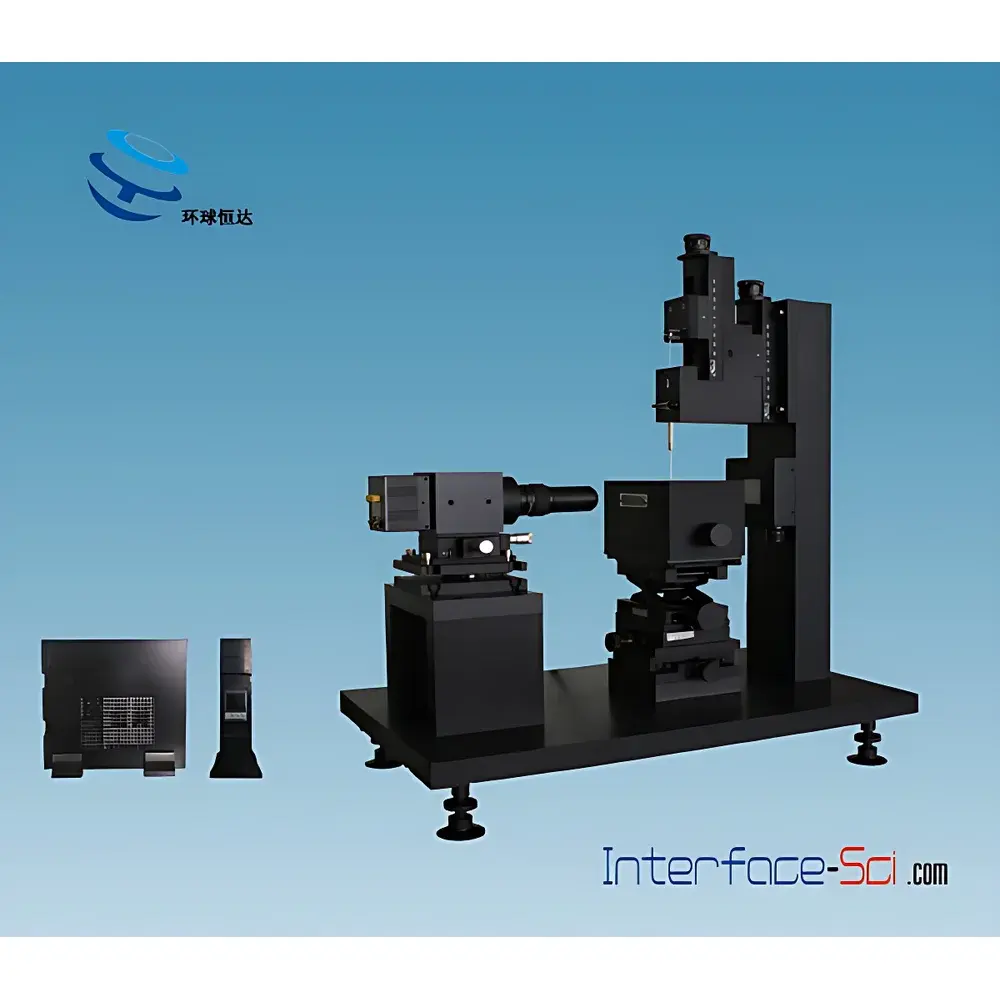
Interface SCI2000H High-Temperature Video Optical Contact Angle Analyzer
| Brand | Interface |
|---|---|
| Origin | Beijing, China |
| Model | SCI2000H |
| Instrument Type | Benchtop Video Optical Contact Angle Analyzer |
| Contact Angle Range | 0–180° |
| Contact Angle Accuracy | ±0.1° |
| Contact Angle Resolution | 0.01° |
| Sample Stage Dimensions | 120 × 100 mm |
| Stage Temperature Range | Ambient to 400 °C |
| Imaging Resolution (Min) | 1280 × 1024 pixels |
| Frame Rate (Standard) | 25 fps |
| Surface/Interfacial Tension Range | 5.0–2000 mN/m |
| Surface Tension Resolution | 0.001 mN/m |
| Measurement Methods | Sessile Drop, Pendant Drop, Captive Bubble, Tilting Plate, and Immersion Plate |
| Software Compliance | Supports ASTM D724, ASTM D5946, ISO 15989 |
Overview
The Interface SCI2000H High-Temperature Video Optical Contact Angle Analyzer is an engineered solution for quantitative interfacial characterization under thermally controlled conditions. It operates on the principle of optical drop shape analysis—capturing high-resolution silhouettes of liquid droplets or bubbles on solid or liquid substrates, then applying mathematical models (e.g., Young–Laplace equation, ellipse/circle fitting, and axisymmetric drop shape analysis) to extract contact angles, surface/interfacial tension, and thermodynamic surface energy parameters. Designed specifically for elevated-temperature operation up to 400 °C, the SCI2000H enables dynamic wetting studies of polymers, molten metals, phase-change materials, and thermally treated coatings—conditions where conventional ambient-only systems fail to capture true interfacial behavior. Its modular architecture supports both static and dynamic measurements—including advancing/receding angles, roll-off angles, and time-resolved contact angle hysteresis—making it suitable for R&D labs focused on surface functionalization, plasma treatment validation, and high-temperature material processing.
Key Features
- High-precision heated sample stage with temperature control from ambient to 400 °C, calibrated traceably to NIST standards and equipped with dual PID feedback loops for thermal stability ≤ ±0.5 °C over 1-hour dwell.
- Five-axis manually actuated sample positioning system: vertical travel (60 mm, 0.1 mm resolution), horizontal X/Y translation (100 mm optional), and 360° manual or motorized rotation (0.01° resolution) for anisotropic surface analysis and roll-off angle quantification.
- Optical subsystem comprising a 0.7–5.0× continuous zoom industrial lens with 55–320 pixel/mm effective magnification, paired with a USB 2.0 monochrome CCD camera (1280 × 1024, 25 fps standard; upgradeable to 2000 fps for rapid wetting kinetics).
- Uniform cold LED backlighting with collimated parallel optics ensures sharp, low-noise droplet contours—critical for sub-degree contact angle reproducibility and edge-detection robustness across low-energy and high-hysteresis surfaces.
- Multi-channel peristaltic pump-based dispensing system with 10–100 µL precision syringes, stainless-steel micro-needles (0.14–0.9 mm ID), and optional motorized Z-axis actuation (50 mm travel, 0.1 µm step resolution) for repeatable droplet deposition.
- Integrated mechanical design featuring crossed roller guides, precision-ground lead screws, and vibration-damped base structure—engineered for long-term dimensional stability and minimal drift during extended thermal cycling.
Sample Compatibility & Compliance
The SCI2000H accommodates heterogeneous sample geometries: flat solids (max 180 mm × ∞ × 60 mm), fibers (with dedicated clamping fixtures), thin films, porous membranes, and compressed powder pellets. Its open-stage architecture allows in situ integration with external gas purging, humidity control chambers, or electrochemical cells. The instrument complies with internationally recognized test standards including ASTM D724 (paper wettability), ASTM D5946 (corona-treated polymer films), and ISO 15989 (water contact angle on treated films). All measurement data—including timestamps, environmental metadata (T, RH), and operator annotations—are logged with audit-trail capability, supporting GLP-aligned documentation and 21 CFR Part 11–ready workflows when deployed with validated software configurations.
Software & Data Management
The proprietary analysis suite implements six algorithmic contact angle calculation methods (tangent, height, circle/ellipse fit, Young–Laplace pendant drop, captive bubble, and automated edge detection), each selectable per frame or batch. Dynamic acquisition supports user-defined intervals down to 40 ms between frames, with synchronized image + numerical export to timestamped SQLite databases. Surface energy modeling includes Neumann’s Equation of State, Owens–Wendt–Rabel, van Oss–Chaudhury–Good acid-base theory, Wu harmonic mean, and Zisman critical surface tension—each validated against reference liquid libraries containing >300 solvents. Raw videos (AVI), annotated images (PNG/TIFF), and Excel-exportable datasets preserve full traceability. Database encryption, role-based access control, and automated backup scheduling are available under enterprise licensing.
Applications
The SCI2000H serves cross-disciplinary interfacial science needs: evaluating plasma, flame, or corona treatment efficacy on polymeric packaging films; quantifying hydrophobic recovery in medical-grade silicone elastomers post-sterilization; characterizing wettability transitions in thermoresponsive hydrogels; assessing solder alloy spreading on PCB substrates at reflow temperatures; mapping surface heterogeneity in carbon fiber composites via multi-point sessile drop mapping; and determining interfacial tension isotherms for surfactant-laden molten salt systems in next-generation thermal storage research. In pharmaceutical development, it supports formulation screening of ophthalmic solutions on contact lens materials and evaluates coating uniformity on tablet cores. In energy applications, it characterizes coal/water slurry adhesion on reactor linings and measures bitumen–brine interfacial aging under reservoir-relevant thermal conditions.
FAQ
What temperature range does the heated stage support, and how is thermal uniformity verified?
The stage operates from ambient to 400 °C, with spatial uniformity ≤ ±1.5 °C across the central 80 mm² zone, confirmed by embedded PT100 sensors and independent IR thermography calibration reports.
Can the system measure contact angles on curved or fibrous substrates?
Yes—dedicated fixtures for single fibers, yarns, and irregular topographies are available; curvature correction algorithms and local baseline detection mitigate geometric distortion effects.
Is the software compliant with FDA 21 CFR Part 11 requirements?
Out-of-the-box functionality meets ALCOA+ principles; full Part 11 compliance requires configuration-controlled deployment with electronic signatures, audit trail activation, and secure user authentication—services provided under IQ/OQ/PQ support packages.
What surface tension methods are implemented, and what is the lowest measurable value?
Pendant drop analysis using Young–Laplace curve fitting and Bashford–Adams table interpolation; minimum resolvable surface tension is 5.0 mN/m with <1% relative uncertainty for aqueous surfactant solutions.
Does the system support automated multi-sample sequential measurement?
Yes—programmable stage navigation, auto-focus routines, and scheduled droplet deposition enable unattended testing of up to 96 positions per run, with results compiled into consolidated Excel reports.



