
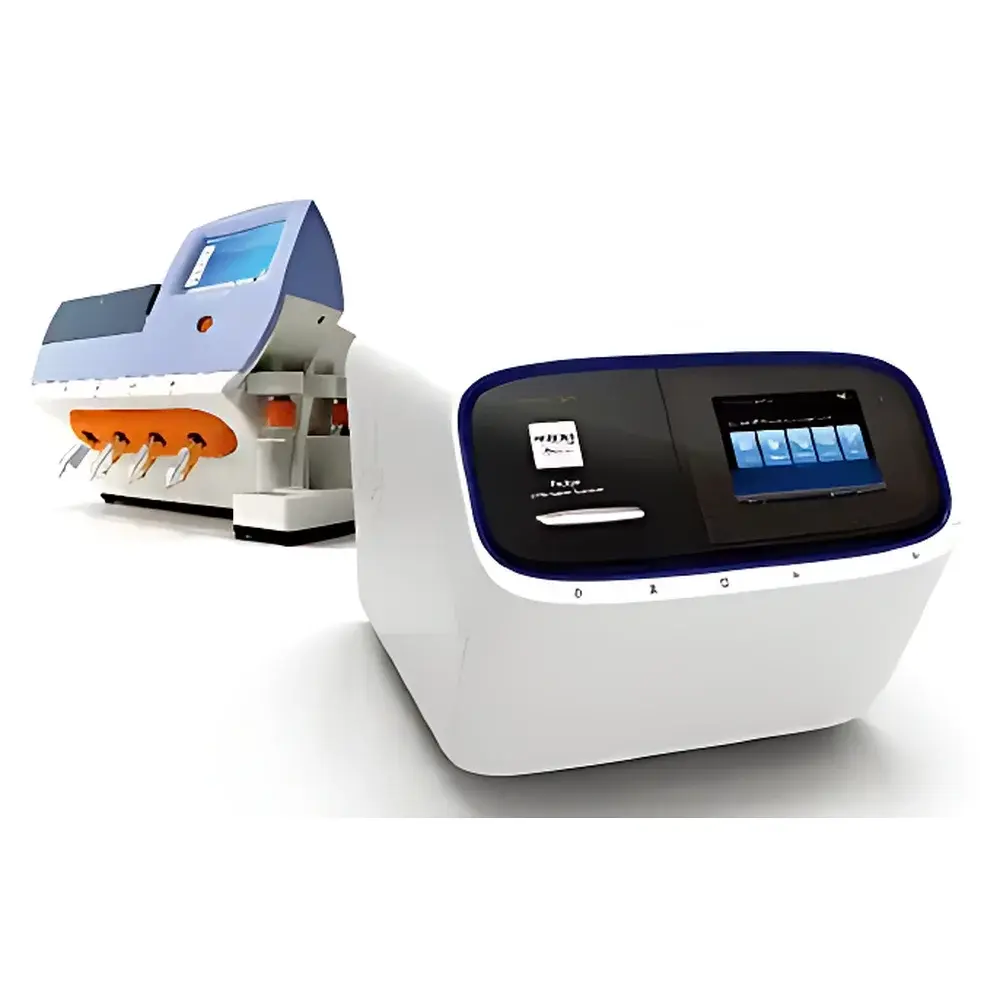
Ion Proton™ Sequencer by Thermo Fisher Scientific (formerly Life Technologies)
| Brand | Thermo Fisher Scientific (Life Technologies) |
|---|---|
| Origin | USA |
| Model | Ion Proton™ |
| Instrument Type | Semiconductor-Based Next-Generation Sequencer |
| Form Factor | Benchtop |
| Primary Application | Whole Human Genome Sequencing, Exome Sequencing, Targeted Panels, RNA-Seq, Epigenetics (e.g., ChIP-seq, methylation analysis) |
| Regulatory Status | For Research Use Only (RUO) |
| Compliance | Designed to support GLP/GMP-aligned workflows |
Overview
The Ion Proton™ Sequencer is a benchtop next-generation sequencing (NGS) platform developed by Thermo Fisher Scientific (originally commercialized under Life Technologies). It employs semiconductor-based sequencing-by-synthesis technology—detecting hydrogen ions released during nucleotide incorporation in real time—to deliver high-throughput, scalable DNA sequencing without optical components or fluorescent dyes. Unlike camera- or CCD-based platforms, the Ion Proton system leverages ion-sensitive field-effect transistor (ISFET) sensor arrays integrated directly into the chip substrate, enabling rapid signal transduction and low-latency base calling. Its architecture supports whole human genome sequencing at ~30× coverage, exome sequencing, transcriptome profiling (RNA-Seq), targeted resequencing panels, and epigenomic applications such as ChIP-seq and bisulfite-treated DNA sequencing. Engineered for precision and reproducibility, the platform delivers read lengths up to 200 bp with high base-call accuracy (>99.5% Q20 after calibration), making it suitable for variant detection—including SNVs, indels, and structural variants—in clinical research and translational genomics settings.
Key Features
- Benchtop footprint (approximately 60 × 75 × 65 cm) designed for integration into standard molecular biology laboratories without dedicated cleanroom infrastructure.
- Two-tier chip format: Ion PI™ Chip (100 million reads per run) and Ion Proton™ I/II Chips (up to 1 billion reads per run), enabling flexible experimental scaling from small RNA libraries to whole-genome projects.
- Integrated templating (Ion OneTouch™ 2 System) and enrichment workflow—fully automated clonal amplification via emulsion PCR on Ion Sphere™ particles—minimizing hands-on time and inter-operator variability.
- Real-time base calling and quality scoring using Torrent Suite™ Software v5.x+, with on-instrument alignment to reference genomes (hg19, GRCh38, mm10, etc.) and variant calling (TVC algorithm).
- Modular thermal control and fluidic delivery system ensuring consistent cluster generation, sequencing chemistry delivery, and wash cycles across >500 consecutive runs.
- ISFET sensor array with >1.2 million independent sensors per Proton I Chip, providing inherent signal redundancy and noise suppression through statistical consensus base calling.
Sample Compatibility & Compliance
The Ion Proton™ Sequencer accepts input nucleic acid libraries prepared from genomic DNA, FFPE-derived DNA, cDNA, amplicons, and sheared chromatin immunoprecipitated DNA. Library preparation kits—including Ion Xpress™ Plus, Ion AmpliSeq™, and Ion Chef™-compatible reagents—are validated for compatibility with human, mouse, rat, non-human primate, and microbial genomes. All consumables carry CE-IVD marking where applicable and are manufactured under ISO 13485-certified processes. The instrument itself is classified as Research Use Only (RUO) per FDA guidance; however, its data management architecture—including encrypted raw signal files (.dat), traceable run logs, and user-accessible audit trails—supports alignment with GLP, GCP, and internal SOPs for preclinical biomarker discovery and assay development. When deployed with validated IT infrastructure and electronic signature controls, the system meets foundational expectations for 21 CFR Part 11 compliance in regulated environments.
Software & Data Management
Torrent Suite™ Software serves as the embedded operating system and primary analysis engine, executing base calling, adapter trimming, alignment (via TMAP aligner), and variant annotation in near real time. Raw data (.bam, .vcf, .tsv) exports are compatible with third-party bioinformatics pipelines including Galaxy, CLC Genomics Workbench, and custom Python/R implementations. The Ion Reporter™ cloud-based application enables collaborative interpretation of variants against ClinVar, COSMIC, dbSNP, and internal knowledge bases—with configurable permission tiers and version-controlled report generation. Local deployment options support air-gapped network configurations for sensitive data handling. All software releases undergo regression testing per ISO/IEC 17025-aligned validation protocols, and release notes document conformance to SAMPL, MIAME, and MINSEQE reporting standards.
Applications
- Whole-genome resequencing for population-scale variant discovery and rare disease cohort analysis.
- Exome capture and sequencing to prioritize coding-region mutations in Mendelian disorders and oncology trials.
- Targeted panel sequencing (e.g., Ion AmpliSeq™ Cancer Hotspot Panel v2) for somatic mutation detection in solid tumors and liquid biopsies.
- Transcriptome quantification and fusion gene detection in RNA-Seq experiments, including strand-specific library protocols.
- Epigenetic profiling via methylated DNA immunoprecipitation sequencing (MeDIP-seq) and histone modification mapping (ChIP-seq).
- Microbial community profiling (16S rRNA, ITS, or shotgun metagenomics) in environmental and host-associated microbiomes.
FAQ
What is the maximum read length supported by the Ion Proton™ platform?
The platform supports single-end reads up to 200 base pairs, optimized for high-fidelity variant detection in coding regions and conserved regulatory elements.
Is the Ion Proton™ Sequencer compatible with automation systems?
Yes—it integrates with Hamilton STARlet, Tecan Freedom EVO, and other liquid handlers via standardized API interfaces and LIMS-compatible sample tracking barcodes.
Does Thermo Fisher provide bioinformatics training and support for Torrent Suite™?
Comprehensive administrator and end-user training programs—including hands-on workshops, remote labs, and certified instructor-led courses—are available through Thermo Fisher Scientific’s Global Training Institute.
Can raw data files be archived in long-term storage formats compliant with NIH GenBank submission requirements?
Yes—Torrent Suite™ generates FASTQ, BAM, and VCF outputs conforming to GA4GH standards; metadata is embedded per MIAME/MINSEQE specifications for seamless deposition into SRA, dbGaP, or EGA repositories.
What service plans are available for preventive maintenance and technical escalation?
Thermo Fisher offers Platinum, Gold, and Silver service contracts with guaranteed response times, on-site engineer dispatch, firmware updates, and priority access to application specialists for method optimization and troubleshooting.




