
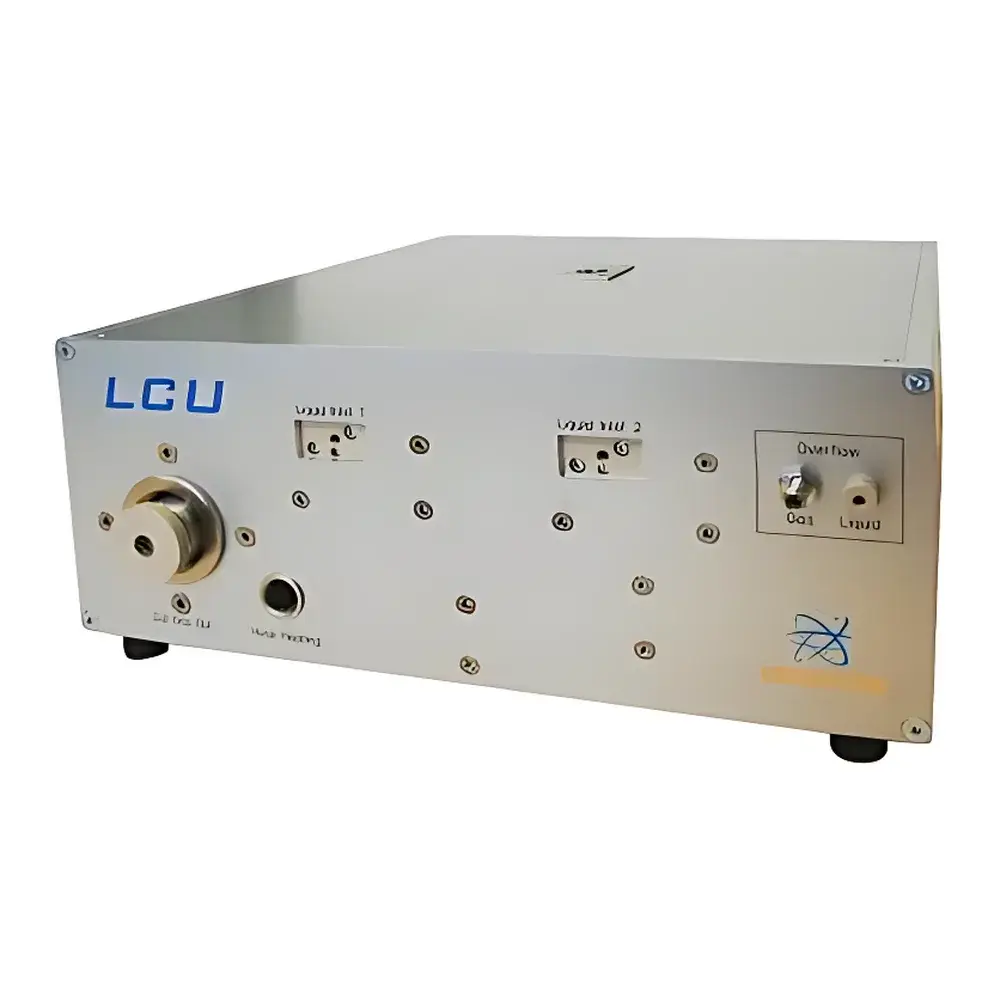
IONICON LCU Liquid Calibration Unit for PTR-MS and Trace VOC Analysis
| Brand | IONICON Analytik GmbH |
|---|---|
| Origin | Austria |
| Model | LCU |
| Configuration Options | LCU-s (Standard), LCU-a (Advanced) |
| Dilution Range | ppt to % (v/v) |
| Output Flow Rate | 0.1–50 L/min (single gas stream) |
| Accuracy | <5% (relative) |
| Response Time | <1 min (for concentration step change, including calculation latency) |
| Humidity Control Range | 10–100% RH @ 40 °C |
| Evaporation Optimization | Dynamic temperature-controlled liquid dosing with real-time vapor pressure compensation |
| Condensation-Free Operation | Integrated heated transfer lines and isothermal vapor path |
| Dimensions (W×H×D) | 35 × 35 × 15 cm |
| Weight | 10 kg |
| Optional LCU-a Enhancements | Dual liquid inlet (second for humidity reference), additional gas inlet with Sulfinet™-coated mixing manifold |
Overview
The IONICON LCU Liquid Calibration Unit is a precision-engineered trace gas calibration system designed specifically for quantitative vapor-phase analysis using proton-transfer-reaction mass spectrometry (PTR-MS) and other high-sensitivity analytical platforms requiring dynamic, gravimetrically traceable VOC standards. Unlike conventional permeation or diffusion-based calibrators, the LCU employs controlled liquid-phase evaporation under thermodynamically stabilized conditions—leveraging real-time vapor pressure modeling, mass-flow-regulated carrier gas dilution, and isothermal vapor transport—to generate stable, reproducible, and metrologically defensible VOC concentrations across an exceptionally wide dynamic range—from sub-ppt (parts-per-quadrillion) to percent-level volume fractions. Its architecture eliminates condensation pathways through fully heated fluidic paths and active thermal management, ensuring molecular integrity of thermally labile compounds and enabling seamless integration into regulated laboratory environments where traceability, repeatability, and matrix independence are critical.
Key Features
- Two-tier configuration architecture: LCU-s (standard) supports single-liquid calibration with full humidity tolerance; LCU-a adds dual-liquid capability—including dedicated humidity reference generation—and a Sulfinet™-coated gas mixing inlet for certified standard gas blending.
- Dynamic liquid dosing with closed-loop temperature control ensures precise evaporation kinetics across diverse volatility ranges (C2–C18 hydrocarbons, oxygenates, sulfur compounds, halogenated VOCs).
- Integrated mass flow controllers (MFCs) regulate both carrier gas and auxiliary streams with ±0.5% full-scale accuracy, enabling programmable dilution profiles and multi-step calibration sequences.
- Response time <1 minute for concentration transitions—validated per ISO 6145-7 (gas mixtures by dynamic volumetric method)—includes onboard calculation latency and physical equilibration.
- Heated vapor path maintained at ≥40 °C throughout, with optional extended-range heating up to 80 °C for high-boiling-point analytes (e.g., PAHs, terpenes, glycols).
- Compact benchtop footprint (35 × 35 × 15 cm) and modular interface design allow direct coupling to PTR-MS inlets, GC-MS sample introduction modules, or ambient air monitoring stacks without external plumbing.
Sample Compatibility & Compliance
The LCU accommodates a broad spectrum of volatile and semi-volatile organic liquids—including aldehydes, ketones, aromatics, esters, ethers, mercaptans, and chlorinated solvents—without chemical modification or catalytic degradation. All wetted surfaces are constructed from electropolished stainless steel and PFA, ensuring inertness toward reactive species (e.g., H2S, NO2, formaldehyde). The system complies with ISO/IEC 17025 requirements for calibration laboratories and supports audit-ready documentation per GLP and FDA 21 CFR Part 11 when operated with validated software protocols. Traceability is maintained through NIST-traceable liquid standards and manufacturer-certified MFC calibrations, fulfilling ASTM D6166 (standard practice for calibration of VOC analyzers) and EN 14662 (ambient air quality—measurement of VOCs by PTR-MS).
Software & Data Management
Control and automation are executed via IONICON’s proprietary CaliSoft suite—a Windows-based application supporting method-driven calibration workflows, real-time concentration logging, and automated report generation (PDF/CSV). The software implements full electronic record keeping with user access levels, audit trails, and digital signatures compliant with 21 CFR Part 11 Annex 11. Calibration parameters—including liquid density, vapor pressure coefficients, carrier gas composition, and temperature gradients—are stored per compound and automatically applied during sequence execution. Remote operation via Ethernet or USB-C enables synchronized triggering with data acquisition systems (e.g., TOF-MS transient capture) and integration into LIMS environments through OPC UA or RESTful API endpoints.
Applications
- Primary and secondary calibration of PTR-TOF, PTR-QiTOF, and SRI-MS instruments for atmospheric chemistry research and emission source profiling.
- Method validation and QC/QA for EPA Method TO-15, TO-17, and ISO 16017-1 compliant VOC monitoring in indoor air, industrial hygiene, and biogenic emission studies.
- Development and verification of quantitative models for sensor response factors, especially for low-concentration biomarkers (e.g., isoprene, acetone, methanol) in breath analysis and plant physiology.
- Trace-level spike recovery testing in complex matrices (e.g., humidified air, exhaust streams, fermentation off-gas) where traditional gas cylinders exhibit adsorption artifacts or limited compound coverage.
- Multi-analyte calibration campaigns involving >20-component liquid mixtures—enabling simultaneous quantification of isomeric VOCs without chromatographic separation.
FAQ
What types of liquid standards are compatible with the LCU?
The LCU accepts neat liquids and pre-mixed solutions in glass vials (1–10 mL capacity); compatibility extends to water-miscible and immiscible organics with boiling points between 20 °C and 250 °C, provided vapor pressure exceeds 0.1 Pa at operating temperature.
Can the LCU be used for humidified calibration standards?
Yes—the LCU-s operates across 10–100% RH at 40 °C; the LCU-a variant includes a dedicated humidity reference channel enabling independent control of water vapor partial pressure alongside VOC concentration.
Is third-party software integration supported?
Calibration sequences can be triggered externally via TTL signals or TCP/IP commands; raw concentration logs and status telemetry are exportable in SI-traceable units (nmol/mol, µg/m³) for ingestion into MATLAB, Python (Pandas), or LabVIEW environments.
How is accuracy verified and maintained over time?
Accuracy validation is performed using gravimetrically prepared reference standards (e.g., NIST SRM 1864); routine verification includes flow rate checks with primary calibrators and vapor pressure model cross-referencing against Antoine equation databases.
Does the LCU require routine maintenance or consumables?
No consumables are required beyond standard liquid standards; annual MFC recalibration and quarterly thermal path verification (using PT100 probes) are recommended for GLP-compliant operation.







