
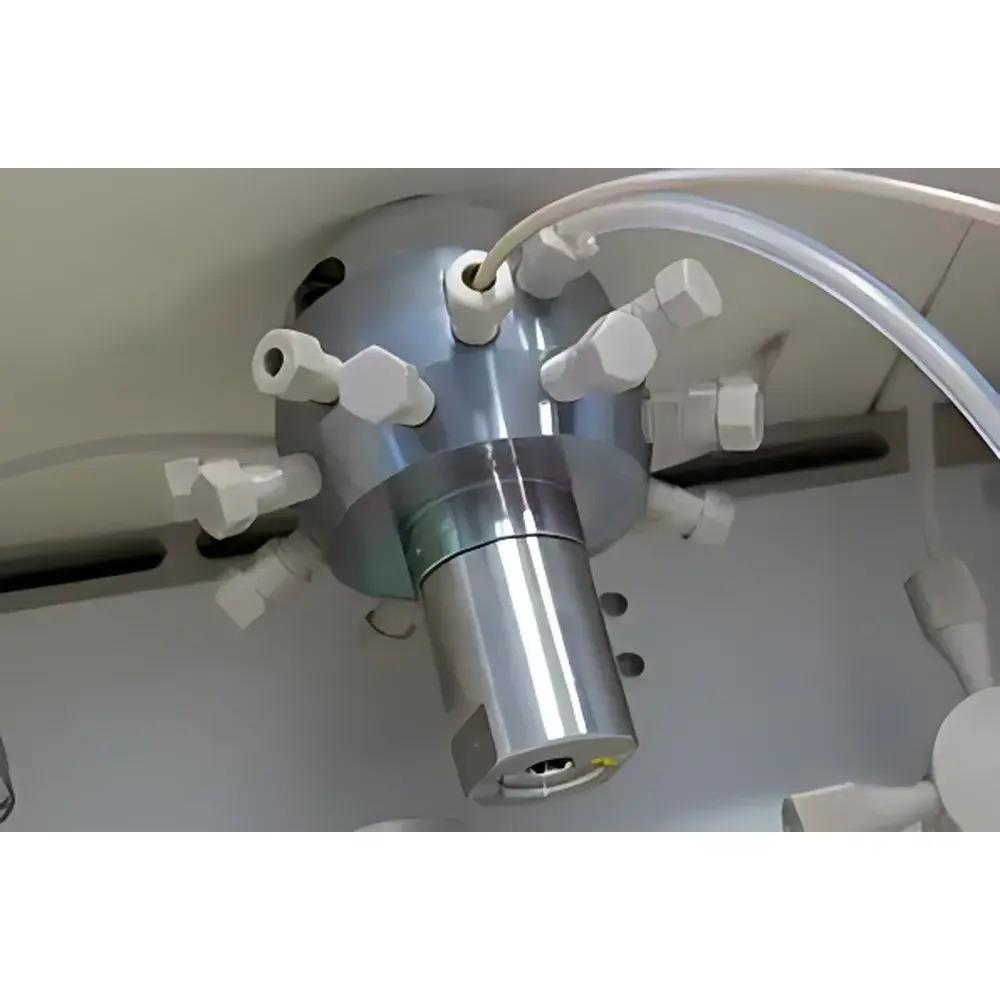
IONICON Multi-Port Sample Injector
| Brand | IONICON Analytik GmbH |
|---|---|
| Origin | Austria |
| Model | Multi-Port Sampling Device |
| Valve Configurations | 2-way and 3-way |
| Port Options | 12-, 16-, 18-, or custom-configurable inlet ports |
| Material Options | PTFE- or PEEK-coated valve bodies |
| Application | Automated, sequential vapor/sampling stream selection for real-time analytical systems |
| Compliance | Designed for integration with PTR-MS, SIFT-MS, and other trace gas analyzers |
Overview
The IONICON Multi-Port Sample Injector is an engineered sample introduction module designed for high-fidelity, automated sequential sampling from multiple gaseous or vapor-phase sources. It operates on the principle of precision pneumatic or motor-driven multi-position valve switching, enabling deterministic routing of sample streams to a central analytical interface—such as a proton-transfer-reaction mass spectrometer (PTR-MS) or selected-ion flow-tube mass spectrometer (SIFT-MS). Unlike passive manifold systems, this device ensures zero cross-contamination between sampling points through positive isolation, pressure-balanced flow paths, and chemically inert internal surfaces. Its architecture supports both time-resolved monitoring across distributed locations (e.g., ambient air inlets, process vents, chamber headspaces) and method-driven repetitive injection sequences required for calibration validation, drift correction, or inter-site comparison studies.
Key Features
- Modular valve platform supporting 2-way and 3-way configurations for flexible inlet/outlet routing
- Scalable port count: standard configurations available with 12, 16, or 18 independent sample inlets; custom layouts up to 32 ports possible upon engineering review
- Chemically resistant internal wetted path: all valves feature optional PTFE or PEEK coating to minimize adsorption, memory effects, and degradation when handling reactive, polar, or high-boiling-point VOCs
- Low dead volume design (< 50 µL per port path) to preserve temporal resolution during rapid switching (typical cycle time < 2 s per port)
- Integrated leak-tight sealing (helium leak rate < 1×10⁻⁹ mbar·L/s) verified per ISO 15848-1 for vacuum-compatible operation
- RS-232/RS-485 and TTL digital I/O interfaces for synchronization with external data acquisition systems and instrument control software
- Mounting-ready chassis compatible with standard 19″ rack enclosures or benchtop integration into analytical laboratories
Sample Compatibility & Compliance
The injector is validated for use with volatile and semi-volatile organic compounds (VOCs and SVOCs), inorganic gases (NH₃, H₂S, NOₓ), and humidified or particulate-laden streams (with optional inline particle filter). It complies with material compatibility requirements outlined in ASTM D6196-20 (standard practice for selecting VOC analytes) and supports method development aligned with EPA TO-15, EN 14662, and ISO 16000-6. All PTFE/PEEK components meet USP Class VI biocompatibility standards. The device is designed to operate within GLP/GMP environments where audit-trail-capable sequence logging and hardware-level access control are implemented via host software integration.
Software & Data Management
The injector does not include embedded firmware but interfaces seamlessly with IONICON’s TOF-DAQ and PTR-TOF Control Suite, enabling synchronized valve actuation, dwell-time programming, and timestamped metadata tagging for each sampled port. Sequence logs—including valve position, timestamp, dwell duration, and error flags—are exported in CSV or HDF5 format for traceability. When deployed in regulated settings, the system supports 21 CFR Part 11-compliant electronic signatures and user-role-based access control when integrated with validated LIMS or ELN platforms.
Applications
- Real-time ambient air quality monitoring across urban, industrial, or indoor microenvironments
- Process analytical technology (PAT) for continuous emission monitoring in chemical manufacturing and semiconductor fabrication
- Dynamic headspace analysis of packaging materials, food matrices, or pharmaceutical stability chambers
- Multi-point soil gas flux studies using static or dynamic chambers coupled to online MS detection
- Automated calibration gas delivery for instrument performance verification and QC/QA workflows
- Research-grade breath analysis with synchronized sampling from multiple donors or anatomical sites
FAQ
What is the maximum operating pressure and temperature range?
The standard configuration supports inlet pressures up to 2 bar (gauge) and ambient temperature operation (15–35 °C); high-temperature variants rated to 80 °C are available under custom specification.
Can the injector be used with corrosive or acidic gas streams?
Yes—when equipped with PEEK-coated valves and fluoropolymer tubing, it demonstrates robust resistance to HCl, Cl₂, SO₂, and other moderately aggressive species per NACE MR0175/ISO 15156 guidelines.
Is remote triggering supported for time-critical experiments?
Yes—TTL pulse input allows external hardware (e.g., laser trigger, reaction timer) to initiate port switching with sub-millisecond jitter.
How is carryover between ports minimized?
Through optimized flow path geometry, programmable purge cycles (using auxiliary carrier gas), and surface passivation—validated by <0.1% carryover for acetone and formaldehyde at 1 ppb levels.
Does the device require routine maintenance or recalibration?
No recalibration is needed; recommended preventive maintenance includes quarterly visual inspection of seals and annual replacement of rotary seal kits under continuous 24/7 operation.
Related Products





