
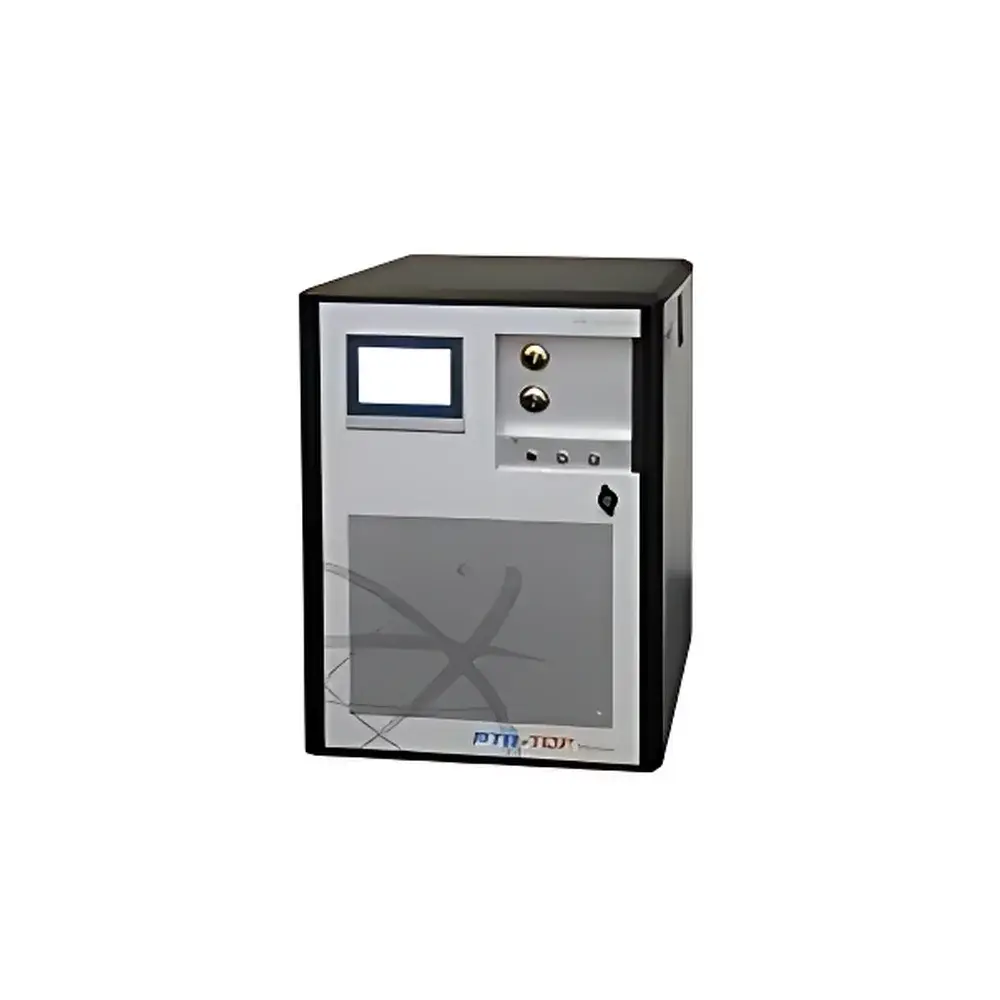
IONICON PTR TOF 1000 ULTRA High-Resolution Online VOCs Analyzer
| Brand | IONICON Analytik GmbH |
|---|---|
| Origin | Austria |
| Manufacturer Type | Authorized Distributor |
| Origin Category | Imported |
| Model | PTR TOF 1000 ULTRA |
| Price | Upon Request |
| Pulse Frequency | ~150 kHz |
| Mass Resolution | >1500 m/Δm (FWHM) for m/z >60 |
| Response Time | <100 ms |
| Sensitivity | >2000 cps/ppbv at m/z 181 (standard) |
| Mass Range | 1–10,000 Da |
| Linear Dynamic Range | 5 pptv – 1000 ppbv |
| Inlet Flow Rate | 50–800 sccm |
| Inlet Heating Range | 40–180 °C |
| Drift Tube Heating Range | 40–120 °C |
| Power Supply | 100–230 V AC, max. 1500 W |
| Interface | Integrated 8″ touchscreen display |
Overview
The IONICON PTR TOF 1000 ULTRA is a high-resolution, time-of-flight proton-transfer-reaction mass spectrometer engineered for real-time, quantitative analysis of volatile organic compounds (VOCs) in ambient air, industrial process streams, and laboratory emission studies. Unlike conventional quadrupole or ion-trap MS systems, this instrument employs soft chemical ionization via proton transfer from H₃O⁺ reagent ions—minimizing fragmentation and preserving molecular integrity—coupled with orthogonal time-of-flight (TOF) mass separation. Its design enables sub-second temporal resolution (<100 ms), enabling dynamic monitoring of rapidly evolving VOC profiles in environmental chambers, biogenic emission studies, or indoor air quality assessments. The system operates without chromatographic separation, delivering direct, untargeted detection across the full mass range (1–10,000 Da), making it particularly suited for discovery-oriented research and regulatory-compliant continuous emissions monitoring where speciation and quantification must coexist under field-deployable conditions.
Key Features
- Ultra-high mass resolution (>1500 m/Δm FWHM at m/z >60) ensures baseline separation of isobaric and near-isobaric species—critical for distinguishing structurally similar VOCs such as monoterpenes, aromatic isomers, or oxygenated organics.
- Proton-transfer-reaction (PTR) ionization delivers soft, reproducible ionization with minimal fragmentation—ideal for quantifying labile compounds including aldehydes, ketones, and multifunctional organics without derivatization.
- Integrated thermal control: independently regulated heating of the sample inlet (40–180 °C) and drift tube (40–120 °C) prevents condensation and wall losses, ensuring quantitative transmission of semi-volatile and polar VOCs.
- Compact, ruggedized architecture with integrated 8-inch touchscreen interface and embedded Linux-based firmware—designed for unattended operation in mobile labs, stack monitoring stations, or cleanroom environments.
- Modular I/O suite (8× digital I/O, 2× analog inputs/outputs) supports synchronization with external sensors (e.g., meteorological stations, GC systems, or PID detectors) and integration into SCADA or LIMS platforms.
- X2 Performance Option enhances sensitivity by >15× at m/z 181 (to >30,000 cps/ppbv), extending detection limits into the low-pptv regime—essential for background-limited applications such as remote atmospheric observatories or clean manufacturing verification.
Sample Compatibility & Compliance
The PTR TOF 1000 ULTRA accepts gaseous samples directly via heated stainless-steel or SilcoNert®-coated inlet lines, accommodating flow rates from 50 to 800 sccm. It maintains quantitative response across a linear dynamic range spanning five orders of magnitude (5 pptv to 1000 ppbv), validated per ISO 16000-6 and ASTM D6196 protocols for indoor air VOC measurement. The instrument’s ion source and detector are designed to meet GLP and GMP-aligned data integrity requirements: all acquisition parameters—including dwell time, calibration gas injection timestamps, and internal standard tracking—are logged with microsecond precision and timestamped to NTP-synchronized system clocks. Audit trails, user access controls, and electronic signatures are supported through optional IONICON DataManager software compliant with FDA 21 CFR Part 11 Annex 11 guidelines.
Software & Data Management
Acquisition and processing are managed via IONICON’s proprietary TOF-DAQ v5.x software, running on an embedded industrial PC. Real-time spectral visualization, peak deconvolution using iterative least-squares fitting, and automated mass calibration (using internal H₃O⁺(H₂O)ₙ clusters) occur during acquisition. Raw .tdf files are stored in HDF5 format, supporting long-term archival and third-party interoperability (e.g., with MATLAB, Python pandas, or OpenMS). Batch processing workflows enable retrospective recalibration, isotopic pattern matching, and time-series clustering (e.g., PCA, t-SNE) for source apportionment. Export options include CSV, mzML, and netCDF—ensuring compatibility with atmospheric modeling tools (e.g., CMAQ, GEOS-Chem) and regulatory reporting templates.
Applications
- Ambient air quality monitoring: Real-time speciation of biogenic VOCs (isoprene, monoterpenes), anthropogenic aromatics (benzene, toluene), and oxidation products (formaldehyde, acetaldehyde) in urban, rural, and forested sites.
- Indoor air and building material emission testing: Quantification of formaldehyde, terpenes, plasticizers, and flame retardants during chamber testing per ISO 16000-9 and EN 16516.
- Industrial process monitoring: Continuous detection of solvent leaks, reactor off-gases, or catalyst deactivation markers in pharmaceutical, petrochemical, and semiconductor fabrication facilities.
- Human exposure science: Breath analysis for metabolic biomarkers (e.g., acetone, isoprene, alkanes) in clinical and occupational health studies.
- Atmospheric chemistry research: Kinetic studies of VOC–OH radical reactions, secondary organic aerosol (SOA) precursor identification, and oxidation mechanism validation via time-resolved product ion mapping.
FAQ
What ionization method does the PTR TOF 1000 ULTRA use, and why is it advantageous for VOC analysis?
It uses proton-transfer-reaction (PTR) ionization with H₃O⁺ as the primary reagent ion. This soft ionization technique yields predominantly intact molecular ions [M+H]⁺ with minimal fragmentation—enabling unambiguous compound identification and robust quantification without retention time alignment or standards for every analyte.
Can the instrument operate unattended for extended periods?
Yes. With its sealed, maintenance-free ion source, temperature-stabilized drift tube, and embedded watchdog timer, the system supports continuous operation for >30 days without intervention—validated under ISO/IEC 17025-accredited field deployments.
Is the mass calibration stable over time and temperature fluctuations?
Mass calibration is continuously referenced to internal water cluster ions (e.g., H₃O⁺(H₂O)ₙ) generated in situ, eliminating reliance on external calibrants. Drift compensation algorithms update calibration in real time, maintaining mass accuracy within ±3 ppm over 24 h at constant ambient temperature.
How is data security and traceability ensured for regulated applications?
All raw spectra, metadata, and operator actions are written to immutable, timestamped binary logs. Optional DataManager software provides role-based access, electronic signatures, and audit trail generation compliant with FDA 21 CFR Part 11 and EU Annex 11 for GxP environments.
Does the system support external triggering or synchronization with other instruments?
Yes. Digital I/O ports allow TTL-level triggering from external devices (e.g., GC oven events, laser pulses, or environmental sensor thresholds), while analog inputs accept synchronized signals (e.g., CO₂ or NOₓ concentration traces) for multi-parameter correlation analysis.




