
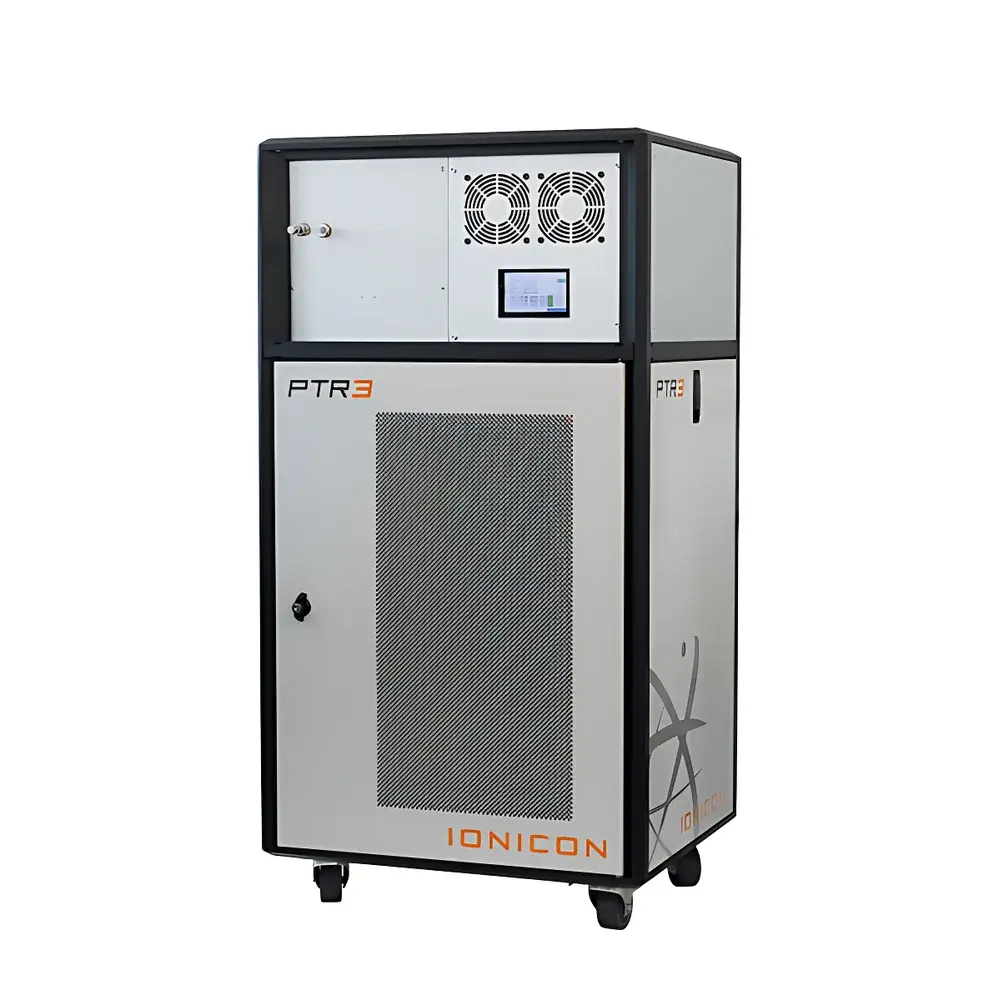
IONICON PTR3-TOF 10K Proton Transfer Reaction Time-of-Flight Mass Spectrometer
| Brand | IONICON Analytik GmbH |
|---|---|
| Origin | Austria |
| Model | PTR3-TOF 10K |
| Detection Principle | Proton Transfer Reaction (PTR) coupled with High-Resolution Time-of-Flight Mass Spectrometry |
| Instrument Type | Online Real-Time Gas Analyzer |
| Configuration | Single-Stream Ambient Air Monitoring System |
| Detection Range | 0.1 pptv – 100 ppbv |
| Mass Resolution | Up to 15,000 m/Δm (FWHM) |
| Accuracy | ±0.001% mass accuracy (calibrated) |
| Response Time | < 100 ms (10–90% step response) |
Overview
The IONICON PTR3-TOF 10K is a state-of-the-art online proton transfer reaction time-of-flight mass spectrometer engineered for real-time, quantitative trace gas analysis of volatile and highly reactive atmospheric species. Unlike conventional VOC detectors relying on metal oxide or photoionization sensors, the PTR3-TOF 10K employs soft chemical ionization via controlled proton transfer from H3O+, NO+, or NH4+ reagent ions—enabling near-unity ionization efficiency for oxygenated organics while preserving molecular integrity. Its core innovation lies in the patented 3D tripole elevated-pressure reactor, which maintains optimal reaction kinetics (10–100 mbar) and minimizes wall losses of short-lived radicals such as RO2 and Criegee intermediates. Coupled with the novel ioniTOF 10K analyzer delivering certified mass resolution >10,000 m/Δm (FWHM) at m/z >129—and up to 15,000 for targeted ions—the system achieves unambiguous separation of isobaric compounds (e.g., C5H8O3 vs. C6H12O2) critical for atmospheric oxidation mechanism studies.
Key Features
- TRION triple reagent ion source enabling millisecond-scale switching among H3O+, NO+, and NH4+—essential for selective detection of carbonyls, nitrates, and amines without hardware reconfiguration
- Dual-stage core sampling inlet with laminar flow design and low-surface-area path (<0.5 m total length), reducing residence time to <30 ms and minimizing heterogeneous loss of ELVOCs and peroxy radicals
- IP-protected 3D tripole reactor operating at 30–80 mbar, optimized for kinetic-limited proton transfer while suppressing fragmentation and clustering artifacts
- ioniTOF 10K high-resolution TOF mass analyzer featuring ultra-stable reflectron optics, digital ion gating, and <100 ps time resolution—ensuring sub-ppqv detection limits and long-term mass stability (<0.1 ppm/h drift)
- ION-BOOSTER ion funnel and hexapole ION-GUIDE for >95% ion transmission efficiency across m/z 20–1000, independent of compound polarity or proton affinity
- Integrated vacuum architecture with dual-stage turbomolecular pumping (2 × 300 L/s) and active temperature stabilization (±0.1°C), enabling continuous 24/7 operation under field-deployable conditions
Sample Compatibility & Compliance
The PTR3-TOF 10K is validated for direct analysis of ambient air, stack emissions, chamber effluents, and breath samples without preconcentration or derivatization. It complies with ISO 16000-30 (indoor air VOC measurement), ASTM D6196 (ambient VOC monitoring), and supports GLP/GMP data integrity requirements through audit-trail-enabled software (21 CFR Part 11 compliant configuration available). Its non-destructive ionization preserves labile functional groups (e.g., hydroperoxides, carbonyl oxides), making it suitable for EPA Method TO-15A extension studies and EMEP/ACTRIS network protocols. Calibration traceability follows NIST SRM 1861a (benzene in nitrogen) and custom multi-component gas standards (ppqv-level uncertainty <2%).
Software & Data Management
Controlled via TOF-DAQ v5.2 software, the system provides real-time spectral acquisition (up to 10 Hz full-spectrum mode), automated mass calibration (internal/external lock-mass), and integrated peak deconvolution using IONIC’s proprietary PeakSight algorithm. Raw data (.raw) and processed results (.csv, .mzML) are stored in FAIR-compliant format with embedded metadata (pressure, temperature, humidity, reagent ion composition). The optional CloudLink module enables secure remote monitoring, automated QC flagging (e.g., signal-to-noise decay >5%/week), and interoperability with ICOS, ACTRIS, and NOAA’s GML databases via REST API.
Applications
- Field-based measurement of highly oxygenated organic molecules (HOMs) and RO2 radical budgets in boreal forest, marine boundary layer, and urban plume studies
- Real-time quantification of biogenic VOC oxidation products (e.g., IEPOX, Z- and E-β-ocimene derivatives) in smog chambers and flow reactors
- Source apportionment of anthropogenic emissions (e.g., solvent use, biomass burning markers) using NO+/NH4+ switching for nitro-aromatics and alkylamines
- Process monitoring of catalytic oxidation reactors and VOC abatement systems with sub-second temporal resolution
- Validation of atmospheric chemistry models (e.g., MCM, GEOS-Chem) through speciated, time-resolved ELVOC and HOM concentration datasets
FAQ
What is the minimum detectable concentration for isoprene under typical ambient conditions?
At m/z 69.070 (C5H8H+), the 1σ detection limit is 0.12 pptv (60-s average, S/N = 2) using H3O+ chemistry at 25°C and 40% RH.
Can the PTR3-TOF 10K operate unattended for extended periods?
Yes—field deployments exceeding 6 months have been documented with automated daily sensitivity checks, pressure/temperature drift correction, and remote diagnostic access via Ethernet or LTE.
Is isotopic ratio analysis supported?
The mass resolution (>15,000) enables baseline separation of 13C/12C isotopologues for compounds up to m/z 300; quantitative δ13C determination requires external calibration with isotopically labeled standards.
How is instrument performance verified during routine operation?
Built-in QC routines include periodic injection of certified VOC standard mixtures (NIST-traceable), real-time reagent ion purity monitoring (H3O+(H2O)n cluster distribution), and automated mass axis validation using internal polyethylene glycol calibrants.
Does the system meet regulatory reporting requirements for air quality networks?
It satisfies EN 14662-3 (ambient VOC monitoring) and supports automated report generation aligned with EEA AQ e-reporting templates, including uncertainty budgeting per EURACHEM/CITAC guidelines.
Related Products







