
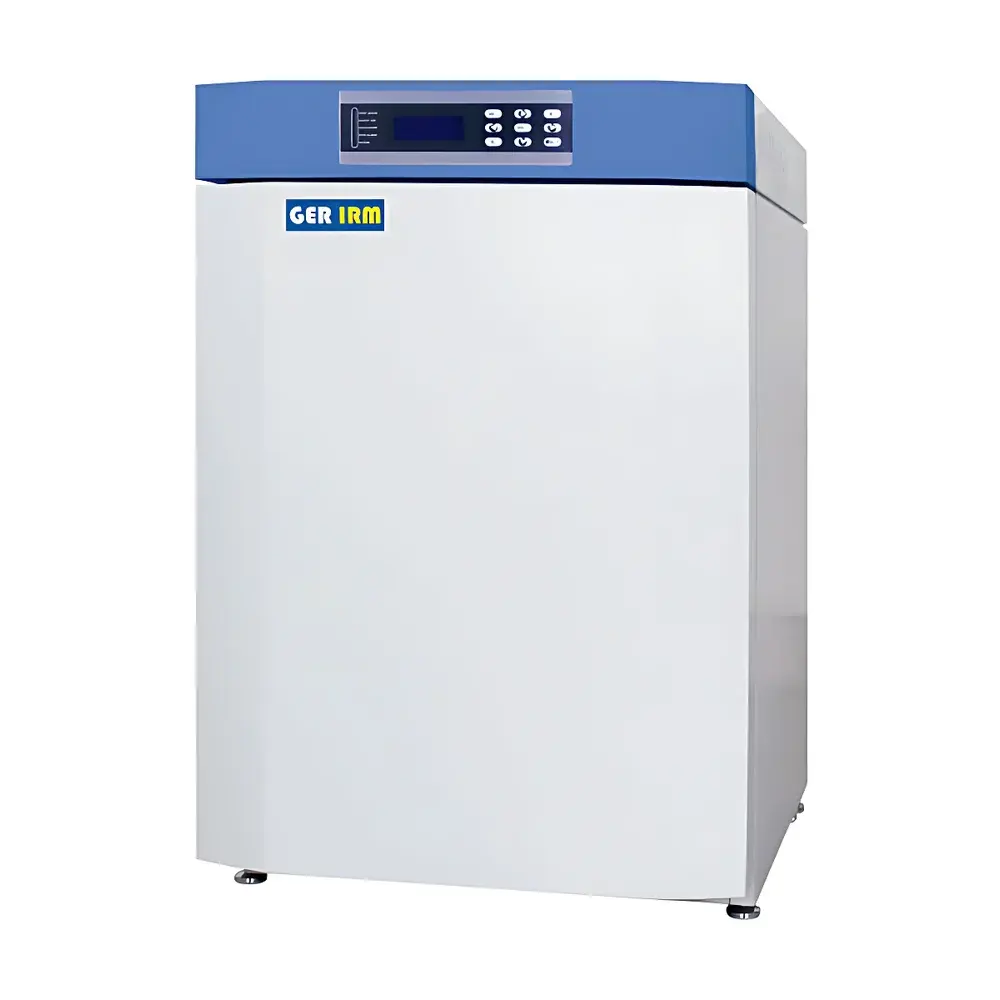
IRM ICA175 Advanced CO₂ Incubator
| Brand | IRM |
|---|---|
| Origin | Hebei, China |
| Manufacturer Type | Direct Manufacturer |
| Product Category | Domestic |
| Model | ICA175 |
| Temperature Range & Accuracy | Ambient +5°C to 60°C ±0.1°C |
| Temperature Uniformity | ±0.1°C |
| Humidity Control | 95% ±3% RH |
| Chamber Capacity | 175 L |
| CO₂ Measurement | IR Sensor (Non-Drifting, Calibration-Free) |
| CO₂ Control Accuracy | ±0.1% at 5% setpoint |
| CO₂ Recovery Rate | ~1%/min after door opening |
| Humidification Reservoir | 3 L with cover |
| Filtration | HEPA Class H14 (≥99.999% @ 0.3 µm) |
| Sterilization | Integrated UV Lamp + HEPA Recirculation |
| Interior Material | Antibacterial Copper Alloy |
| Door Configuration | Standard Right-Swing (Left-Swing Optional) |
| Power Supply | AC 220 V, 500 W |
Overview
The IRM ICA175 Advanced CO₂ Incubator is a precision-engineered, air-jacketed cell culture incubator designed for stable, contamination-controlled environments in regulated life science laboratories. It operates on the principle of active CO₂ concentration regulation via non-dispersive infrared (NDIR) sensing—ensuring drift-free, real-time measurement without periodic recalibration. The system maintains physiological conditions critical for mammalian cell culture: tightly controlled temperature (ambient +5°C to 60°C), high-humidity atmosphere (95% ±3% RH), and precise CO₂ concentration (0–20%, typically 5% for bicarbonate-buffered media). Its air-jacket architecture—combined with high-efficiency insulation, dual PT1000 temperature sensors, and intelligent PID control—delivers exceptional thermal stability (±0.1°C uniformity) and rapid recovery following door openings. The copper-alloy interior and fully rounded chamber geometry minimize microbial retention and support routine cleaning validation under GLP-compliant workflows.
Key Features
- NDIR-based CO₂ sensor (Finnish-sourced): Fast response (<30 s), zero long-term drift, no calibration required—ideal for high-throughput labs where operational continuity is essential.
- HEPA H14 recirculating filtration system: Removes ≥99.999% of airborne particles ≥0.3 µm; achieves ISO Class 5 (100-grade) cleanroom-equivalent air quality within 5 minutes of door closure.
- Antibacterial copper alloy chamber: Inherently inhibits bacterial adhesion and biofilm formation on all interior surfaces, validated per ISO 22196 for sustained antimicrobial efficacy.
- Dual-layer heated glass door (air-jacket configuration): Prevents condensation and thermal bridging, eliminating moisture accumulation that could compromise sterility or optical clarity during microscopy-based monitoring.
- 3 L covered humidification pan with rapid-recovery design: Maintains consistent humidity without introducing aerosolized contaminants; cover minimizes cross-contamination between adjacent cultures.
- UV-C germicidal lamp (254 nm): Strategically positioned to irradiate chamber walls and air plenum during unoccupied cycles—validated for >3-log reduction of common environmental isolates (e.g., Bacillus subtilis, Aspergillus niger).
- Tilt-resistant adjustable shelving: Supports load stability up to 50% drawer extension—prevents spillage of flasks and multiwell plates during routine handling.
Sample Compatibility & Compliance
The ICA175 accommodates standard T-flasks (up to T225), Petri dishes, multiwell plates (6–96-well), roller bottles, and microcarriers—compatible with both adherent and suspension culture formats. Its chamber dimensions (480 × 520 × 700 mm W×D×H) allow flexible stacking and ergonomic access. All materials in contact with the incubation environment comply with USP Class VI biocompatibility standards. The unit supports audit-ready documentation protocols: temperature and CO₂ logs are timestamped and exportable (CSV), meeting minimum requirements for FDA 21 CFR Part 11 compliance when paired with validated LIMS integration. It conforms to IEC 61010-1 (Safety Requirements for Laboratory Equipment) and EN 60335-1 (Household and Similar Electrical Appliances), with full CE marking for EU deployment.
Software & Data Management
The integrated LCD interface provides real-time visualization of chamber parameters—including temperature, CO₂ concentration, relative humidity, UV cycle status, and alarm history—with configurable thresholds and audible/visual alerts. While the base model operates without proprietary software, data logging is enabled via RS-485 or optional USB-to-serial adapter for connection to laboratory information management systems (LIMS) or SCADA platforms. Event-driven logging captures door openings, CO₂ deviations (>±0.1%), temperature excursions, and sterilization cycles—supporting traceability in GMP-aligned QC/QA environments. Audit trail functionality records user ID, timestamp, and parameter changes—aligning with ALCOA+ principles (Attributable, Legible, Contemporaneous, Original, Accurate, Complete, Consistent, Enduring, Available).
Applications
This incubator serves as a foundational platform across academic, clinical, and industrial life science domains: primary and immortalized mammalian cell line maintenance (e.g., HEK293, CHO, MCF-7); stem cell expansion under hypoxic or normoxic conditions; hybridoma culture for monoclonal antibody production; organoid and 3D scaffold-based assays; microbiological co-culture studies; vaccine development workflows (e.g., viral propagation in Vero cells); and regulatory-compliant stability testing per ICH Q5C guidelines. Its robust performance makes it suitable for ISO 13485-certified medical device manufacturing facilities and contract research organizations conducting GLP-compliant toxicology or pharmacokinetic studies.
FAQ
Is the CO₂ sensor truly calibration-free?
Yes—the NDIR sensor uses factory-trimmed optical pathlength and reference channel compensation, eliminating zero/span drift over its service life (typical MTBF >10 years). No user intervention or external gas standards are required.
How does the HEPA system achieve ISO Class 5 air quality so rapidly?
The internal blower delivers ≥60 air changes per hour through a sealed H14 filter, combined with laminar flow design and minimized dead zones—validated via particle counting per ISO 14644-1.
Can the incubator be integrated into a centralized building management system (BMS)?
Yes—via Modbus RTU (RS-485) or optional Ethernet gateway, enabling remote monitoring of alarms, setpoints, and environmental logs.
What validation support is provided for IQ/OQ/PQ protocols?
IRM supplies a comprehensive DQ/IQ/OQ template package, including test scripts, acceptance criteria aligned with ASTM E1241 and ISO 13845, and blank calibration record forms.
Is the copper alloy interior compatible with common disinfectants like 70% ethanol or hydrogen peroxide vapor?
Yes—copper surfaces retain antimicrobial activity after repeated exposure to standard lab-grade disinfectants; no degradation or patina formation observed under routine use.





