
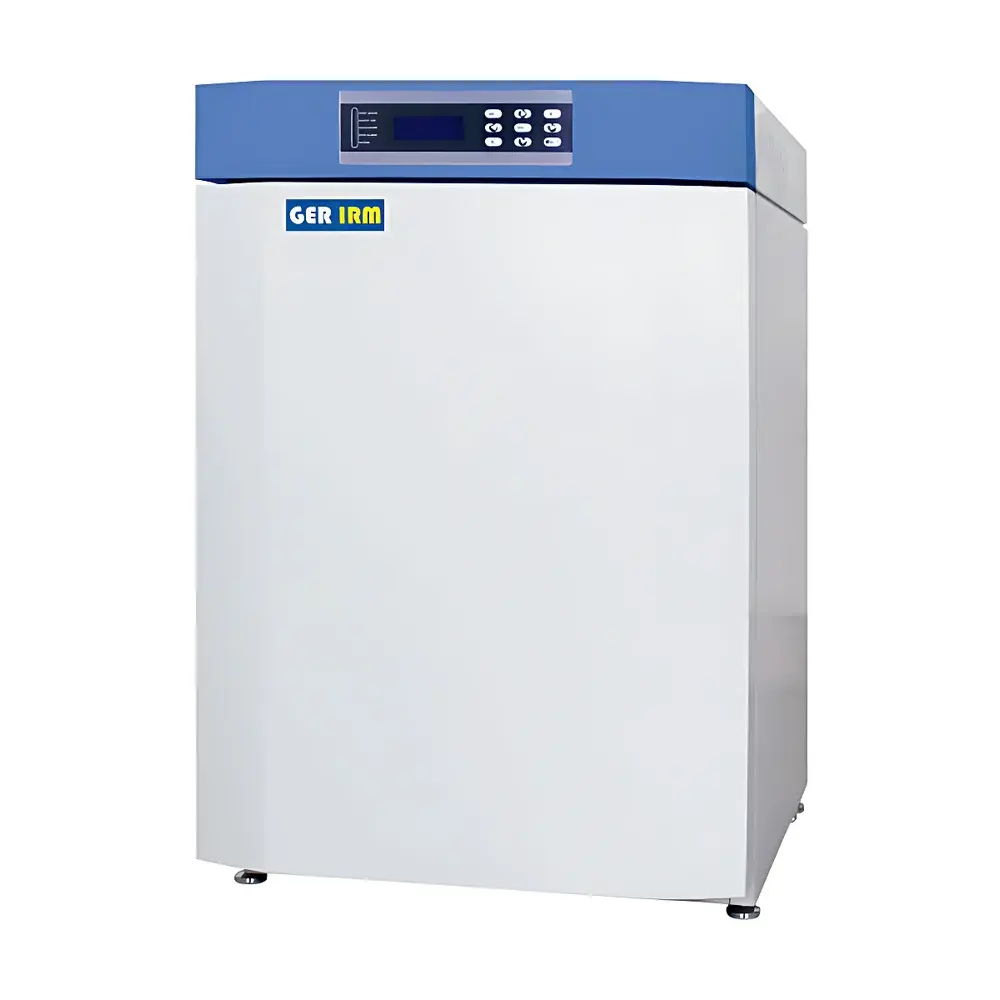
IRM ICW190 Water-Jacketed CO₂ Incubator
| Brand | IRM |
|---|---|
| Origin | Hebei, China |
| Manufacturer Type | Direct Manufacturer |
| Product Type | Water-Jacketed CO₂ Incubator |
| Model | ICW190 |
| Temperature Range | Ambient +5°C to 60°C |
| Temperature Uniformity | ±0.1°C |
| Relative Humidity Control | 95% ±3% |
| Chamber Capacity | 190 L |
| CO₂ Range | 0–20% |
| CO₂ Control Accuracy | ±0.1% (at 5% setpoint) |
| CO₂ Sensor Type | Infrared (IR-CO₂), drift-free, factory-calibrated |
| Humidification Reservoir | 3 L with cover |
| HEPA Filtration Efficiency | ≥99.999% for particles ≥0.3 µm |
| UV Sterilization Lamp | Standard |
| Internal Chamber Material | Antimicrobial Copper Alloy |
| Door Configuration | Right-hinged (left-hinge optional) |
| Power Supply | AC 220 V, 500 W |
Overview
The IRM ICW190 Water-Jacketed CO₂ Incubator is an engineered platform designed for long-term, high-fidelity cell and tissue culture under tightly controlled physiological conditions. Unlike forced-air (gas-jacketed) systems, the water-jacketed architecture provides superior thermal mass and insulation—minimizing temperature fluctuations during door openings, power interruptions, or ambient lab variations. It operates on the principle of convective heat transfer through a circulating water mantle surrounding the inner chamber, delivering exceptional thermal stability (±0.1°C uniformity) across the full 190 L working volume. The incubator maintains a physiologically relevant atmosphere via a closed-loop infrared CO₂ sensing and proportional control system—ensuring accurate, drift-free regulation between 0–20% CO₂, critical for pH stabilization in bicarbonate-buffered media. Integrated humidity management employs a 3 L covered water reservoir positioned at the chamber base, enabling rapid rehydration post-door event while preventing cross-contamination. All internal surfaces are constructed from antimicrobial copper alloy with seamless, fully rounded corners—supporting ISO 5 (Class 100) cleanroom-equivalent air quality within 5 minutes of door closure when paired with the standard HEPA filtration system.
Key Features
- Water-jacketed thermal design with dual-layer PT1000 platinum resistance sensors (Honeywell-sourced) and intelligent PID algorithm for precise, stable temperature control (ambient +5°C to 60°C)
- Finnish-imported, factory-calibrated infrared CO₂ sensor—no routine recalibration required; response time <60 seconds after door opening; recovery rate ~1% CO₂ per minute
- Standard 0.3 µm HEPA filter achieving ≥99.999% particle capture efficiency; validated to support ISO 5 (Class 100) airborne particulate levels within 5 minutes of door closure
- Antimicrobial copper alloy interior chamber with fully radiused corners—reducing microbial adhesion sites and simplifying decontamination protocols
- Dual-glass door system: inner door features integrated heating to prevent condensation; outer door includes auxiliary heating in gas-jacketed variants (not applicable to ICW190)
- Tilt-resistant adjustable shelving—maintains horizontal alignment even when extended halfway, mitigating risk of medium spillage during handling
- UV germicidal lamp (254 nm) mounted in the chamber ceiling for periodic non-chemical surface sterilization of walls and overhead surfaces
- LCD interface with real-time display of temperature, CO₂ concentration, relative humidity, and system status alerts
Sample Compatibility & Compliance
The ICW190 supports a broad spectrum of adherent and suspension cultures—including primary cells, stem cell lines, hybridomas, and bacterial strains requiring CO₂-enriched environments. Its design aligns with fundamental requirements of Good Laboratory Practice (GLP) and supports audit-readiness for GMP-regulated workflows in biopharmaceutical development. While not certified to IEC 61010-1 or ISO 13485 out-of-the-box, the unit incorporates safety-critical features such as overtemperature cutoff, CO₂ high/low alarms (user-adjustable thresholds), and door-open duration logging. Humidity and CO₂ control performance meet typical acceptance criteria outlined in ASTM E1957 (Standard Guide for Validation of CO₂ Incubators) and ISO 13408-2 (Aseptic processing of health care products—Part 2: Filtration). The HEPA filter meets EN 1822-1 H14 classification standards for high-efficiency particulate air filtration.
Software & Data Management
The ICW190 operates via embedded firmware with no external PC dependency. All operational parameters—including setpoints, alarm limits, and calibration offsets—are stored in non-volatile memory. Event logging captures timestamps for door openings, temperature excursions (>±0.3°C), CO₂ deviations (>±0.2%), and UV cycle activation. Data export is not supported via USB or network interface; however, the LCD panel provides real-time trend visualization for temperature and CO₂ over the preceding 24 hours. For laboratories requiring electronic record retention compliant with FDA 21 CFR Part 11, third-party data loggers with analog input compatibility (0–5 V or 4–20 mA) may be connected to the incubator’s analog output ports (available upon request with optional I/O module).
Applications
This incubator serves core workflows in academic research laboratories, contract research organizations (CROs), and industrial R&D facilities engaged in mammalian cell culture, vaccine development, monoclonal antibody production, regenerative medicine, and toxicology screening. It is routinely deployed in applications demanding high reproducibility across multi-day experiments—such as embryoid body formation, co-culture assays, organoid expansion, and CRISPR-edited line propagation. Its stability profile makes it suitable for sensitive applications including induced pluripotent stem cell (iPSC) maintenance, where even transient CO₂ or temperature deviations may trigger spontaneous differentiation. In clinical diagnostics and translational research settings, the ICW190 supports ex vivo expansion of dendritic cells, T lymphocytes, and mesenchymal stromal cells under cGMP-aligned environmental controls.
FAQ
Is the CO₂ sensor truly maintenance-free?
Yes—the infrared (IR) CO₂ sensor is factory-calibrated and exhibits negligible drift over its service life. No user recalibration is required under normal operating conditions.
What is the recommended maintenance schedule?
Weekly visual inspection of water jacket level and humidification reservoir; quarterly cleaning of HEPA pre-filter; annual verification of temperature and CO₂ accuracy using NIST-traceable reference instruments.
Can this incubator be integrated into a building management system (BMS)?
Not natively—but analog output signals (temperature, CO₂) can be interfaced with third-party BMS controllers via optional 0–5 V or 4–20 mA modules.
Does the unit comply with electromagnetic compatibility (EMC) directives?
It conforms to GB/T 18268.1–2010 (Chinese national standard equivalent to IEC 61326-1), covering emission and immunity requirements for laboratory equipment.
Is validation documentation available?
IRM provides a Factory Acceptance Test (FAT) report with initial temperature uniformity, CO₂ accuracy, and humidity verification data. IQ/OQ protocol templates compatible with ISO/IEC 17025 and GLP frameworks are available upon request.
Related Products




