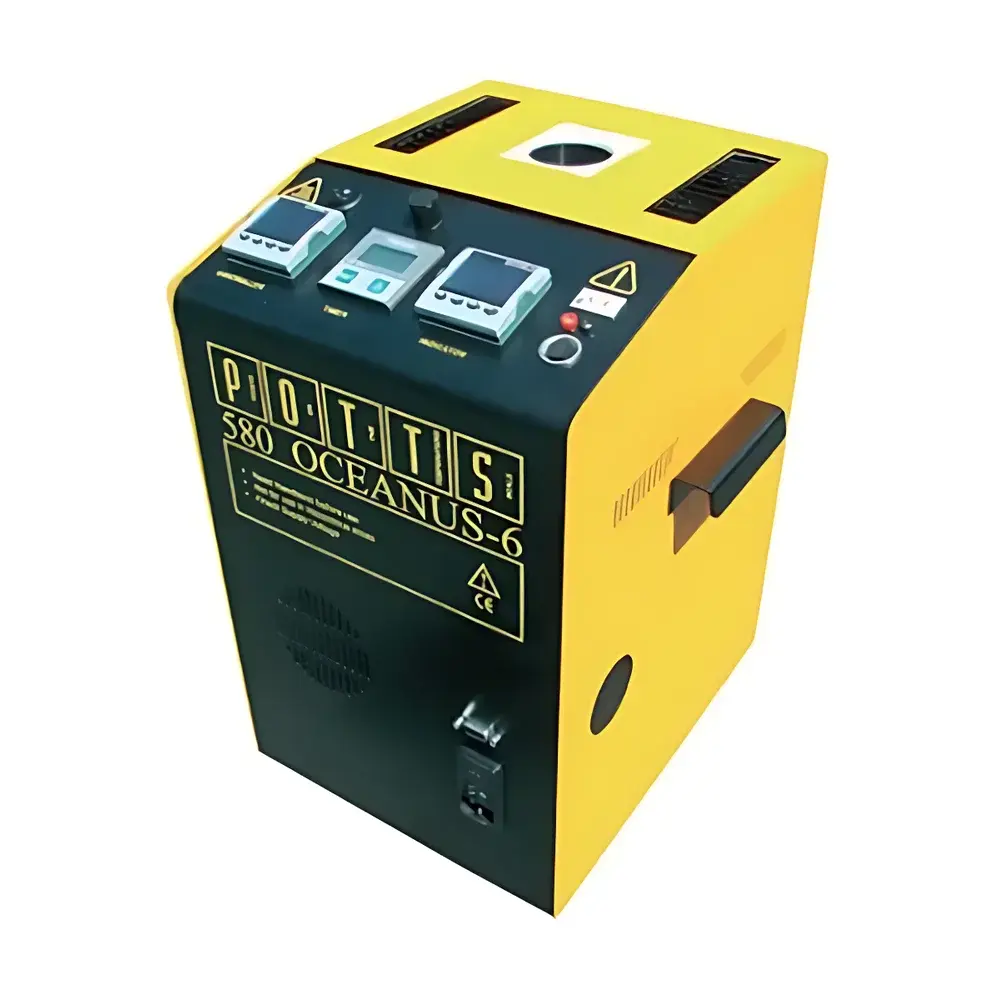
ISOTECH Model 580 Multi-Function Dry-Block Calibrator
| Brand | ISOTECH |
|---|---|
| Origin | United Kingdom |
| Model | 580 |
| Temperature Range | −25 °C to +140 °C |
| Accuracy | ±0.1 °C (standard mode), ±0.04 °C (high-stability mode) |
| Uniformity | ±0.05 °C |
| Stability (30 min) | ±0.03 °C (dry-block), ±0.025 °C (stirred liquid bath), ±0.001 °C (ice/water bath), ±0.3 °C (blackbody), ±0.5 °C (surface sensor), ±0.0002 °C (ITS-90 fixed points) |
| Calibration Well Dimensions | Ø50 mm × 300 mm depth |
| Standard Insert | 6-hole, Ø8.0 mm × 250 mm depth |
| Display Resolution | 0.01 °C (−19.99 to 99.99 °C), 0.1 °C (100.0 to 140.0 °C) |
| Communication Interface | RS232 |
| Power Supply | 208–240 V AC, 50/60 Hz, 300 W |
| Dimensions (H×W×D) | 430 × 310 × 300 mm |
| Weight | 17 kg |
| Cooling Time (20 °C → −10 °C) | 90 min |
| Heating Time (−10 °C → 80 °C) | 60 min |
| Units | °C, °F, K |
Overview
The ISOTECH Model 580 Multi-Function Dry-Block Calibrator is a metrologically rigorous, field-deployable thermal calibration platform engineered for primary and secondary temperature standard laboratories, accredited calibration service providers, and industrial quality assurance departments requiring traceable, multi-mode thermal source stability. Unlike conventional dry-well calibrators limited to solid-block operation, the Model 580 integrates six distinct thermal environments—dry-block, stirred liquid bath, ice/water triple-point bath, blackbody cavity, surface temperature simulator, and ITS-90 fixed-point realization—within a single, compact chassis. Its core architecture leverages high-thermal-mass aluminum alloy blocks with precision-machined well geometry, coupled with dual-zone PID-controlled heating/cooling elements and active ambient compensation algorithms. This enables stable, uniform thermal fields compliant with ISO/IEC 17025 requirements for uncertainty budgeting in temperature calibration workflows.
Key Features
- Multi-mode thermal source: supports dry-block calibration, stirred liquid bath (using optional glycol or ethanol), ice/water triple-point realization (−0.01 °C to +0.01 °C), blackbody cavity (for infrared thermometer validation), surface sensor simulation (via thermally conductive plate), and ITS-90 fixed-point referencing (e.g., gallium melt at 29.7646 °C)
- High-volume calibration well: Ø50 mm × 300 mm depth accommodates long-form probes (RTDs, thermocouples, PRTs) and multiple sensors simultaneously
- Two operational variants: Field Version (S) includes integrated digital indicator with external sensor input; Basic Version (B) features front-panel setpoint and block temperature display
- Thermal stability performance: ±0.03 °C over 30 minutes in dry-block mode, verified per ASTM E2877-21 Annex A2 protocols
- Enhanced uniformity: ±0.05 °C axial/radial gradient across the central 60 mm zone of the well, measured using NIST-traceable miniature PRT arrays
- Full-range 0.01 °C resolution enabled via PC software interface, supporting both manual and automated calibration sequences
Sample Compatibility & Compliance
The Model 580 accepts standard probe diameters from Ø1.5 mm to Ø8.0 mm via its supplied 6-hole insert (Ø8.0 mm × 250 mm depth), with optional inserts available for Ø3.2 mm, Ø4.8 mm, and custom geometries. It is compatible with all major sensor types—including Type T, J, K, S, R, B thermocouples; Pt100, Pt1000, and 4-wire SPRTs; thermistors; and infrared reference sources. The instrument meets IEC 61000-4 electromagnetic compatibility standards and carries CE marking under the EU Measuring Instruments Directive (MID) Annex MI-001. Its calibration methodology aligns with ISO 17025 clause 6.5.2 (equipment verification), ASTM E2877-21 (dry-well performance specification), and EURAMET cg-18 (guidelines for temperature calibrator accreditation). Traceability is maintained through factory calibration against UKAS-accredited standards at NPL-equivalent uncertainty levels.
Software & Data Management
The ISOTECH CalSoft™ PC application (Windows 10/11 compatible) provides full instrument control, automated calibration sequence execution (per ISO/IEC 17025 Annex C), real-time data logging, and uncertainty calculation per GUM (JCGM 100:2008). The RS232 interface supports bidirectional communication, enabling remote setpoint adjustment, temperature ramp profiling, and live stability monitoring. All measurement sessions generate timestamped, user-annotated CSV and PDF reports compliant with FDA 21 CFR Part 11 requirements—including electronic signatures, audit trail logging, and data integrity safeguards. Calibration certificates issued include expanded uncertainty (k=2), coverage of environmental corrections, and traceability statements linked to NPL or NIST reference standards.
Applications
- Primary laboratory verification of industrial RTDs, thermocouples, and digital thermometers prior to field deployment
- On-site calibration of process temperature sensors in pharmaceutical cleanrooms (GMP Annex 1), semiconductor fabs, and HVAC commissioning
- Validation of fixed-point cells (water triple point, gallium, indium) per ITS-90 realization protocols
- Performance testing of infrared thermometers and thermal imagers using the integrated blackbody cavity mode
- Stability assessment of temperature-controlled incubators, ovens, and environmental chambers via surface sensor simulation
- Training and proficiency testing for metrology technicians under ILAC P10 competency frameworks
FAQ
Does the Model 580 support automatic calibration reporting per ISO/IEC 17025?
Yes—the CalSoft™ software generates compliant reports with uncertainty budgets, environmental correction factors, and traceability documentation.
Can the unit be used for water triple-point cell realization?
Yes—the ice/water bath mode achieves ±0.001 °C stability over 30 minutes, meeting the requirements of ITS-90 for triple-point maintenance.
Is external cooling required for operation below 0 °C?
No—the integrated thermoelectric cooling system enables autonomous operation down to −25 °C without cryogenic fluids or external chillers.
What is the typical calibration interval recommended by ISOTECH?
Annual calibration is advised; however, users operating under ISO/IEC 17025 may establish interval based on usage frequency, stability history, and risk assessment per clause 6.5.3.
Are NIST-traceable calibration certificates included with purchase?
A factory certificate with uncertainties referenced to UKAS-accredited standards is supplied; NIST-traceable certificates are available as an optional service.