
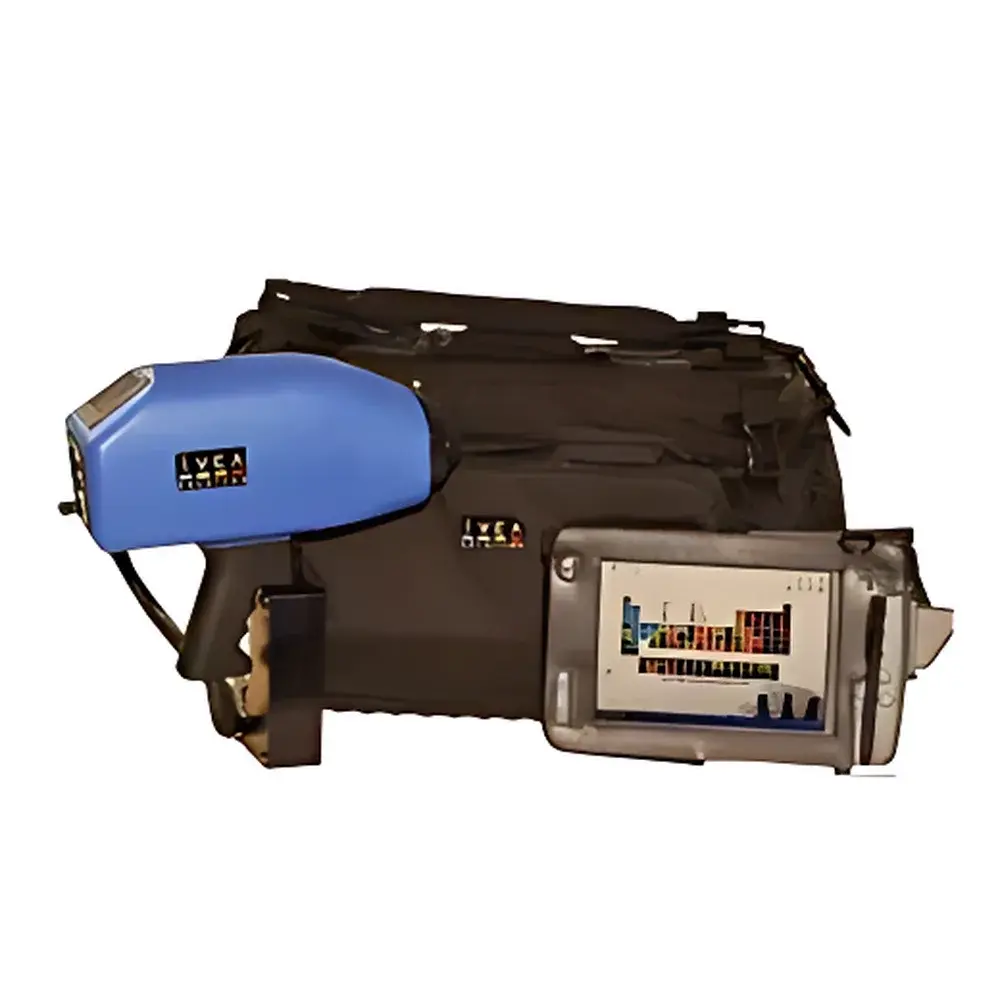
IVEA easyLIBS Handheld Laser-Induced Breakdown Spectroscopy Probe
| Brand | IVEA |
|---|---|
| Origin | France |
| Model | easyLIBS |
| Instrument Type | Handheld |
| Integration | Modular |
| Laser Source | Dual-Pulse Nd:YAG, 1064 nm |
| Spot Size | ~300 µm |
| Detection Limit | 1–500 ppm (element-dependent) |
| Weight (system with case) | <7 kg |
| Power Supply | Integrated portable battery pack |
| Software | AnaLIBS (included on dedicated laptop) |
| Optical Collection | Co-aligned laser focusing & plasma signal collection optics |
| Imaging | Built-in CMOS camera for real-time sample surface visualization |
| Fiber Spectrometer Options | User-selectable, multiple wavelength ranges available |
Overview
The IVEA easyLIBS Handheld Laser-Induced Breakdown Spectroscopy Probe is a fully integrated, field-deployable LIBS platform engineered for rapid, in-situ elemental analysis without sample preparation. It operates on the fundamental principle of laser-induced plasma spectroscopy: a high-energy, dual-pulse Nd:YAG laser (1064 nm) is focused onto the sample surface to generate a transient microplasma; emitted atomic and ionic line spectra from the cooling plasma are collected via an optimized optical path and dispersed by a user-selected miniature fiber-coupled spectrometer. The resulting spectral signatures are quantitatively interpreted using chemometric algorithms embedded in the AnaLIBS software suite. Designed for operational robustness in non-laboratory environments—including open-pit mines, scrap yards, industrial maintenance sites, and geological survey zones—the system delivers laboratory-grade qualitative and semi-quantitative elemental identification (Z ≥ 11, Na and above) with sub-millimeter spatial resolution and real-time spectral acquisition.
Key Features
- Modular handheld architecture enabling configuration flexibility: users select spectrometer modules (e.g., 190–450 nm, 250–800 nm, or extended UV-VIS-NIR ranges) to match target elements and matrix interference requirements.
- Integrated dual-path optical design: one channel delivers collimated 1064 nm laser pulses with active focus stabilization; the second co-axially collects plasma emission with high étendue efficiency (>0.1 NA), minimizing signal loss across broad spectral bands.
- Real-time visual targeting: a high-resolution CMOS camera aligned parallel to the laser axis provides live video feed of the analysis spot (300 µm diameter), allowing precise positioning on heterogeneous or irregular surfaces.
- Dual-beam laser alignment verification: two low-power pilot lasers intersect at the focal plane, providing unambiguous visual confirmation of optimal focus prior to ablation—critical for reproducibility across variable surface topographies and operator skill levels.
- Self-contained power management: rechargeable Li-ion battery pack supports ≥4 hours of continuous operation (typical duty cycle: 1–5 Hz pulse repetition, 10–30 s per measurement), eliminating dependence on external AC sources during extended field campaigns.
- Transport-optimized mechanical design: complete system—including probe head, spectrometer module, control electronics, and battery—is housed in a shock-absorbing, IP54-rated portable case weighing <7 kg, compliant with IATA carry-on regulations for air travel.
Sample Compatibility & Compliance
The easyLIBS probe accommodates solid conductive and non-conductive materials—including metals, alloys, soils, rocks, ceramics, polymers, and coated substrates—without vacuum requirements or electrical grounding. Surface roughness up to 50 µm RMS does not significantly degrade signal stability due to adaptive focus verification. While not certified for regulatory compliance testing (e.g., ASTM E2926-22 for LIBS), the system supports GLP-aligned workflows: raw spectra and metadata (laser energy, delay time, gate width, ambient temperature/humidity) are timestamped and stored in HDF5 format with immutable audit trails. Data export formats include CSV, ASCII, and .spc, compatible with third-party spectral libraries (e.g., NIST Atomic Spectra Database) and multivariate calibration tools (e.g., PLS, PCA). All firmware and AnaLIBS software revisions are version-controlled and documented per ISO/IEC 17025:2017 Annex A.2 guidelines for measurement software validation.
Software & Data Management
AnaLIBS software—pre-installed on a ruggedized Windows laptop included with each system—provides full instrument control, spectral acquisition, library matching, and quantitative calibration. Core capabilities include automatic background subtraction (iterative polynomial fitting), peak deconvolution (Voigt profile modeling), and multi-element calibration curve generation using certified reference materials (CRMs). The software enforces 21 CFR Part 11-compliant user access controls (role-based permissions), electronic signatures for report approval, and encrypted local database storage. Raw spectral data, processed results, and acquisition logs are automatically archived with SHA-256 hash integrity verification. Remote diagnostics and firmware updates are supported via secure TLS 1.3 connection; no cloud storage or telemetry is enabled by default.
Applications
- Geological field screening: rapid discrimination of ore types (e.g., Fe-, Cu-, Ni-bearing minerals), identification of rare earth element (REE) anomalies in regolith samples, and stratigraphic correlation via trace-element fingerprinting.
- Scrap metal sorting: real-time alloy grade verification (e.g., distinguishing 304 vs. 316 stainless, Ti-6Al-4V vs. CP-Ti) at recycling facilities with >95% classification accuracy under controlled conditions.
- Industrial asset integrity: coating thickness estimation (via depth profiling with sequential laser shots), corrosion product analysis on pipelines, and inclusion mapping in cast components.
- Archaeometric and cultural heritage studies: non-contact analysis of pigments, ceramics, and metallurgical artifacts where sampling is prohibited.
- Environmental site assessment: detection of heavy metals (Pb, As, Cd, Cr) in soil and sediment matrices at concentrations approaching regulatory screening levels (e.g., EPA Region 9 TCLs).
FAQ
Is the easyLIBS probe suitable for quantitative analysis?
Yes—when calibrated against matrix-matched certified reference materials and validated per ISO 17025 procedures, it achieves relative standard deviations (RSD) of ≤15% for major elements and ≤25% for trace elements (10–100 ppm range) under field conditions.
Can the system operate in direct sunlight?
The probe incorporates optical bandpass filtering and temporal gating (delay: 0.5–5 µs; integration window: 1–100 µs) to suppress ambient light interference; performance remains stable under diffuse daylight but requires shading for optimal SNR in full solar exposure.
What maintenance is required for long-term field deployment?
No consumables or routine optical alignment are needed; only periodic cleaning of the sapphire window (using spectroscopic-grade methanol) and annual verification of laser energy output and spectrometer wavelength calibration using NIST-traceable standards.
Does the system support remote data transmission?
Yes—via optional LTE/WiFi module; encrypted spectral datasets and summary reports can be transmitted to centralized LIMS or cloud-based analytical dashboards while preserving local data sovereignty per GDPR and CCPA requirements.





