
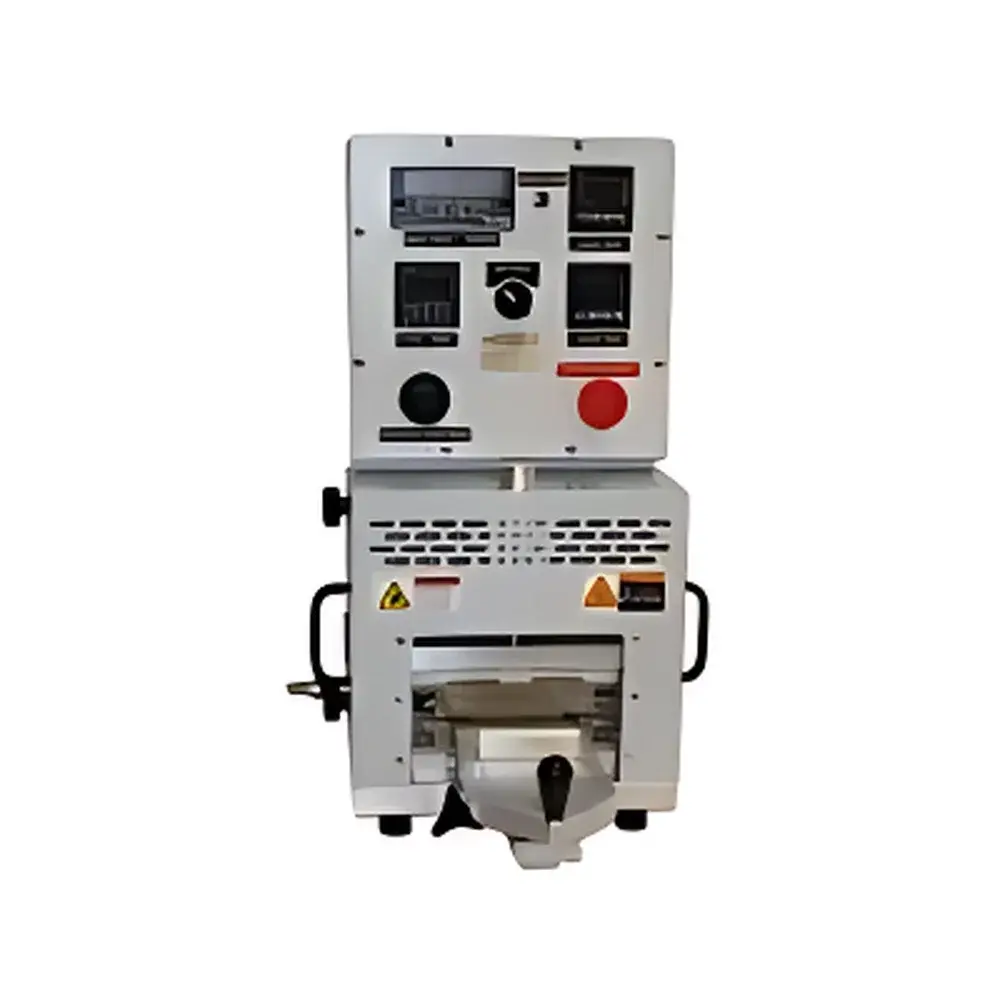
Jade Enterprise TS-4 Laboratory Heat Seal Tester
| Origin | Guangdong, China |
|---|---|
| Manufacturer Type | Authorized Distributor |
| Origin Category | Domestic (China) |
| Model | TS-4 |
| Pricing | Available Upon Request |
| Sealing Temperature Range | Ambient to 205°C (±0.1°C accuracy) |
| Sealing Pressure Range | 9–72.5 kg (20–160 lb), 0.1 kg resolution |
| Sealing Time Range | 0.1–99 s, 0.1 s resolution |
| Load Cell Capacity | 136 kg (300 lb), ±0.09 kg accuracy |
| Net Weight | 20.4 kg (45 lb) |
| Dimensions (W×D×H) | 58.4 × 50.8 × 83.8 cm (23 × 20 × 33 in) |
Overview
The Jade Enterprise TS-4 Laboratory Heat Seal Tester is an electromechanical thermal sealing instrument engineered for precise, repeatable heat seal process simulation under controlled laboratory conditions. It operates on the principle of resistive heating and pneumatic or mechanical pressure application to replicate industrial heat sealing processes—enabling standardized preparation of test specimens for subsequent seal strength evaluation (e.g., peel or tensile testing per ASTM F88 or ISO 11607-2). Unlike production-line sealers, the TS-4 provides granular control over three critical process variables: temperature, dwell time, and sealing pressure—each independently adjustable and digitally monitored. Its design adheres to the thermomechanical boundary conditions defined in ASTM F2029 (“Standard Test Method for Making Heat-Sealed Packages for Test Specimens”) and QB/T 2358 (“Plastic Films—Heat Seal Strength Test Method”), ensuring methodological consistency across quality control, R&D, and regulatory validation workflows in flexible packaging development.
Key Features
- Precision digital temperature control with ±0.1°C accuracy across a 0–205°C range, achieved via calibrated platinum RTD sensor and PID-regulated heating elements;
- High-resolution pressure actuation system with 0.1 kg resolution and full-scale range of 9–72.5 kg, enabling reproducible force application independent of operator technique;
- Programmable dwell time from 0.1 s to 99 s in 0.1 s increments, synchronized with pressure and temperature activation to eliminate timing drift;
- Integrated high-capacity load cell (136 kg / 300 lb capacity, ±0.09 kg accuracy) directly measures actual compressive force applied to the specimen during sealing—not inferred from air pressure or mechanical settings;
- Stainless-steel sealing bar and anvil assembly with uniform thermal mass distribution to minimize edge effects and ensure consistent heat transfer across the seal interface;
- Compact benchtop footprint (58.4 × 50.8 × 83.8 cm) and 20.4 kg weight optimized for integration into ISO/IEC 17025-accredited QC labs without requiring dedicated floor space or structural reinforcement.
Sample Compatibility & Compliance
The TS-4 accommodates a broad spectrum of flexible substrates—including polyethylene (PE), polypropylene (PP), polyester (PET), aluminum foil laminates, metallized films, and nonwoven medical packaging materials—within standard specimen widths up to 150 mm. Seal width is configurable via interchangeable sealing bars (standard 10 mm width; optional 5 mm and 25 mm bars available). All operational parameters are traceable to NIST-traceable calibration standards. The instrument satisfies mandatory requirements for method validation under ISO 11607-1 (Packaging for terminally sterilized medical devices) and supports audit readiness for FDA 21 CFR Part 820 (Quality System Regulation) and EU MDR Annex I GSPRs. Data outputs comply with GLP documentation standards when paired with validated software (see Software & Data Management).
Software & Data Management
While the TS-4 operates as a standalone instrument with local LCD interface, it supports RS-232 or USB-to-serial connectivity for integration with LIMS or custom QA platforms. Optional JadeLink™ PC software (v3.2+) enables automated parameter logging, real-time graphing of temperature/pressure/time profiles, electronic signature capture, and export of CSV/Excel reports compliant with 21 CFR Part 11 requirements—including audit trail generation, user access controls, and data integrity safeguards. Calibration certificates include uncertainty budgets per ISO/IEC 17025:2017 Annex A.3, and firmware updates are version-controlled and documented for change management compliance.
Applications
- Optimization of heat seal initiation temperature (HST) and hot tack profiles during film formulation;
- Validation of seal integrity for sterile barrier systems in Class 7/8 cleanroom-packaged medical devices;
- Comparative assessment of seal strength across laminate structures (e.g., PET/AL/PE vs. PP/PE) under accelerated aging conditions;
- Root cause analysis of seal failures (leak paths, delamination, scorching) by isolating individual process variable contributions;
- Supporting shelf-life studies per ISO 11607-2 Annex B, where seal performance must be verified after accelerated or real-time aging;
- Training and SOP development for packaging line technicians using lab-scale process replication prior to pilot trials.
FAQ
Does the TS-4 meet ASTM F2029 requirements for seal specimen preparation?
Yes—the TS-4 implements all mandatory procedural controls specified in ASTM F2029, including independent verification of sealing temperature, pressure, and dwell time, with documented traceability to national standards.
Can the instrument be calibrated in-house, or is third-party certification required?
The TS-4 includes user-accessible calibration routines for temperature and pressure; however, initial factory calibration and annual verification must be performed by an ISO/IEC 17025-accredited laboratory to maintain compliance with ISO 9001 and medical device QMS requirements.
Is the sealing bar temperature uniformity validated across its length?
Yes—uniformity is verified per ASTM E220 at five points along the bar axis, with maximum deviation ≤ ±1.5°C at 121°C and ≤ ±2.0°C at 205°C, as documented in the Certificate of Conformance supplied with each unit.
What maintenance intervals are recommended for long-term measurement stability?
Load cell zero-point verification every 200 cycles; thermal sensor calibration annually or after 500 operating hours; sealing bar surface inspection and cleaning after each use to prevent polymer buildup that may affect heat transfer.



