
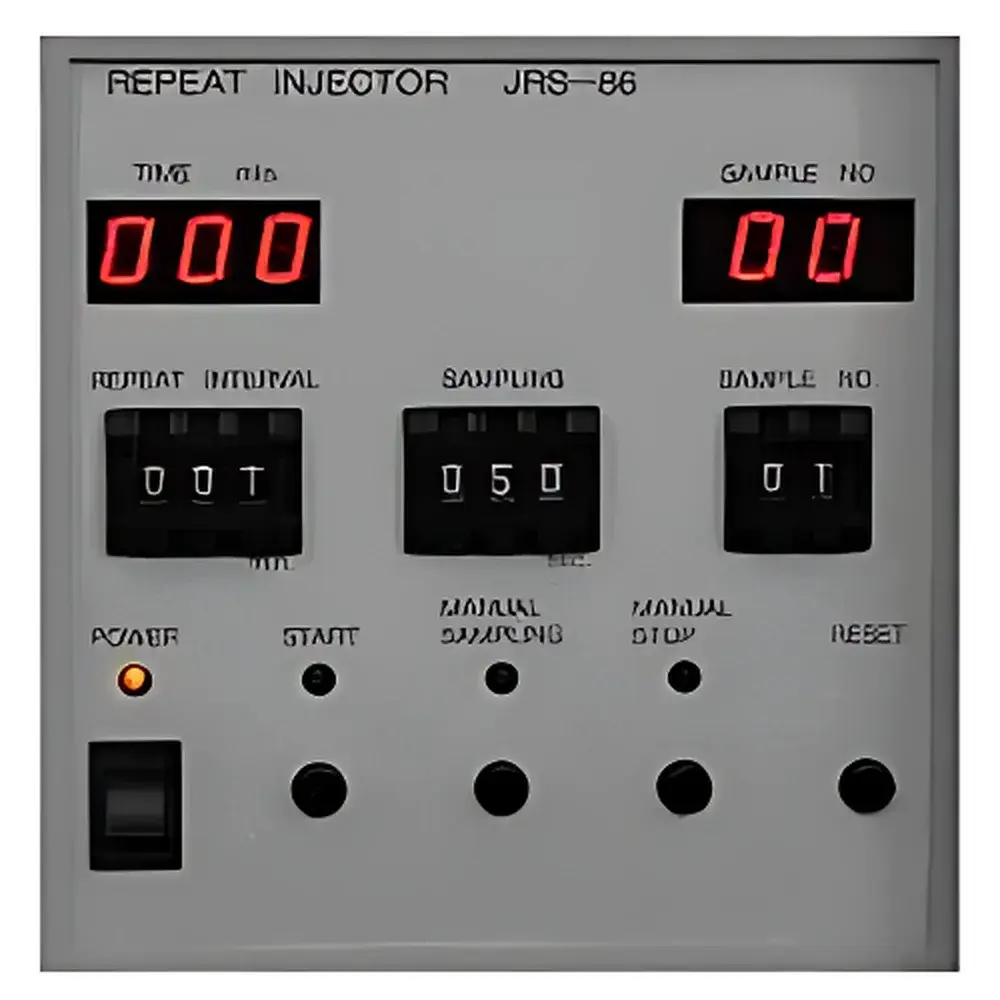
JAI JRS-86 Multifunctional Autosampler for Recirculating Preparative HPLC Systems
| Brand | JAI |
|---|---|
| Origin | Japan |
| Model | JRS-86 |
| Control System | CPU-controlled |
| Sample Injection Volume Range | 100 µL to 50 mL |
| Injection Interval | 1–999 minutes |
| Maximum Number of Repetitive Injections | 99 |
| Compatible Systems | Integrated with JAI 9102 and 9103 Recirculating Preparative HPLC Units |
| Configuration | Rack-mounted, in-line installation at pump suction side |
Overview
The JAI JRS-86 Multifunctional Autosampler is an engineered solution designed specifically for automated, high-fidelity repetitive sample introduction in recirculating preparative high-performance liquid chromatography (HPLC) workflows. Unlike conventional autosamplers intended for analytical-scale injections, the JRS-86 operates upstream of the preparative pump—directly at the suction side—enabling precise metering and sequential reintroduction of the same sample loop into the recirculation circuit. This architecture supports iterative fraction enrichment, on-column concentration optimization, and method development requiring controlled temporal spacing between identical injections. Its integration with the JAI 9102 and 9103 preparative HPLC platforms ensures mechanical and timing synchronization with high-pressure gradient delivery, minimizing dwell volume effects and preserving system backpressure stability during repeated aspiration-injection cycles.
Key Features
- CPU-based real-time control logic for deterministic injection sequencing, with non-volatile memory retention of user-defined protocols across power cycles.
- Wide dynamic injection volume range (100 µL to 50 mL), achieved via programmable syringe displacement and calibrated valve actuation—suitable for both microfractionation and bulk loading applications.
- Adjustable inter-injection interval (1–999 minutes), enabling kinetic studies, solvent equilibration monitoring, or timed re-injection under evolving column conditions.
- Dedicated mechanical interface for seamless rack-mount installation within the JAI 9102/9103 chassis, maintaining ISO 13485-aligned alignment tolerances and leak-tight fluid path integrity.
- Pressure-compensated aspiration module minimizes pulsation-induced volume deviation during low-flow recirculation modes, ensuring ≤±1.5% volumetric reproducibility per injection (per JAI internal validation protocol).
Sample Compatibility & Compliance
The JRS-86 accommodates standard 12×75 mm, 16×100 mm, and 20×120 mm glass or polypropylene vials without adapter modification. It supports aqueous, organic, and mixed-solvent matrices compatible with JAI’s PEEK- and sapphire-wetted components. The device complies with IEC 61000-6-2 (EMC immunity) and IEC 61000-6-4 (EMC emission) standards. When deployed in regulated environments—including GLP-compliant natural product isolation labs or GMP-aligned API purification suites—the JRS-86 supports audit-ready operation when paired with JAI’s optional 21 CFR Part 11–compliant software suite (requiring external PC host with time-stamped electronic signatures and immutable event logs).
Software & Data Management
Control is executed via JAI’s proprietary ChromoLink™ firmware (v3.2+), accessible through a dedicated RS-232/USB-C interface. No embedded touchscreen or local GUI is provided; all configuration occurs remotely via host PC using ASCII command protocol (documented in JAI Technical Manual TM-JRS86-REV4). Injection sequences, volume calibrations, and error logs are stored in non-volatile EEPROM with timestamped CRC-32 checksums. Raw execution data—including actual injection timestamps, detected pressure transients, and valve cycle counts—is exportable as CSV for third-party LIMS integration or statistical process control (SPC) analysis. Firmware updates require signed binary files authenticated against JAI’s public key infrastructure.
Applications
- Iterative sample reinjection for preparative chiral resolution where enantiomeric excess improves with repeated passage through the same chiral column.
- On-column concentration enhancement in trace analyte isolation, particularly for thermally labile natural products where evaporation-based concentration is undesirable.
- Method robustness testing under variable residence time conditions—e.g., assessing column fouling kinetics or mobile phase degradation over extended recirculation periods.
- Automated generation of concentration-response curves in preparative bioaffinity chromatography, using fixed-volume reinjection at logarithmically spaced intervals.
- Support for ISO 17025-accredited reference material production, where repeatability of mass-on-column must be demonstrated across ≥99 consecutive injections.
FAQ
Can the JRS-86 operate independently of the JAI 9102/9103 systems?
No. The JRS-86 lacks standalone pump drivers or high-pressure fluid handling capability. It functions exclusively as a synchronized peripheral module, relying on the host system’s pressure feedback loop and timing bus for trigger coordination.
Is calibration traceable to NIST or JCSS standards?
Volumetric calibration certificates (traceable to JCSS Class A standards) are available upon request for individual units; however, field recalibration requires JAI-certified service personnel and proprietary flow verification fixtures.
What maintenance intervals are recommended for long-term recirculation use?
Syringe seal inspection every 500 injection cycles; rotor seal replacement every 2,000 cycles or annually—whichever occurs first—using JAI OEM part #JRS86-SEAL-KIT-01.
Does the JRS-86 support partial-loop injection mode?
No. It operates exclusively in full-loop fill-and-displace mode to ensure consistent dwell volume and avoid carryover in high-concentration preparative workflows.
Can injection parameters be modified mid-sequence?
Yes—via real-time ASCII command override—but doing so invalidates the original sequence audit trail and triggers a new log file generation per 21 CFR Part 11 requirements.



