
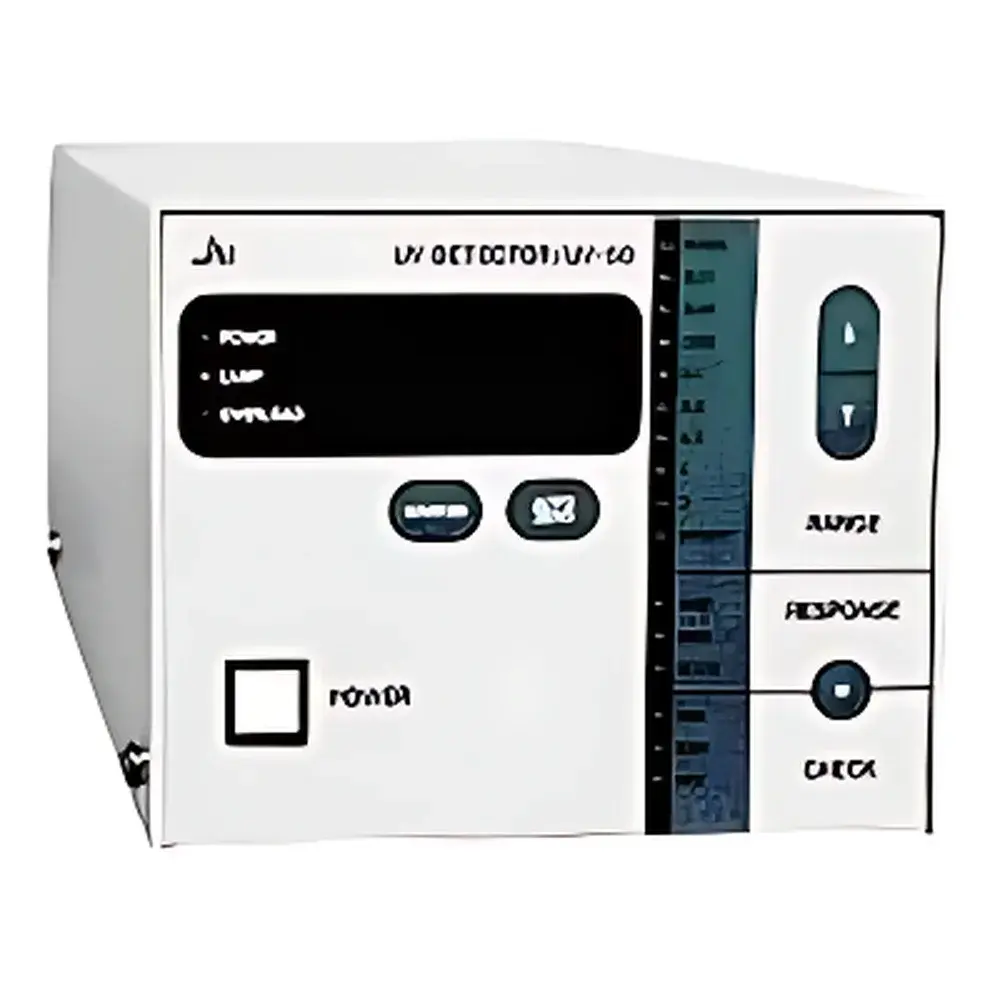
JAI UV-50 Selectable-Wavelength Ultraviolet Detector
| Brand | JAI |
|---|---|
| Origin | Japan |
| Manufacturer Type | Authorized Distributor |
| Product Origin | Imported |
| Model | UV-50 |
| Instrument Type | Ultraviolet Detector (UVD) |
| Wavelength Range | 200–380 nm (selectable via interchangeable interference filters) |
| Standard Wavelength | 254 nm |
| Detection Method | Dual-Beam Filter Photometry |
| Light Source | Deuterium Lamp |
| Noise | ≤0.00005 AU |
| Drift | ≤0.002 AU/hr |
| Flow Cell Path Length | 0.5 mm (standard), optional 0.2 mm or 1.0 mm |
| Flow Cell Volume | 20 µL |
| Saturation Concentration | 4% (at 0.5 mm path length) |
| Output Signals | 100 mV and 10 mV full-scale analog outputs |
| Zero Adjustment | Automatic |
| Dimensions (W×H×D) | 150 × 120 × 420 mm |
| Power Supply | AC 85–135 V, 50/60 Hz, 100 VA |
| Weight | 8 kg |
Overview
The JAI UV-50 Selectable-Wavelength Ultraviolet Detector is a precision optical detection module engineered for integration into high-performance liquid chromatography (HPLC) systems—specifically designed to operate within the LC-9200 series instrument chassis. It employs dual-beam filter photometry with a stable deuterium lamp as its broadband UV source, enabling reliable absorbance measurements across a tunable spectral range of 200–380 nm. Wavelength selection is achieved through mechanically interchangeable interference filters, with 254 nm serving as the default analytical wavelength optimized for aromatic compounds, nucleic acids, and many pharmaceutical actives. Unlike fixed-wavelength detectors, the UV-50 supports method flexibility without requiring hardware replacement—users simply install the appropriate filter to match application-specific absorption maxima. Its compact footprint and internal mounting architecture minimize optical path variability and thermal drift, supporting reproducible quantitation in regulated laboratory environments.
Key Features
- Dual-beam optical design compensates for lamp intensity fluctuations and solvent baseline shifts, enhancing long-term signal stability.
- Interchangeable interference filters allow discrete wavelength selection from 200 nm to 380 nm—ideal for method development and multi-analyte detection.
- Low-noise electronics deliver ≤0.00005 AU RMS noise and ≤0.002 AU/hr baseline drift—meeting sensitivity requirements for trace-level quantification per ICH Q2(R2) guidelines.
- Modular flow cell options (0.2 mm, 0.5 mm, and 1.0 mm path lengths) permit optimization of sensitivity versus linear dynamic range; standard 20 µL volume ensures compatibility with standard 4.6 mm ID analytical columns.
- Automatic zero adjustment eliminates manual baseline offset calibration, reducing operator dependency and improving inter-day consistency.
- Two analog output ranges (10 mV and 100 mV full scale) support seamless interfacing with legacy chart recorders, data acquisition systems, or modern chromatography data systems (CDS).
Sample Compatibility & Compliance
The UV-50 is compatible with common HPLC mobile phases including aqueous buffers, acetonitrile, methanol, and tetrahydrofuran—provided they exhibit adequate UV transparency at the selected wavelength. Its 0.5 mm path-length cell achieves a saturation concentration of 4% (w/v) for typical UV-absorbing solutes, ensuring linearity over three orders of magnitude under standard conditions. The detector complies with fundamental electromagnetic compatibility (EMC) requirements per IEC 61326-1 and meets electrical safety standards per IEC 61010-1. While not inherently 21 CFR Part 11–compliant (as it lacks embedded audit trail or electronic signature functionality), its analog outputs are fully compatible with validated CDS platforms that enforce ALCOA+ data integrity principles. It is routinely deployed in GLP-compliant environmental testing labs and QC laboratories supporting USP , EP 2.2.46, and JP 2.07 chromatographic methods.
Software & Data Management
As a standalone analog detector, the UV-50 does not incorporate onboard firmware, display, or digital communication interfaces (e.g., USB, RS-232, or Ethernet). All signal processing, peak integration, and calibration occur externally within the host chromatography data system. Its dual-range analog outputs ensure compatibility with both legacy integrators and modern CDS platforms—including Thermo Chromeleon, Waters Empower, Agilent OpenLab CDS, and Shimadzu LabSolutions. When integrated into a validated workflow, raw voltage signals are digitized at ≥16-bit resolution and timestamped by the CDS, enabling full traceability per FDA expectations for electronic records. Audit trails, user access controls, and electronic signatures must be implemented at the CDS level—not the detector itself.
Applications
- Pharmaceutical QC testing of active pharmaceutical ingredients (APIs) and excipients per USP monographs requiring UV detection at 254 nm or alternate wavelengths.
- Environmental analysis of polycyclic aromatic hydrocarbons (PAHs), phenols, and nitroaromatics using EPA Method 8330B and related protocols.
- Food and beverage quality control—quantification of preservatives (e.g., benzoic acid, sorbic acid), antioxidants (e.g., BHT), and natural pigments (e.g., anthocyanins).
- Academic and industrial research involving method scouting for unknown compounds where absorbance maxima are not pre-established.
- Stability-indicating assays where selectivity is enhanced by tuning detection wavelength away from degradation product overlap.
FAQ
Can the UV-50 be used with UHPLC systems?
Yes—provided the flow cell is rated for the system’s maximum backpressure and dwell volume constraints are respected. The standard 20 µL cell is suitable for flow rates up to 2 mL/min; low-volume alternatives (e.g., 0.2 mm path length) reduce extra-column dispersion for sub-2 µm particle applications.
Is the deuterium lamp user-replaceable?
Yes—the lamp is accessible via a front-panel service door and features standardized socket alignment; lamp lifetime is typically 1,000–2,000 hours depending on duty cycle and warm-up protocols.
Does the detector support gradient compensation?
No—it performs no real-time solvent correction. Baseline stability during gradients relies on the dual-beam architecture and proper mobile phase degassing; post-run baseline subtraction may be applied in the CDS.
What calibration standards are recommended?
NIST-traceable potassium dichromate solutions in 0.005 M H₂SO₄ are recommended for wavelength accuracy verification; caffeine or uracil solutions are commonly used for sensitivity and linearity checks per USP .




