
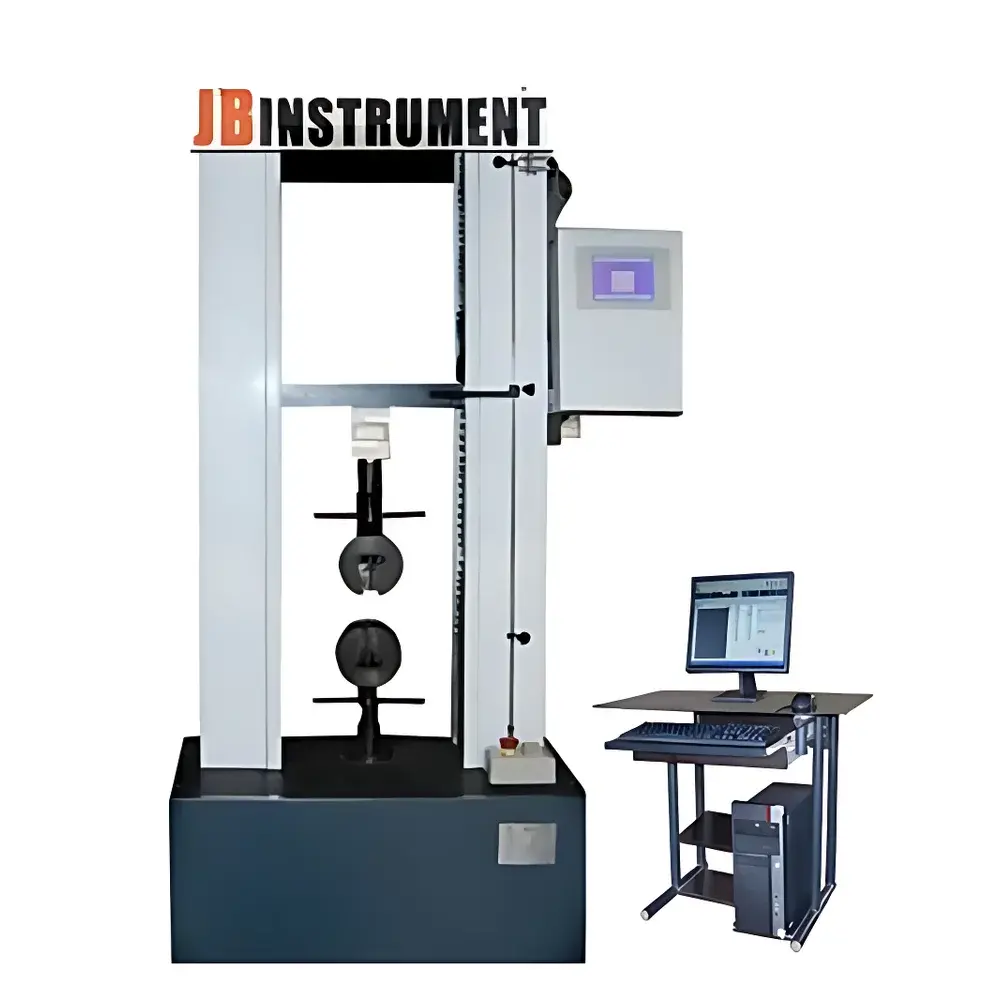
JB-117B Universal Testing Machine by Jiubin Instruments
| Key | Max Test Load: 20 kN |
|---|---|
| Accuracy Class | ISO 7500-1 Class 1 |
| Speed Range | 1–500 mm/min |
| Effective Stroke | ~900 mm |
| Load Resolution | 0.001 N |
| Load Accuracy | ±0.01% FS |
| Displacement Resolution | ±0.005% (JIS-compliant encoder) |
| Control System | Full-digital triple-closed-loop (force, displacement, strain) with adaptive PID algorithm |
| Data Acquisition | 1/300,000 internal resolution, auto-ranging |
| Compliance | ASTM E4, ASTM E8, ISO 6892-1, GB/T 228.1, EN 10002-1 |
| Software | Windows-based, bilingual (EN/CN), CFR Part 11-ready audit trail & user permission management |
| Interface | USB-standard I/O, dual-display mode (touchscreen + PC) |
| Power | 220 V AC |
| Weight | 270 kg |
| Dimensions (W×D×H) | 900 × 400 × 1600 mm |
Overview
The JB-117B Universal Testing Machine by Jiubin Instruments is a precision-engineered electromechanical system designed for static mechanical characterization of metallic and non-metallic materials under uniaxial loading conditions. It operates on the fundamental principle of controlled force application via servo-controlled AC motor actuation, coupled with high-fidelity real-time measurement of load (via calibrated S-type or beam-type load cell), axial displacement (via optical rotary encoder with 1000 P/R resolution), and specimen deformation (optional extensometer input). The machine conforms to internationally recognized calibration and performance standards—including ISO 7500-1 Class 1 accuracy for force measurement, ASTM E4 for verification of force-measuring instruments, and ISO 6892-1 for tensile testing of metallic materials—ensuring traceable, repeatable, and auditable test results suitable for quality control, R&D validation, and regulatory submission environments.
Key Features
- Triple-closed-loop digital control architecture supporting simultaneous, seamless switching between force-, displacement-, and strain-controlled test modes without mechanical or software-induced discontinuities.
- Adaptive neural network–based PID tuning algorithm ensures stable regulation across wide dynamic ranges—from sub-newton preload initiation to full-scale 20 kN loading—minimizing overshoot and settling time.
- High-resolution data acquisition system with 1/300,000 internal count resolution and auto-ranging capability delivers consistent signal fidelity across all capacity segments (e.g., 10 kN and 20 kN configurations).
- Dual-display operation: Independent touchscreen interface for standalone testing and full-featured Windows-based software for advanced analysis, report generation, and long-term data archival.
- Comprehensive safety subsystems including programmable upper/lower travel limits, overload emergency stop, leakage current protection, and automatic return-to-initial-position post-test.
- Configurable test parameter sets with password-protected access levels, decimal precision selection (2–3 digits), and unit flexibility (N, kN, lbf, kgf, etc.) aligned with regional metrological conventions.
Sample Compatibility & Compliance
The JB-117B accommodates a broad spectrum of standardized and custom geometries—from ASTM D638 Type I dog-bone specimens and ISO 527-2 multipurpose bars to wire, fiber, thin films, and composite laminates. Its modular grip system supports wedge-action, pneumatic, hydraulic, and specialized fixtures (e.g., peel, shear, bending, and compression platens), enabling compliance with ASTM D882 (thin plastic film), ASTM D3039 (composite tensile), ISO 179 (Charpy impact pre-conditioning), and GB/T 1040 series. All firmware and software modules are structured to support GLP/GMP-aligned workflows, including electronic signatures, audit trail logging per FDA 21 CFR Part 11 requirements, and version-controlled test method templates.
Software & Data Management
The bundled Windows application provides ISO/IEC 17025–compatible data handling: automated calculation of tensile strength, yield point (upper/lower), Young’s modulus, elongation at break, Poisson’s ratio (with biaxial extensometry), peel adhesion energy, and cyclic hysteresis metrics. Raw time-stamped datasets (load, displacement, strain) are stored in vendor-neutral CSV and XML formats; proprietary .JBT project files retain full metadata—including operator ID, environmental conditions, calibration history, and instrument configuration snapshots. Backup policies allow scheduled archiving to network drives or NAS endpoints. Report outputs comply with ISO/IEC 17025 Annex A.1 formatting rules and support bilingual (English/Chinese) generation with configurable header/footer branding.
Applications
This system serves as a primary mechanical test platform in QC laboratories across automotive component suppliers (e.g., seat belt webbing, brake hose tensile integrity), medical device manufacturers (catheter shaft stiffness, suture tensile strength), packaging R&D (peel strength of laminated pouches, puncture resistance of blister foils), and academic materials science departments (nanocomposite reinforcement efficiency, biopolymer viscoelastic transitions). Its 1–500 mm/min speed range and <0.01% full-scale load accuracy make it equally suitable for quasi-static ductility assessment and controlled-rate creep/stress-relaxation profiling—provided auxiliary environmental chambers or extensometers are integrated.
FAQ
What international standards does the JB-117B validate against?
It meets ISO 7500-1 Class 1 for force measurement accuracy, ASTM E4 for verification, and supports test protocols defined in ASTM E8, ISO 6892-1, EN 10002-1, and GB/T 228.1.
Is the system compliant with FDA 21 CFR Part 11?
Yes—the software includes role-based user authentication, electronic signature capture, immutable audit trails, and secure data export functions required for regulated life sciences applications.
Can third-party extensometers be connected?
Yes, the system provides analog and digital input channels compatible with LVDT, clip-on, and video extensometers meeting ASTM E83 Class B-1 specifications.
What is the calibration interval recommendation?
Annual verification against traceable deadweight standards is advised; internal self-calibration routines and daily verification checks using certified reference loads are supported.
Does the machine support cyclic or fatigue testing?
While optimized for static tests, it supports low-cycle tension-compression sequences up to 10 Hz when paired with optional high-speed servo drivers and dedicated fatigue software modules.



