
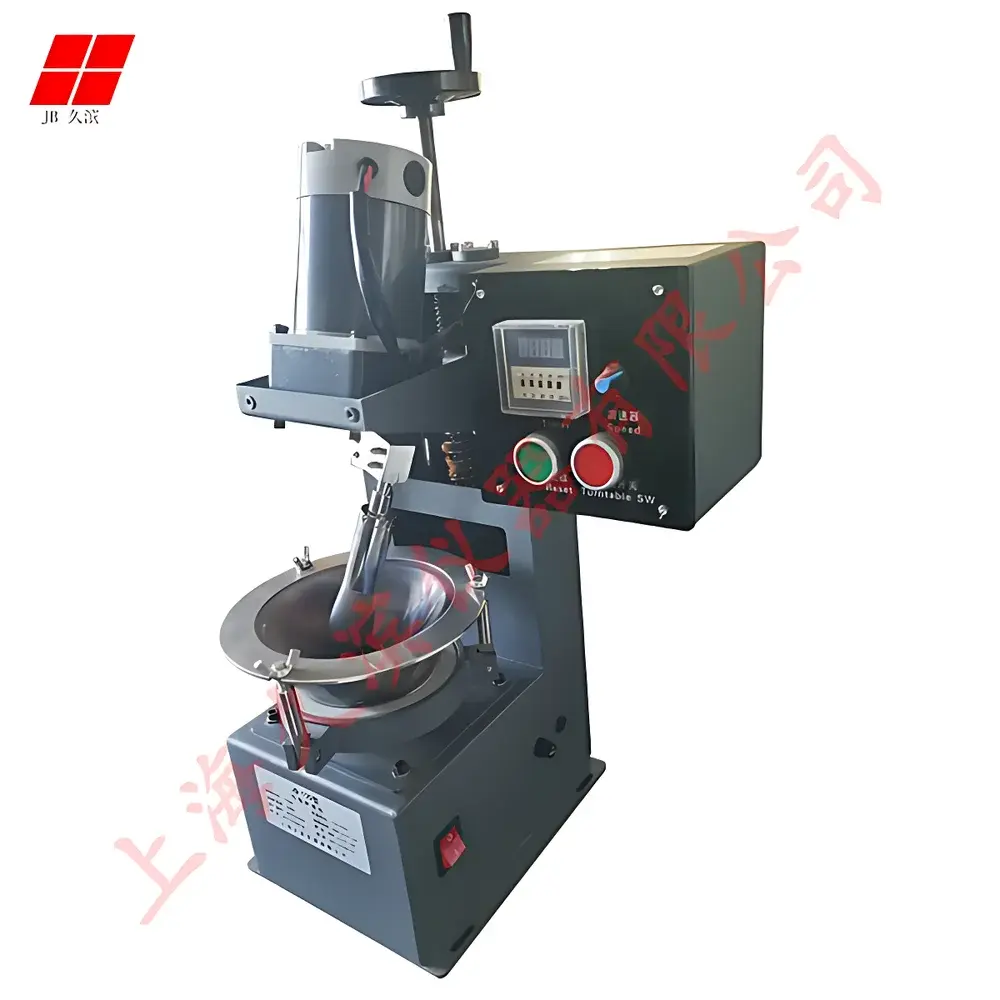
JB-120 Benchtop Agate Mortar Grinder by Jiubin Instruments
| Brand | Jiubin Instruments |
|---|---|
| Model | JB-120 |
| Grinding Bowl Diameter | 120 mm |
| Batch Capacity | 100 g per cycle |
| Pestle Rotation Speed | 1–100 rpm (adjustable) |
| Mortar Rotation Speed | 10 rpm |
| Pestle Motor Power | 25 W |
| Mortar Motor Power | 10 W |
| Grinding Time Range | 1–999 min (programmable) |
| Dimensions (L×W×H) | 310 × 240 × 580 mm |
| Weight | 18 kg |
| Voltage | 220 V, 50/60 Hz |
| Bowl & Pestle Material | Natural Agate |
| Origin | Shanghai, China |
| Equipment Type | Laboratory Mortar Grinder |
Overview
The JB-120 Benchtop Agate Mortar Grinder is an electromechanical laboratory grinding system engineered for controlled, reproducible size reduction of brittle, medium-hard, and soft solid materials. It operates on the principle of coaxial conical碾压 (conical compression grinding), where a precisely aligned agate pestle rotates along a shallow conical trajectory while the agate mortar rotates slowly in the opposite direction. This dual-motion geometry generates uniform compressive shear forces across the entire sample bed—eliminating localized hotspots and minimizing thermal degradation or amorphization common in high-energy ball milling. Unlike planetary or vibratory mills, the JB-120 delivers gentle yet effective comminution ideal for heat-sensitive pigments, pharmaceutical excipients, and analytical reference standards requiring minimal structural alteration. Its design conforms to fundamental principles of mechanical alloying and particle size control defined in ISO 13320 (laser diffraction) and ASTM D5231 (particle size analysis of pigments), serving as a pre-processing step prior to dispersion stability testing or spectroscopic characterization.
Key Features
- High-purity natural agate grinding components—chemically inert, non-contaminating, and resistant to acid/alkali corrosion, ensuring sample integrity for trace-level analysis.
- Independent speed control: pestle rotation adjustable from 1 to 100 rpm; mortar rotation fixed at 10 rpm for optimized force coupling and consistent shear rate.
- Programmable grinding duration (1–999 minutes) with automatic shutdown and audible completion signal—enabling unattended operation under GLP-compliant workflows.
- Ergonomic benchtop footprint (310 × 240 × 580 mm) and low operational noise (<65 dB(A)) suitable for shared lab environments and QC laboratories.
- Spring-loaded pestle head ensures constant contact pressure against the hemispherical mortar base—maintaining uniform grinding force regardless of sample volume or density variation.
- Low-power consumption architecture (25 W pestle + 10 W mortar motor) supports continuous duty cycles without thermal throttling or motor fatigue.
Sample Compatibility & Compliance
The JB-120 is validated for use with inorganic oxides (e.g., TiO₂, Al₂O₃, SiO₂), organic pigments (e.g., phthalocyanines, quinacridones), carbon-based materials (carbon black, graphite), and pharmaceutical APIs or excipients requiring micronization without polymorphic transition. It accommodates samples with initial particle sizes up to 2 mm and viscosities up to 50 Pa·s when pre-mixed with dispersants. All mechanical interfaces comply with IEC 61000-6-2 (immunity) and IEC 61000-6-4 (emission) standards. The unit meets CE marking requirements for laboratory equipment and supports audit-ready documentation for FDA 21 CFR Part 11–aligned SOPs when integrated with timestamped electronic logs.
Software & Data Management
While the JB-120 operates via a dedicated front-panel keypad interface, its programmable parameters—including runtime, pestle speed, and start/stop sequences—are fully recordable via optional RS-232 or USB-to-serial adapter (sold separately). When connected to laboratory information management systems (LIMS), it supports CSV export of session metadata (date/time stamp, operator ID, batch ID, parameter set) for traceability. No proprietary software is required; configuration files are human-readable plain-text and compatible with standard validation protocols under ISO/IEC 17025 and GMP Annex 11.
Applications
- Pigment dispersion preparation for rheological evaluation of inkjet inks and automotive coatings.
- Micronization of metal oxide nanoparticles prior to BET surface area analysis or XRD crystallinity assessment.
- Homogenization of pharmaceutical blends containing hygroscopic or thermolabile actives before content uniformity testing (USP <905>).
- Preparation of certified reference materials (CRMs) for SEM-EDS calibration where elemental contamination must be avoided.
- Grinding of geological samples (e.g., clays, feldspars) for XRF fusion bead preparation without borate flux interference.
- Processing of botanical extracts for HPLC method development where cellulose degradation must be minimized.
FAQ
What materials are compatible with the agate mortar and pestle?
Natural agate is suitable for grinding non-metallic, non-fibrous solids with Mohs hardness ≤7. Avoid use with tungsten carbide, silicon carbide, or hardened steels, which may cause abrasion-induced chipping.
Can the JB-120 achieve nanoscale particle size?
Yes—under optimized conditions (e.g., 30–60 min grinding of dry TiO₂ with intermittent cooling), D50 values below 500 nm have been verified using laser diffraction (Malvern Mastersizer 3000); however, final distribution depends on feedstock morphology and moisture content.
Is the unit compliant with Good Manufacturing Practice (GMP) requirements?
The JB-120 itself is not GMP-certified, but its design supports GMP execution: stainless steel housing options, cleanable surfaces, parameter lockout functionality, and integration-ready data logging meet baseline expectations for equipment qualification (IQ/OQ/PQ) in pharmaceutical manufacturing environments.
How often does the agate pestle require recalibration or replacement?
Agate components do not require recalibration. With proper handling and avoidance of impact loading, service life exceeds 5 years under typical academic or industrial QC usage (≈2000 grinding cycles). Visual inspection for microfractures is recommended every 500 cycles.
Does the grinder support inert atmosphere operation?
No—the standard JB-120 lacks gas purge ports or sealed chamber capability. For oxygen- or moisture-sensitive materials, users should perform grinding under glovebox conditions or use pre-dried, argon-flushed sample vials loaded immediately prior to operation.



