
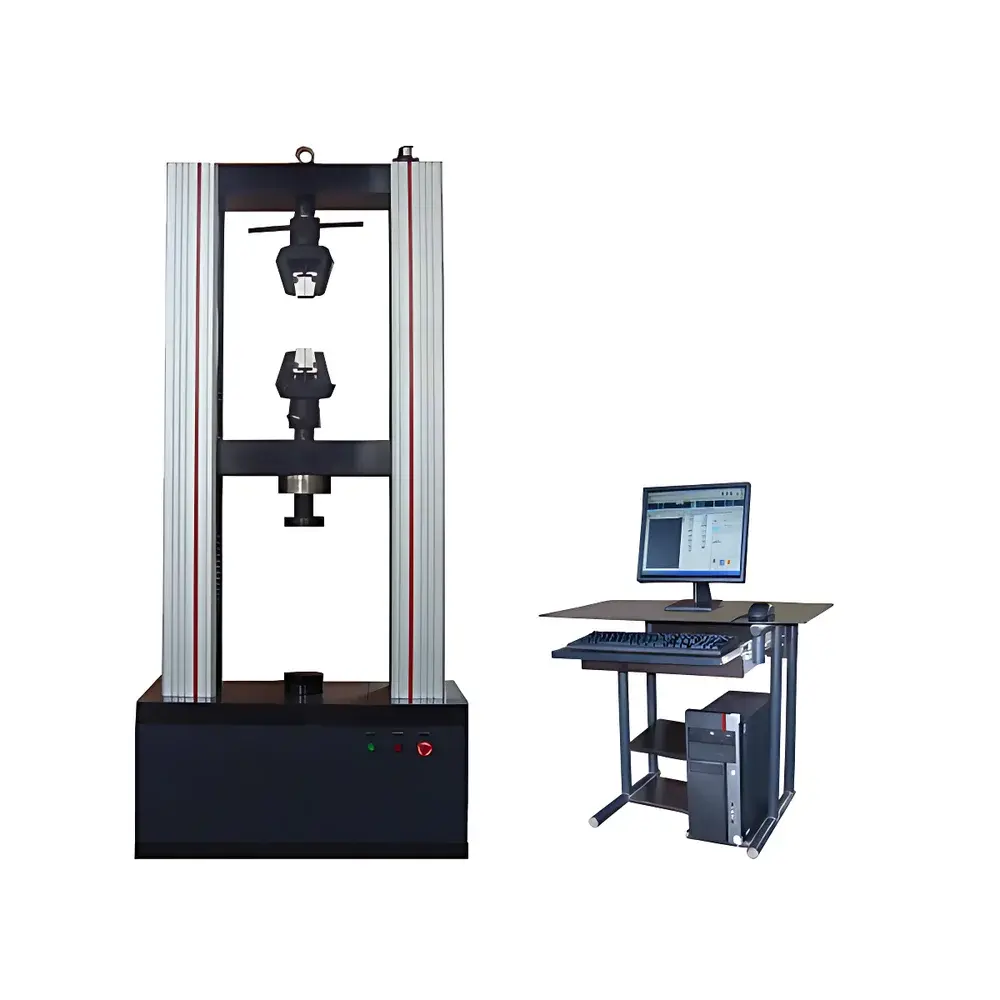
JB-120A Universal Testing Machine by Jiubin Instruments
| Key | Max Test Load: 100 kN |
|---|---|
| Accuracy Class | 0.5 |
| Load Resolution | 0.001 N |
| Speed Range | 0.001–500 mm/min |
| Effective Stroke | ~1000 mm |
| Position Resolution | ±0.005% (encoder-based) |
| Load Accuracy | ±0.05% |
| Control System | Full-digital triple-closed-loop (force, displacement, strain) with adaptive PID algorithm |
| Drive Motor | Panasonic servo motor |
| Mechanical Transmission | High-precision Taiwanese ball screw |
| Software | Windows-based, bilingual (EN/CN), ASTM/ISO-compliant data processing |
| Compliance | Meets ISO 7500-1, ASTM E4, ASTM E8/E21, GB/T 228.1, and GLP-ready audit trail functionality |
| Power Supply | 380 V AC |
| Weight | 860 kg |
| Dimensions (W×D×H) | 1200 × 650 × 1800 mm |
Overview
The JB-120A Universal Testing Machine by Jiubin Instruments is a high-accuracy, electromechanical materials testing system engineered for precision mechanical property characterization under tension, compression, bending, peel, shear, and cyclic loading conditions. Built upon a robust dual-column floor-standing architecture, it implements a true triple-closed-loop digital control architecture—simultaneously regulating force, displacement, and strain via adaptive neuron-based PID algorithms. This ensures seamless mode transitions (e.g., load-controlled to displacement-controlled) without mechanical shock or data discontinuity—critical for reliable yield point detection, plastic deformation analysis, and fracture mechanics evaluation. The machine complies with international metrological standards including ISO 7500-1 (static calibration of force-proving instruments), ASTM E4 (verification of force-measuring systems), and ASTM E8/E21 (tensile testing of metallic materials), supporting traceable, auditable test execution in regulated environments.
Key Features
- Full-digital, real-time triple-closed-loop control (force/displacement/strain) with automatic inter-loop switching and zero-transition overshoot
- Panasonic AC servo motor drive delivering ultra-stable speed control from 0.001 to 500 mm/min, with <±0.05% load accuracy and ±0.005% displacement repeatability
- High-rigidity frame with Taiwan-sourced precision ground ball screw transmission and integrated overload protection (mechanical limit switches, emergency stop, leakage current cutoff)
- Dual-display operation: independent touchscreen interface and Windows-based PC software—both fully functional for test setup, execution, and real-time monitoring
- 1/300,000 internal resolution across full 100 kN capacity with auto-ranging and 0.001 N display resolution
- Bilingual (English/Chinese) software interface compliant with 21 CFR Part 11 requirements: electronic signatures, audit trail logging, user access levels, and password-protected parameter modification
- Comprehensive post-test analysis: automatic calculation of tensile strength, yield strength (upper/lower), Young’s modulus, elongation at break, proof strength, bend modulus, peel adhesion energy, and puncture resistance
- USB-standardized peripheral connectivity (no proprietary ports); modular plug-in architecture for rapid maintenance and component replacement
Sample Compatibility & Compliance
The JB-120A accommodates a broad spectrum of specimen geometries and material classes—including metallic alloys (stainless steel, bearing steel, aluminum, copper), polymers (thermoplastics, elastomers, composites), thin films, textiles, paperboard, safety webbing, adhesives, biomedical sutures, and automotive components. Standard test configurations support ASTM D638 (plastics), ASTM D3039 (composites), ISO 6892-1 (metals), ISO 179 (impact-modified plastics), GB/T 228.1 (Chinese national standard for metallic tensile testing), and EN 13115 (packaging tape peel). Optional fixtures—including wedge-action grips, pneumatic clamps, flexural jigs, peel testers, and custom-designed holders—are available per ISO 2041 or customer-specified geometry, ensuring full alignment with method-defined boundary conditions.
Software & Data Management
The embedded Windows application provides GLP/GMP-aligned data governance: all test parameters, raw acquisition timestamps, operator ID, environmental metadata (if sensor-integrated), and post-processed results are immutably logged with SHA-256 hashing. Users may export reports in PDF, Excel, or XML formats—with configurable templates adhering to laboratory SOPs. Curve replay functionality enables retrospective re-analysis using original acquisition data; zoom, overlay, derivative computation, and region-of-interest integration are supported. Backup is automated to user-defined network drives or local partitions, with versioned file naming and optional encryption. All calculations conform to ISO 5893 and ASTM E251 definitions for engineering stress/strain, true stress/strain conversion, and modulus determination.
Applications
This system serves quality control laboratories, R&D centers, and third-party certification bodies conducting standardized mechanical tests on structural and functional materials. Typical use cases include: qualification of aerospace fasteners per AMS 2300; validation of medical device polymer compliance with ISO 10993-12; tensile verification of battery electrode coatings; peel strength assessment of laminated packaging per ASTM F904; compressive yield evaluation of orthopedic foam; and cyclic fatigue pre-screening of elastomeric seals. Its 1000 mm effective stroke and dual-control redundancy make it suitable for both short-gauge high-strain-rate testing and long-travel low-speed creep protocols.
FAQ
What international standards does the JB-120A comply with for calibration and testing?
It meets ISO 7500-1 (class 0.5 verification), ASTM E4 (force system calibration), ASTM E8/E21 (metallic tensile), ASTM D638/D3039 (polymer/composite), and GB/T 228.1.
Can the system generate 21 CFR Part 11-compliant audit trails?
Yes—software includes electronic signatures, immutable event logs, role-based access control, and parameter change history with operator attribution.
Is remote operation or network integration supported?
The USB-native architecture supports LAN-connected host PCs; optional OPC UA or Modbus TCP gateway modules enable SCADA-level integration.
What is the maximum specimen height accommodated in compression mode?
With standard platens, vertical clearance is 1000 mm; extended-height configurations are available upon request.
Does the machine support high-temperature or environmental chamber integration?
Yes—standardized mounting interfaces and signal isolation allow seamless coupling with external temperature/humidity chambers (−70°C to +300°C range).



