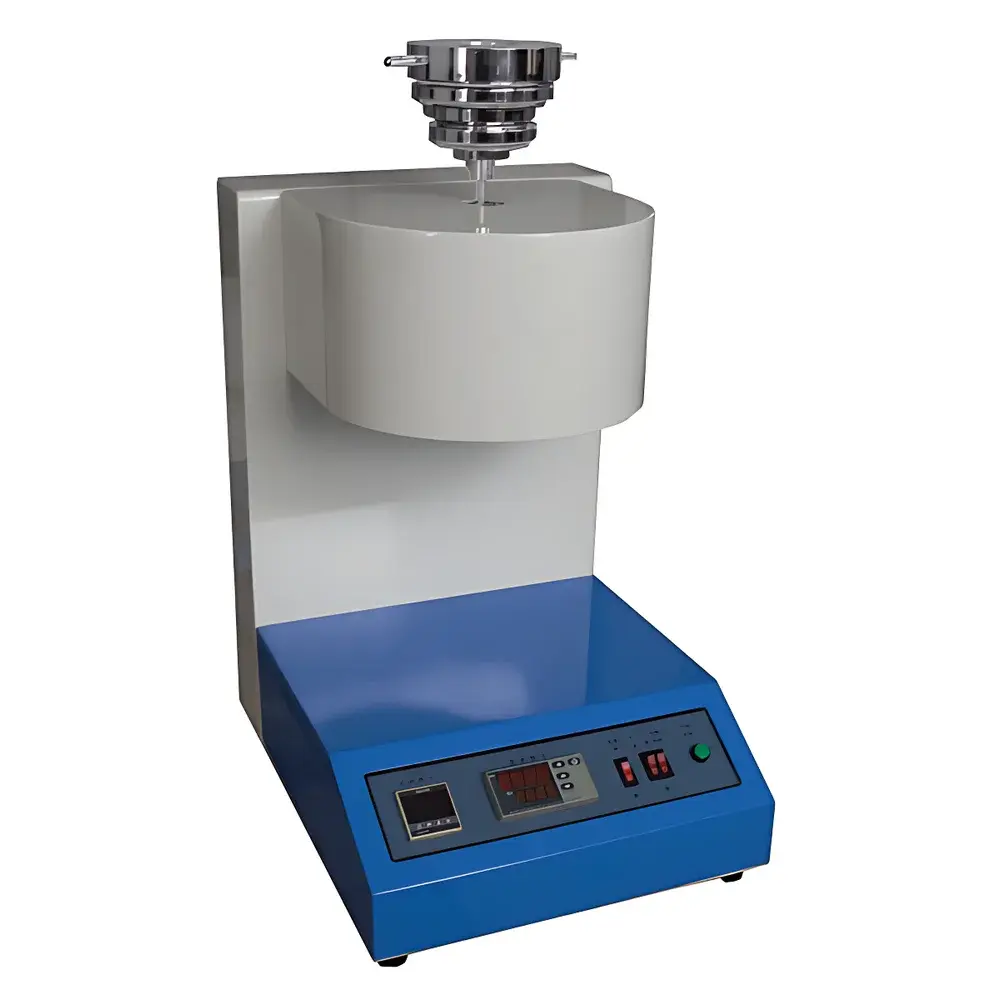
JB-280 Mass-Flow Melt Flow Indexer by Jiubin Instruments
| Brand | Jiubin Instruments |
|---|---|
| Origin | Shanghai, China |
| Model | JB-280 |
| Temperature Control Range | 50–400 °C |
| Temperature Accuracy | ±0.2 °C |
| Temperature Resolution | 0.1 °C |
| Die Capillary Inner Diameter | 2.095 ±0.005 mm |
| Barrel Inner Diameter | 9.550 ±0.025 mm |
| Piston Head Diameter | 9.475 ±0.01 mm |
| Piston Head Length | 6.35 ±0.1 mm |
| Piston Travel Distance | 30 mm |
| Position Detection Accuracy | ±0.1 mm |
| Temperature Recovery Time | ≤4 min |
| Max Power Consumption | ≤500 W |
| Standard Weights | 0.325 kg (with piston rod), 0.875 kg, 0.96 kg, 1.2 kg, 1.64 kg |
| Display | LCD with Chinese interface |
| Functions | Automatic timing, automatic cutting, thermal printing |
Overview
The JB-280 Mass-Flow Melt Flow Indexer, engineered by Jiubin Instruments, is a precision laboratory instrument designed for the standardized determination of Melt Mass-Flow Rate (MFR) and Melt Volume-Flow Rate (MVR) of thermoplastic polymers. It operates on the fundamental principle of extrusion rheometry under controlled temperature and defined load conditions—consistent with the core methodology of ASTM D1238, ISO 1133-1:2011, and GB/T 3682–2000. The instrument applies a known gravitational force via calibrated weights to drive molten polymer through a standardized capillary die; mass or volume of extrudate collected over a fixed time interval is then used to calculate flow rate in g/10 min (MFR) or cm³/10 min (MVR). Its robust thermal architecture, high-stability PID temperature control, and repeatable mechanical actuation ensure measurement consistency required for QC laboratories, R&D facilities, and third-party testing centers serving the rubber and plastic industry.
Key Features
- High-precision temperature control system with ±0.2 °C accuracy across a 50–400 °C operating range, enabling reliable testing of low-melting thermoplastics (e.g., LDPE) and high-temperature engineering resins (e.g., PEEK, PPS).
- Integrated LCD display with native Chinese interface supports intuitive operation without external PC dependency—ideal for production-floor deployment and routine quality checks.
- Automated timing and programmable cut-off intervals synchronize precisely with piston displacement, minimizing operator-induced variability in sample collection.
- Dual-mode functionality: configurable for both MFR (mass-based) and MVR (volumetric) measurements using optional melt density input or direct volumetric calibration.
- Thermally stable barrel assembly featuring a precision-ground 9.550 ±0.025 mm inner-diameter cylinder and a matched 9.475 ±0.01 mm piston head—ensuring consistent annular gap geometry critical for laminar flow compliance per ISO 1133 Annex A.
- Standardized 2.095 ±0.005 mm capillary die manufactured to strict tolerances, traceable to national metrological standards.
- Five certified reference weights (0.325 kg, 0.875 kg, 0.96 kg, 1.2 kg, 1.64 kg) cover common test conditions including ISO 1133 Condition G (2.16 kg), Condition D (5.0 kg), and ASTM D1238 Load C (1.2 kg) and Load E (5.0 kg).
Sample Compatibility & Compliance
The JB-280 is validated for use with a broad spectrum of thermoplastic materials, including but not limited to polyethylene (PE), polypropylene (PP), acrylonitrile-butadiene-styrene (ABS), polystyrene (PS), polyamide (PA6, PA66), polyoxymethylene (POM), polycarbonate (PC), acrylics (PMMA), and fluoropolymers (e.g., PTFE, PVDF). All mechanical dimensions—including barrel bore, piston geometry, and die specifications—conform strictly to ISO 1133-1:2011 Clause 6 and ASTM D1238 Section 7 requirements. The instrument’s thermal performance meets the temperature stabilization and recovery criteria specified in ISO 1133 Annex B. While the device itself does not carry CE or UKCA marking, its design principles and dimensional compliance support integration into GLP-compliant workflows when operated under documented SOPs and routine calibration verification per ISO/IEC 17025.
Software & Data Management
The JB-280 operates as a standalone unit with embedded firmware and requires no proprietary software for basic operation. All test parameters—including temperature setpoint, dwell time, cut interval, and weight selection—are configured directly via the front-panel interface. Measurement results—including elapsed time, cut count, and calculated MFR/MVR values—are displayed in real time and automatically printed via the integrated thermal printer. For traceability, each printout includes date/time stamp, operator ID field (manually entered), and test condition summary. While the instrument lacks native USB/Ethernet connectivity or electronic data export, printed records satisfy minimum documentation requirements for ISO 9001 internal audits and supplier qualification processes. Laboratories requiring electronic audit trails may integrate manual data entry into LIMS systems or supplement with external digital loggers compliant with FDA 21 CFR Part 11 when used in regulated environments.
Applications
- Raw material acceptance testing per supplier specifications (e.g., MFR tolerance bands for PP homopolymer grades).
- In-process monitoring during compounding and extrusion to verify batch-to-batch rheological consistency.
- Stability assessment of polymer degradation following thermal aging or UV exposure—quantified via MFR drift over time.
- Correlation studies between MFR and mechanical properties (e.g., tensile strength, impact resistance) during formulation development.
- Supporting regulatory submissions where ISO/ASTM-compliant MFR data are referenced—for example, in medical-grade polymer dossiers aligned with ISO 10993-12.
- Educational use in polymer science laboratories to demonstrate shear-thinning behavior and thermal sensitivity of melt viscosity.
FAQ
Does the JB-280 support both MFR and MVR measurements?
Yes. The instrument measures extrudate mass directly for MFR (g/10 min); MVR (cm³/10 min) is derived either by inputting known melt density or via volumetric calibration using a calibrated piston displacement sensor.
Is calibration certification included with shipment?
No factory-issued calibration certificate is supplied standard; however, all dimensional components (barrel, die, piston) are manufactured to ISO 1133 tolerances, and temperature sensors are pre-verified at point-of-manufacture. Users are advised to perform initial verification per ISO 1133-2:2011 Annex C prior to first use.
Can the JB-280 be used for ASTM D3364 (UHMWPE) testing?
No. The JB-280 is not configured for ultra-high molecular weight polyethylene testing, which requires specialized long-barrel geometries, extended dwell times, and non-standard die configurations outside the scope of ISO 1133-1 and ASTM D1238.
What maintenance is required to sustain measurement accuracy?
Daily cleaning of the barrel, piston, and die with brass brushes and high-purity solvents (e.g., xylene for PE/PP) is mandatory. Annual verification of temperature uniformity profile and weight calibration against NIST-traceable masses is recommended.
Is technical support available in English for international users?
Yes. Jiubin Instruments provides English-language operation manuals, troubleshooting guides, and remote assistance via email and video call—subject to regional distributor agreements.