
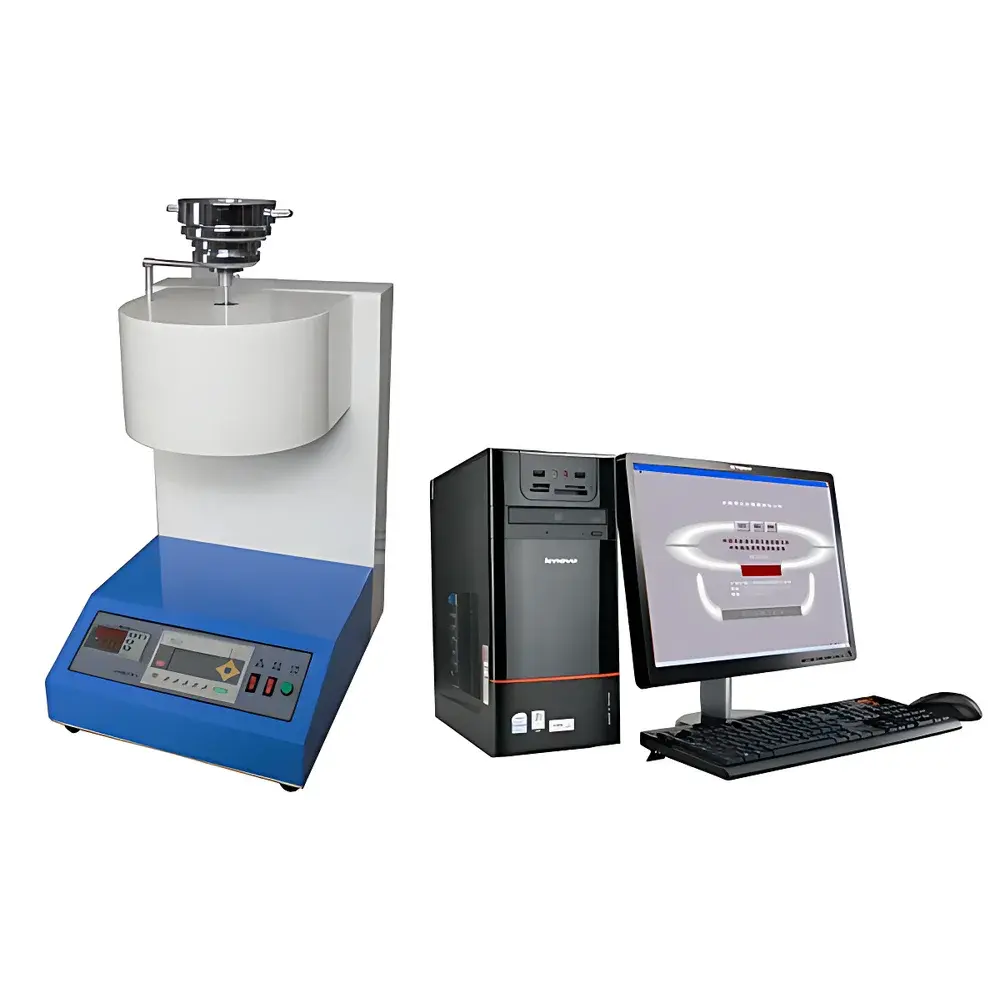
JB-280C Automatic Melt Flow Indexer – Jiubin Instruments
| Brand | Jiubin Instruments |
|---|---|
| Model | JB-280C |
| Standard Compliance | GB/T 3682, ISO 1133-1:2011, ASTM D1238 |
| Temperature Range | 50–450 °C |
| Temperature Accuracy | ±0.2 °C |
| Resolution | 0.1 °C |
| MFR Range | 0.1–800.00 g/10 min |
| MVR Range | 0.1–800.00 cm³/10 min |
| Load Levels | 5 standard weights (3.185 N to 49 N) |
| Barrel ID | 9.550 ± 0.025 mm |
| Die ID | 2.095 ± 0.005 mm |
| Piston Stroke Detection | ±0.1 mm over 30 mm travel |
| Power Consumption | ≤500 W |
| Temperature Recovery Time | ≤4 min |
| Control System | Industrial PLC with LCD HMI + PC-based data interface |
| Cutting Modes | Manual, Time-controlled, Auto-triggered |
| Measurement Methods | Mass Flow Rate (MFR) and Volume Flow Rate (MVR) |
| Melt Density Calculation | Enabled |
| Calibration Support | Built-in temperature calibration function |
| Data Handling | Local storage, USB export, thermal printer support |
Overview
The JB-280C Automatic Melt Flow Indexer by Jiubin Instruments is a precision-engineered instrument designed for the quantitative assessment of melt flow behavior in thermoplastic polymers under standardized load and temperature conditions. It operates on the fundamental principle of extrusion rheometry—measuring either the mass (MFR) or volume (MVR) of polymer melt extruded through a standardized capillary die under controlled gravitational or applied load within a heated barrel. This methodology conforms rigorously to international test standards including ISO 1133-1:2011, ASTM D1238, and GB/T 3682, making it suitable for quality control, material specification verification, and R&D laboratories engaged in polymer formulation, compounding, or incoming raw material evaluation.
Key Features
- Industrial-grade temperature control architecture: Independent PID-controlled heating unit with high-stability nickel-chromium alloy heating elements cast into the barrel assembly—engineered for long-term thermal integrity at up to 450 °C without degradation or drift.
- Dual-mode measurement capability: Simultaneous support for both mass-based (MFR, g/10 min) and volume-based (MVR, cm³/10 min) flow rate determination, enabling direct calculation of melt density (ρ = MFR / MVR) without external instrumentation.
- Triple-cutting logic system: Programmable cut modes—manual initiation, fixed-time intervals, and auto-triggered cuts based on piston displacement—ensuring repeatability across operator skill levels and test protocols.
- High-fidelity mechanical metrology: Precision-machined barrel (ID 9.550 ± 0.025 mm), die (ID 2.095 ± 0.005 mm), and piston (OD 9.475 ± 0.01 mm, length 6.35 ± 0.1 mm) meet ISO 1133 dimensional tolerances, minimizing shear history artifacts and ensuring inter-laboratory comparability.
- Robust control & traceability framework: PLC-based real-time control with LCD human-machine interface (HMI), integrated temperature calibration routine, and timestamped data logging—fully compatible with GLP-compliant documentation workflows.
Sample Compatibility & Compliance
The JB-280C is validated for use with a broad spectrum of thermoplastic resins, including but not limited to polyethylene (PE), polypropylene (PP), acrylonitrile-butadiene-styrene (ABS), polyoxymethylene (POM), polycarbonate (PC), nylon (PA6, PA66), and fluoropolymers (e.g., PTFE-modified compounds). Its operational range (0.1–800.00 g/10 min MFR) accommodates ultra-high-viscosity engineering grades as well as low-viscosity injection molding grades. All mechanical components—including five certified load configurations (3.185 N to 49 N)—are traceable to national metrological standards and fully aligned with ISO 1133 Annex B requirements for force application accuracy. The system supports routine verification per ISO 1133-2 for equipment qualification and satisfies audit readiness criteria for ISO/IEC 17025-accredited testing laboratories.
Software & Data Management
While the JB-280C operates autonomously via its embedded PLC and LCD interface, optional PC connectivity enables enhanced data governance. Raw test parameters—including setpoint temperature, actual barrel temperature (recorded every second), piston position timeline, cut timestamps, and final MFR/MVR values—are stored internally and exportable via USB to CSV format. Thermal printer output provides immediate hardcopy reports with full metadata: date/time, operator ID, sample ID, test standard referenced, load level, temperature, and calculated results. The system’s built-in temperature calibration function allows periodic verification against NIST-traceable reference thermometers—supporting compliance with FDA 21 CFR Part 11 where electronic records are maintained, provided local validation protocols are implemented.
Applications
- Quality assurance of virgin and recycled thermoplastic pellets prior to extrusion or injection molding
- Batch-to-batch consistency monitoring in polymer manufacturing and toll compounding
- Correlation of MFR with molecular weight distribution (MWD) trends during polymerization process development
- Screening of thermal stability and degradation onset via sequential MFR measurements at elevated temperatures
- Validation of processing window compatibility for multi-material co-extrusion systems
- Supporting technical data sheet generation for regulatory submissions (e.g., REACH, UL recognition files)
FAQ
Does the JB-280C comply with ASTM D1238 Condition E (2.16 kg load at 230 °C for PP)?
Yes—the instrument supports all standard ASTM D1238 test conditions, including Condition E, via programmable load selection and precise temperature stabilization within ±0.2 °C.
Can MVR be measured without prior knowledge of melt density?
Yes—MVR is determined volumetrically using piston displacement tracking and calibrated die geometry; melt density is then derived post-test as ρ = MFR / MVR.
Is third-party calibration certification available?
Jiubin Instruments provides factory calibration documentation; users may engage ISO/IEC 17025-accredited service providers for on-site verification and certification against national standards.
What maintenance intervals are recommended for long-term accuracy?
Barrel and die cleaning after each test series; annual verification of temperature sensors and load calibration using traceable deadweight standards is advised.
Does the system support automated report generation with lab-specific headers and footers?
Native firmware supports basic report formatting; custom branding and advanced templating require integration with LIMS or third-party reporting software via exported CSV data.





