
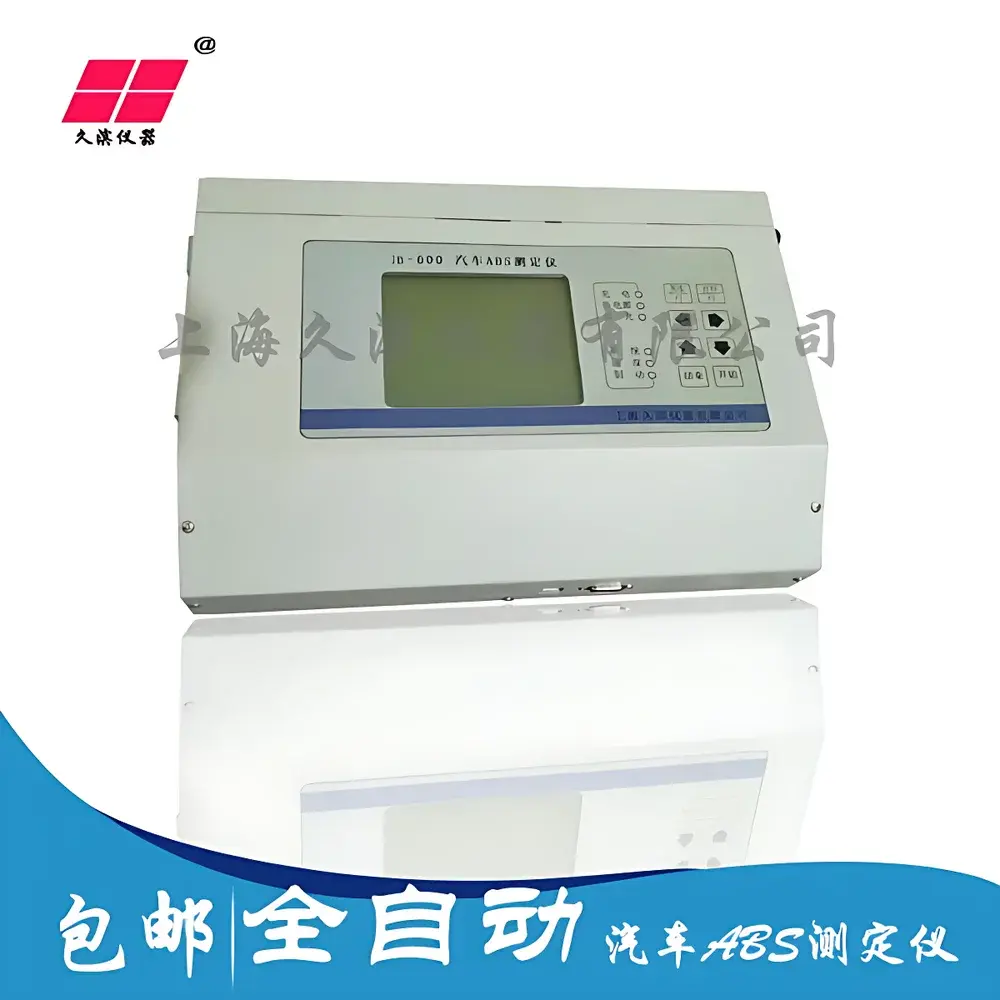
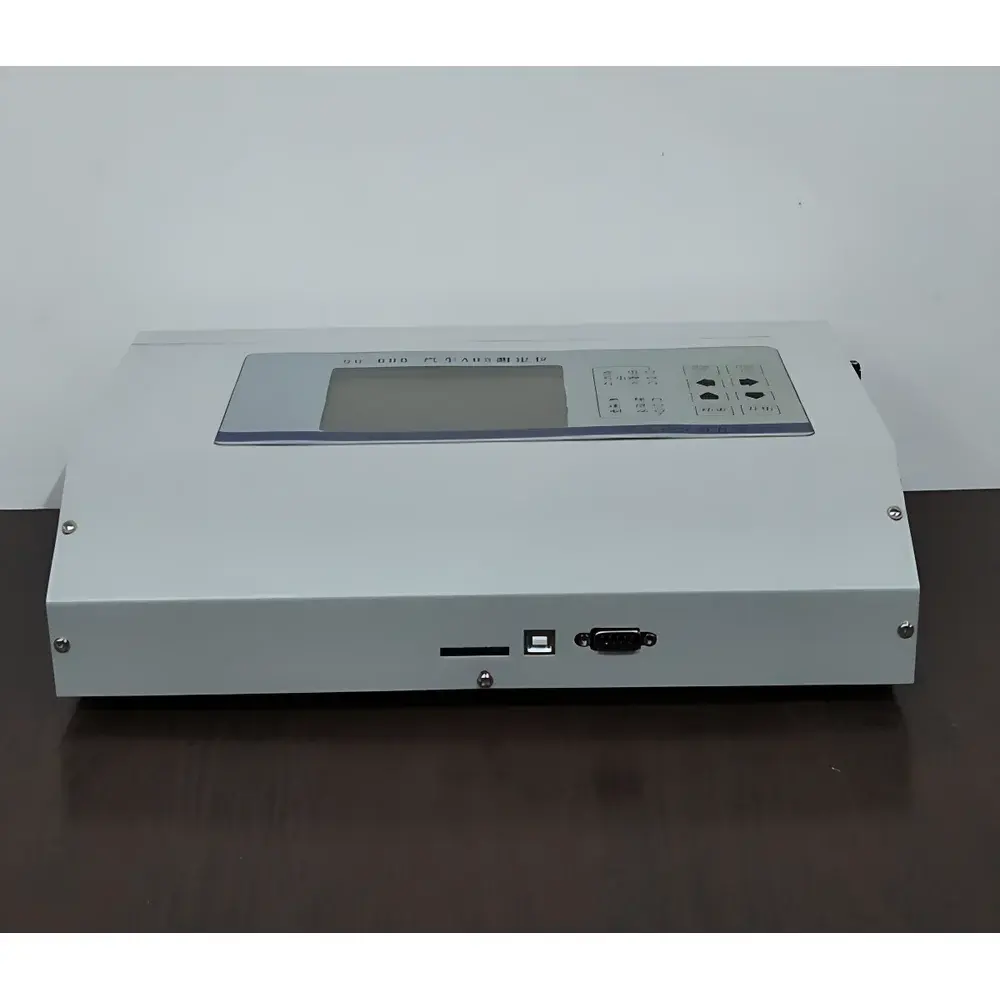
JB-600 ABS Performance Test System by Jiubin Instruments
| Key | Brand: Jiubin Instruments |
|---|---|
| Model | JB-600 |
| Origin | Shanghai, China |
| Processor | STMicroelectronics STM32 (ARM Cortex-M3 core) |
| Input Channels | 1 vehicle speed + 4 wheel speed + 1 external control |
| Output Interfaces | USB 2.0, RS-232, SD card slot, external display port |
| Power Supply | 12 V DC (vehicle battery powered) |
| Dimensions | 370 × 260 × 90 mm |
| Weight | 2.0 kg |
| Vehicle Speed Sensing | GPS or non-contact photoelectric sensor |
| Wheel Speed Sensing | High-precision optical pulse encoder (200 pulses/rev), mountable on 4-/5-/6-bolt wheel hubs |
| Compliance | GB/T 13594–2003, UNECE Regulation No. 13 Annex 13 |
Overview
The JB-600 ABS Performance Test System is a dedicated, standards-compliant instrumentation platform engineered for quantitative evaluation of Anti-lock Braking System (ABS) functionality in motor vehicles and trailers. It operates on the fundamental principle of real-time slip ratio calculation—defined as the normalized difference between vehicle longitudinal speed and individual wheel rotational speed—enabling direct, traceable assessment of ABS intervention timing, modulation frequency, and stability under deceleration. Designed in strict accordance with GB/T 13594–2003 “Performance Requirements and Test Methods for Anti-lock Braking Systems of Motor Vehicles and Trailers” and UNECE Regulation No. 13 Annex 13, the system supports full-scope regulatory testing including peak braking coefficient (PBC) determination, adhesion utilization analysis, and energy storage device performance verification (e.g., hydraulic accumulator response time and pressure decay characteristics). Data acquisition is synchronized at the hardware level using an STMicroelectronics STM32 microcontroller based on the ARM Cortex-M3 architecture—ensuring deterministic timing, low-latency sampling, and robust electromagnetic compatibility in automotive test environments.
Key Features
- High-fidelity dual-speed acquisition architecture: Simultaneous capture of vehicle reference speed (via GPS or non-contact photoelectric sensor) and four independent wheel speeds (via precision optical encoders delivering 200 pulses per revolution)
- Hardware-level synchronization engine: Ensures sub-millisecond timestamp alignment across all five speed channels—critical for accurate slip ratio derivation and transient ABS event detection
- Dual-data-path operation: Real-time streaming to host laptop via USB 2.0 or RS-232; autonomous logging to onboard SD card (FAT32 formatted, up to 32 GB) with timestamped binary files compliant with ISO 8601 date-time notation
- Modular mechanical interface: Encoder mounting kits compatible with standard 4-, 5-, and 6-bolt wheel hub configurations—no wheel removal or brake caliper disassembly required
- Vehicle-integrated power architecture: Operates directly from 12 V DC automotive electrical systems with reverse-polarity and overvoltage protection (10–16 V operating range)
- Compact, ruggedized enclosure: Aluminum alloy chassis (370 × 260 × 90 mm, 2.0 kg) rated IP54 for dust resistance and limited water ingress protection during outdoor brake testing
Sample Compatibility & Compliance
The JB-600 is validated for use across passenger cars, light commercial vehicles, heavy-duty trucks, and semi-trailers equipped with hydraulic or pneumatic ABS architectures. It accommodates both single-axle and multi-axle configurations and supports differential wheel speed analysis for directional stability assessment. All measurement algorithms and data reporting structures conform to the metrological traceability requirements defined in GB/T 13594–2003 and UNECE R13 Annex 13—including mandatory test conditions (surface μ ≥ 0.8, ambient temperature 0–40 °C, dry pavement), minimum sampling rates (≥1 kHz per channel), and uncertainty budget documentation per ISO/IEC 17025:2017 clause 7.6. The system’s firmware and calibration certificate are maintained under a controlled revision protocol aligned with GLP principles for laboratory testing environments.
Software & Data Management
Data processing is performed using proprietary Windows-based application software (v3.2+, 64-bit, .NET Framework 4.8), which implements ISO/IEC 17025-compliant audit trails: every test session logs operator ID, calibration status, environmental metadata (optional external thermometer/hygrometer input), and digital signatures for report generation. Raw binary files (.jbd format) retain full-resolution time-series data and support post-hoc reprocessing with configurable filtering (Butterworth low-pass, 50 Hz cutoff), derivative computation (deceleration rate, jerk), and statistical aggregation (mean slip ratio per wheel, ABS activation count per stop). Export options include CSV (for MATLAB/Python integration), PDF test reports with embedded plots (slip vs. time, wheel speed overlay), and XML schemas compatible with enterprise LIMS platforms. Software validation documentation is available upon request for FDA 21 CFR Part 11 or EU Annex 11 compliance assessments.
Applications
- Regulatory type-approval testing per GB/T 13594–2003 and ECE R13 for OEMs and Tier-1 suppliers
- ABS control algorithm validation in vehicle dynamics labs—including hardware-in-the-loop (HIL) correlation studies
- Brake system durability evaluation: Monitoring degradation of slip regulation consistency across repeated high-energy stops
- Academic research on tire-road friction modeling, where measured slip ratios feed into Pacejka Magic Formula parameter identification
- Quality assurance in final assembly lines: 100% functional verification of ABS ECU communication integrity and sensor signal fidelity
- Technical training for automotive engineering programs: Hands-on instruction in brake dynamics, closed-loop control theory, and ISO-standardized test protocols
FAQ
Does the JB-600 support real-time ABS fault code reading via OBD-II?
No. The JB-600 is a physical-layer performance measurement instrument—not a diagnostic scan tool. It evaluates ABS behavior through kinematic parameters only.
Can the system be used on vehicles with electronic parking brakes (EPB) or brake-by-wire systems?
Yes, provided the EPB does not interfere with wheel rotation during dynamic testing. Brake-by-wire actuation must remain transparent to wheel speed sensors; verification via oscilloscope monitoring of encoder output is recommended prior to certification testing.
Is firmware update capability available remotely?
Firmware updates require local connection via USB and authenticated access credentials. No remote update functionality is implemented to maintain integrity of measurement-critical code per IEC 61508 SIL-2 requirements.
What calibration interval is recommended for metrological traceability?
Annual calibration against NIST-traceable speed simulators is advised. A full calibration certificate—including uncertainty budgets for each input channel—is issued with each service.
Are third-party software drivers (e.g., LabVIEW, Python pySerial) supported for custom automation?
Yes. A documented ASCII command protocol (RS-232) and USB CDC ACM class interface are provided, enabling integration into automated test benches without proprietary middleware.





