
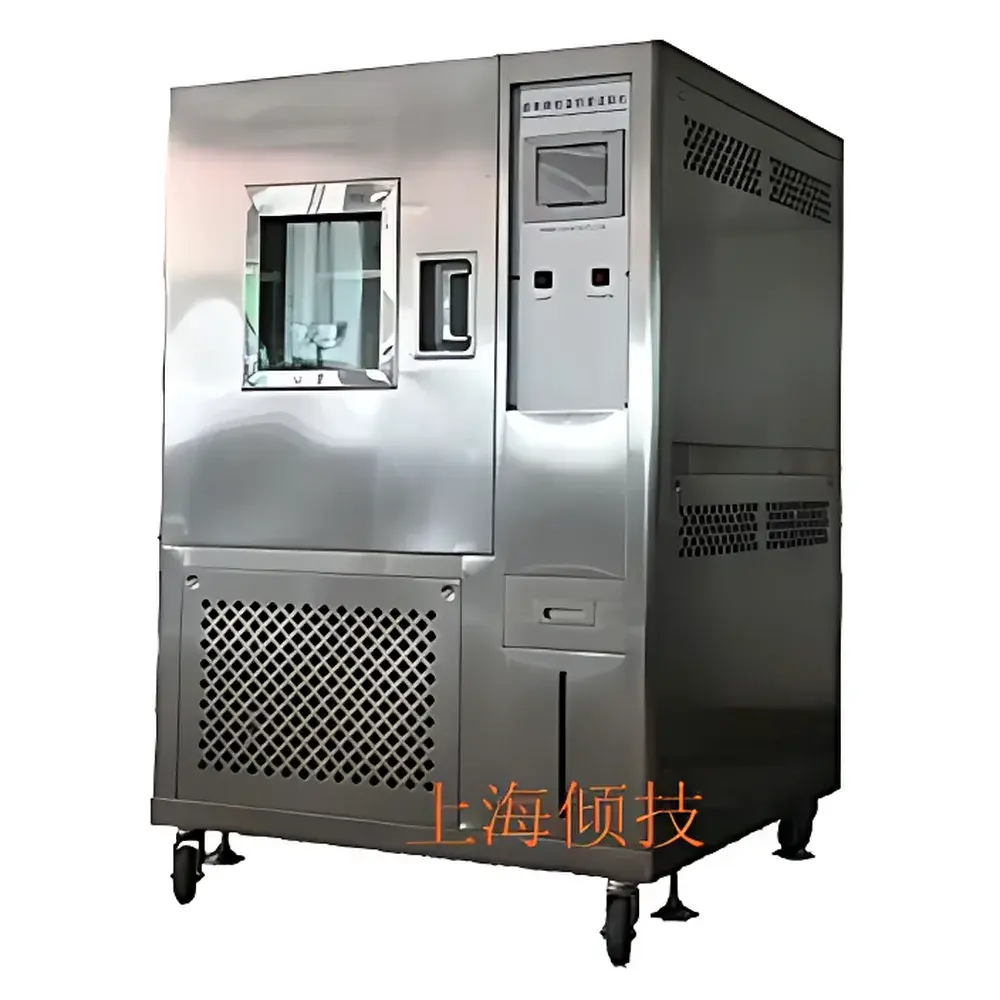
Qinji QJCLR8731 Thermal Shock Test Chamber
| Brand | Qinji |
|---|---|
| Origin | Shanghai, China |
| Model | QJCLR8731 |
| High-Temperature Zone Range | 60–200 °C |
| Low-Temperature Zone Range | −10 to −65 °C (standard), optional −75 °C |
| Test Chamber Operating Range | −10 to −60 °C (standard), optional −50 °C or −60 °C |
| Temperature Stability | ±1 °C |
| Temperature Uniformity | ±2 °C |
| Recovery Time | ≤5 min |
| Heating Rate (typical) | 40 min (from −65 °C to +200 °C) |
| Cooling Rate (typical) | 60–90 min (from +200 °C to −65 °C) |
| Controller | 7.5″ color LCD touchscreen with bilingual (English/Chinese) interface, 256-color display, adjustable backlight, direct-key operation |
| Safety Protections | Fuseless circuit breaker, compressor high-pressure/overheat/overcurrent protection, chamber overtemperature protection, fan overload protection |
| Standard Accessories | Two sample racks, one 50 mm diameter cable port |
Overview
The Qinji QJCLR8731 Thermal Shock Test Chamber is an engineered environmental stress screening (ESS) system designed to evaluate material and component reliability under rapid, repetitive transitions between extreme high- and low-temperature conditions. It operates on the principle of two-zone static thermal shock—separate, independently controlled high-temperature and low-temperature chambers—with a mechanical transfer mechanism that moves test specimens between zones in under 5 seconds. This architecture enables precise, repeatable thermal cycling per internationally recognized test standards including GB/T 2423.1–2021 (IEC 60068-2-1), GB/T 2423.2–2021 (IEC 60068-2-2), GJB 150.5A–2009, and GB/T 10592–2008. The system is purpose-built for accelerated life testing, failure mode identification, solder joint integrity validation, and qualification of electronic assemblies, automotive ECUs, aerospace avionics, and polymer-based enclosures subjected to operational thermal transients.
Key Features
- Independent dual-chamber design with electrically heated high-temp zone (60–200 °C) and cascade refrigeration low-temp zone (−10 to −65 °C standard; −75 °C optional)
- High-fidelity temperature control using PID algorithm with ±1 °C stability and ±2 °C uniformity across the working volume
- 7.5-inch industrial-grade color LCD touchscreen controller with English/Chinese language support, real-time graphing, data logging, and programmable multi-step profiles
- Robust safety architecture including compressor discharge pressure monitoring, motor winding temperature sensing, chamber overtemperature cutoff, and fan current surveillance
- Transfer mechanism with pneumatic actuation and position feedback ensures repeatable specimen movement with <5 s dwell-to-dwell transition time
- Standard configuration includes two stainless-steel sample racks and one 50 mm diameter access port for external signal or power feedthrough
Sample Compatibility & Compliance
The QJCLR8731 accommodates test specimens up to 300 mm × 300 mm × 300 mm (W×D×H) within its insulated working chamber. Its thermal performance meets the spatial uniformity and temporal repeatability requirements specified in MIL-STD-810H Method 503.5 and IEC 60068-2-14. The system supports compliance-driven test execution for industries subject to ISO 9001, IATF 16949, and AS9100 quality management systems. While not inherently 21 CFR Part 11 compliant, audit-ready operation—including user access logs, parameter change history, and electronic signature support—can be implemented via optional software integration with validated LIMS or MES platforms.
Software & Data Management
The embedded controller provides local data storage for up to 100 test programs and 30 days of continuous 1-second interval temperature logging. Export is supported via USB 2.0 to CSV format for post-processing in MATLAB, Excel, or statistical process control (SPC) tools. Optional PC-based software (Qinji TestSuite™) adds remote monitoring, automated report generation (PDF/Excel), alarm escalation via email/SNMP, and GLP/GMP-aligned electronic record retention with user authentication and audit trail functionality. All firmware updates are delivered via signed binary packages to ensure system integrity.
Applications
- Qualification testing of printed circuit board assemblies (PCBAs) per IPC-9701 for intermetallic growth and solder fatigue resistance
- Validation of encapsulant adhesion and coefficient of thermal expansion (CTE) mismatch in optoelectronic packaging
- Accelerated aging studies of lithium-ion battery modules under extreme thermal cycling
- Material compatibility assessment for automotive interior trim components exposed to desert-to-winter ambient extremes
- Reliability screening of MEMS sensors prior to AEC-Q200 qualification
- Research into glass transition behavior and microcrack propagation in thermoset composites
FAQ
What is the standard temperature range for the low-temperature chamber?
The standard low-temperature zone operates from −10 °C to −65 °C. Optional configurations extend to −75 °C upon request and subject to additional lead time and validation.
Does the system support automatic test sequencing with dwell times and cycle counts?
Yes—the controller supports up to 99 programmable steps per profile, including ramp rates, dwell durations, cycle repetition, and conditional branching based on chamber sensor readings.
Is calibration traceability provided with the instrument?
Each unit ships with a factory calibration certificate traceable to NIM (National Institute of Metrology, China). Third-party ISO/IEC 17025 calibration services are available upon installation.
Can the chamber accommodate samples with active electrical bias during testing?
Yes—via the standard 50 mm cable port, which is gasket-sealed and rated for operation across the full thermal range without compromising chamber integrity.
What maintenance intervals are recommended for long-term reliability?
Compressor oil and refrigerant filter replacement every 24 months; door seal inspection and cleaning quarterly; controller firmware update verification annually.



