
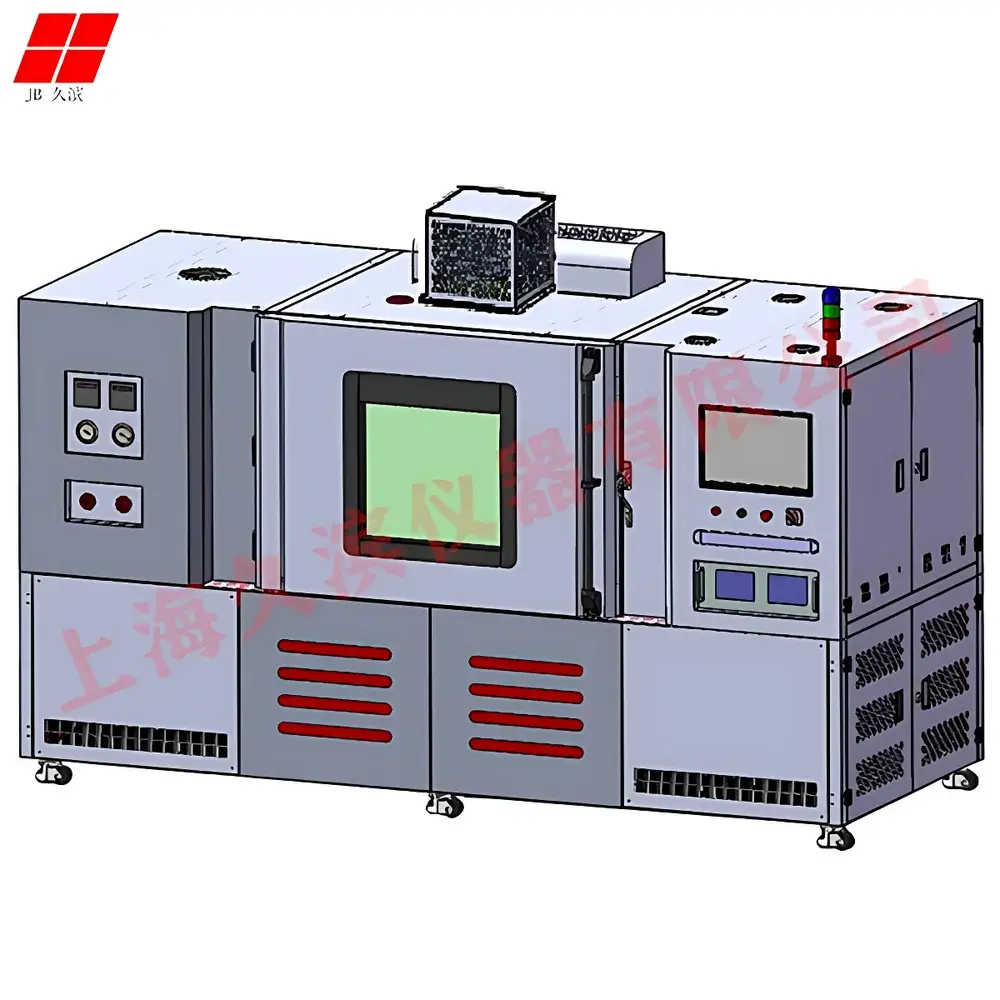
JB-Bin JM8 High-Pressure Hydraulic Pulsation Fatigue Test System
| Brand | JB-Bin |
|---|---|
| Origin | Shanghai, China |
| Model | JM8 |
| Test Medium | Oil, Water, or Ethylene Glycol Mixture |
| Max Pulse Pressure | 0–70 MPa (adjustable, optional higher range) |
| Pressure Control Accuracy | ±0.01 bar |
| Pulse Frequency | 0–2 Hz (dependent on specimen volume and compliance) |
| Waveform Options | Square, T-wave, Triangular, Sine |
| Test Temperature Range | –40 °C to +150 °C (±3 °C) |
| Cycle Capacity | ≥100,000 cycles per continuous test run |
| Continuous Operation Duration | ≥720 hours (30 days) |
| Specimen Capacity | 2–8 units (configurable per system setup) |
| Mounting Angles | 90° or 180° per ISO 6803 / SAE J1401 / GB/T 14904 compliance |
Overview
The JB-Bin JM8 High-Pressure Hydraulic Pulsation Fatigue Test System is an engineered platform for accelerated life-cycle validation of fluid-conveying components under dynamic pressure loading. It operates on the principle of controlled hydraulic pulsation—generating repeatable, programmable pressure waveforms within sealed test specimens to simulate real-world service conditions in automotive, aerospace, and industrial hydraulic systems. Designed in accordance with core fatigue testing standards—including ISO 6803 (rubber hoses), SAE J1401 (brake hose pulse testing), ISO 1402 (hydraulic hose assemblies), and GB/T 14904 (Chinese national standard for hose durability)—the JM8 delivers traceable, reproducible stress cycling across a wide operational envelope. Its architecture integrates closed-loop pressure regulation, thermally stabilized fluid conditioning, and synchronized data acquisition to support both R&D qualification and production-line QA verification.
Key Features
- High-fidelity pressure control with ±0.01 bar accuracy over the full 0–70 MPa range, enabling precise replication of transient load profiles encountered in brake, cooling, and fuel delivery systems.
- Multi-waveform generation capability (square, T-wave, triangular, sine) with user-defined rise/fall times and dwell periods—critical for simulating pressure transients from pump pulsation, thermal expansion, or valve switching events.
- Thermally regulated test medium circulation supporting stable operation from –40 °C to +150 °C (±3 °C), accommodating low-temperature elastomer brittleness evaluation and high-temperature seal degradation studies.
- Modular specimen manifold accommodating 2–8 test units simultaneously, with configurable mounting angles (90° or 180°) to replicate OEM installation geometry per ISO/SAE mounting protocols.
- Robust hydraulic architecture featuring industrial-grade pulse generator, low-pulsation recirculation pump, and stainless-steel fluid path components rated for long-term exposure to oils, glycol-water mixtures, and deionized water.
- Fail-safe monitoring suite including real-time leak detection, overpressure cutoff, temperature deviation alarms, and automatic shutdown upon parameter deviation beyond user-defined thresholds.
Sample Compatibility & Compliance
The JM8 accommodates a broad spectrum of fluid-handling components: rubber and thermoplastic hoses (e.g., brake, power steering, HVAC, turbocharger intercooler), metallic tube assemblies, crimped or flanged fittings, heat exchangers (radiators, oil coolers, condensers), reservoirs (brake master cylinders, expansion tanks), and filtration modules. All test configurations comply with mechanical mounting requirements specified in ISO 6803 Annex A, SAE J1401 Section 5.2, and GB/T 14904 Clause 6. Pressure cycling protocols are programmable to meet pass/fail criteria defined in ISO 1402:2017 (Clause 7.3), USCAR-21 (Section 4.3), and OEM-specific engineering specifications (e.g., Ford WSS-M97B44-D, GM GMW14872). The system supports GLP-compliant audit trails when operated with validated software configurations.
Software & Data Management
The JM8 integrates a Windows-based control and acquisition platform built on industry-standard measurement libraries (NI LabVIEW RT engine), offering deterministic timing for waveform synchronization and cycle counting. Software features include: real-time pressure waveform visualization with zoom/pan and overlay comparison; automated cycle logging with timestamped event markers (start, stop, fault, temperature excursion); export of CSV/Excel-compatible datasets for statistical process control (SPC); customizable report templates compliant with internal QA documentation requirements; and password-protected user roles (operator, engineer, administrator). Optional FDA 21 CFR Part 11 compliance package provides electronic signature support, audit trail encryption, and data integrity validation—enabling use in regulated GMP environments where traceability and data sovereignty are mandatory.
Applications
- Validation of hose assembly durability under repeated pressure surges in automotive braking and steering systems.
- Accelerated aging assessment of elastomeric seals and O-rings in high-temperature coolant circuits.
- Verification of brazed or welded joint integrity in aluminum radiators and oil coolers subjected to thermal-mechanical cycling.
- Qualification testing of aerospace-grade flexible ducting per MIL-DTL-24672 and AS5683.
- Development-stage benchmarking of new polymer formulations against legacy materials using standardized pulse spectra.
- Production lot sampling for zero-defect manufacturing programs requiring 100% functional reliability assurance.
FAQ
What standards does the JM8 system support out-of-the-box?
The system includes preconfigured test templates for ISO 6803, SAE J1401, ISO 1402, and GB/T 14904. Custom protocol development is supported via open scripting interface.
Can the system operate unattended for extended durations?
Yes—designed for continuous 720-hour (30-day) operation with integrated thermal management, fluid level monitoring, and automated fault recovery protocols.
Is remote monitoring available?
Standard Ethernet connectivity enables secure remote access via VNC or dedicated client application; optional OPC UA server module supports integration into MES/SCADA platforms.
How is calibration maintained across long-term deployments?
The system supports NIST-traceable pressure transducer calibration with automated drift compensation algorithms; annual recalibration intervals are documented in the maintenance log.
Does the JM8 support multi-channel pressure acquisition?
Yes—up to eight independent high-speed pressure channels (10 kHz sampling) can be synchronized with temperature and cycle counters for distributed system analysis.



