
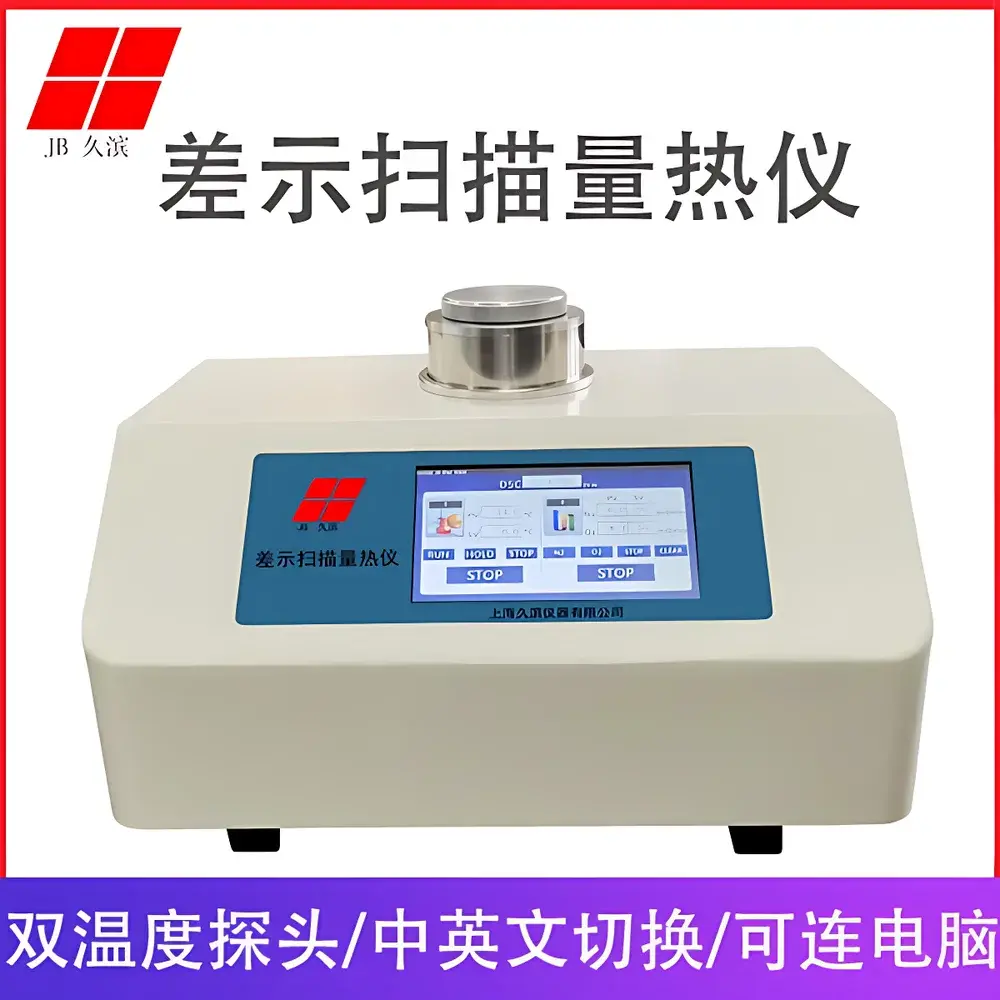
JB-DSC-800 Differential Scanning Calorimeter by Jiubin Instruments
| Brand | Jiubin Instruments |
|---|---|
| Origin | Shanghai, China |
| Model | JB-DSC-800 |
| Sample Capacity | Single |
| Instrument Type | Heat-Flow DSC |
| Temperature Range | Ambient to 600 °C |
| Temperature Accuracy | ±0.1 °C |
| Heating/Cooling Rate | 0.1–80 °C/min |
| DSC Signal Range | 0 to ±600 mW |
| Temperature Resolution | 0.01 °C |
| DSC Noise Level | 0.001 mW |
| DSC Sensitivity & Resolution | 0.01 mW |
| Atmosphere Control | Automated Gas Switching (N₂, O₂, Air) |
| Gas Flow Rate | 0–200 mL/min |
| Gas Pressure | 0.2 MPa |
| Display | 7-inch 24-bit color LCD touchscreen |
| Data Interface | Standard USB |
| Calibration | Integrated reference materials with one-click temperature & enthalpy calibration |
| Power Supply | AC 220 V, 50 Hz |
| Power Consumption | 600 W |
Overview
The JB-DSC-800 Differential Scanning Calorimeter is a precision heat-flow-type thermal analysis instrument engineered for rigorous characterization of thermal transitions in polymeric, composite, pharmaceutical, and inorganic materials. Operating on the principle of measuring differential heat flow between a sample and an inert reference under controlled linear or isothermal temperature programs, the JB-DSC-800 delivers high-fidelity thermograms essential for quantitative determination of phase transitions, reaction enthalpies, and kinetic stability parameters. Its operational range—spanning ambient to 600 °C with programmable heating/cooling rates from 0.1 to 80 °C/min—supports both routine quality control and advanced research applications, including glass transition (Tg), melting (Tm), crystallization (Tc), oxidative induction time (OIT), and cure kinetics analysis. Designed in compliance with ISO 11357 (Parts 2, 3, and 6) and GB/T 19466 series standards, the system provides metrologically traceable data suitable for regulatory submissions and interlaboratory comparison.
Key Features
- Hermetically sealed all-metal furnace architecture optimized for baseline stability, signal-to-noise ratio, and thermal homogeneity across the full temperature range.
- High-stability alloy-based heat-flux sensor with enhanced corrosion and oxidation resistance, ensuring long-term calibration integrity and reproducible sensitivity of 0.01 mW.
- Dual-channel real-time temperature control powered by a Cortex-M3 ARM microcontroller, enabling precise ramp-hold-ramp profiles and sub-second thermal response tracking.
- Integrated gas management system with automatic switching between inert (N₂) and reactive (O₂, air) atmospheres; programmable flow (0–200 mL/min) and pressure (0.2 MPa) control for standardized OIT and decomposition studies.
- 7-inch 24-bit color capacitive touchscreen interface with intuitive navigation, live thermogram preview, and on-device parameter configuration—no external PC required for basic operation.
- USB 2.0 bidirectional communication protocol supporting firmware updates, remote monitoring, and seamless data export to third-party analysis platforms.
Sample Compatibility & Compliance
The JB-DSC-800 accommodates standard aluminum, gold-coated aluminum, and high-pressure stainless-steel crucibles (up to 10 mg sample mass), enabling analysis of thermally sensitive composites, filled polymers, carbon-fiber-reinforced resins, and catalytically active formulations. It meets critical requirements for ISO 11357-2 (Tg determination), ISO 11357-3 (melting/crystallization enthalpy), and ISO 11357-6 (oxidative stability assessment), with built-in calibration routines traceable to NIST-certified indium, zinc, and tin standards. All thermal data records include embedded metadata (timestamp, operator ID, atmosphere, purge rate, heating rate), satisfying GLP documentation prerequisites and facilitating FDA 21 CFR Part 11–compliant audit trails when paired with validated laboratory information management systems (LIMS).
Software & Data Management
The instrument ships with dedicated Windows-based analysis software supporting ASTM E1356 and ISO 11357-compliant peak integration, baseline correction, Tg inflection point calculation (midpoint/tangent methods), crystallinity estimation via enthalpy ratio, and isoconversional kinetic modeling (e.g., Ozawa-Flynn-Wall). Raw DSC curves are saved in ASCII-compatible .txt format and native .dsc binary format with full header metadata. Software features include multi-curve overlay, derivative thermogram generation (dT/dt), automatic onset/midpoint/peak temperature annotation, and customizable report templates compliant with internal SOPs or external regulatory formats (e.g., ICH Q5C, USP ). Data security protocols support user-level access control, electronic signatures, and versioned file archiving.
Applications
- Composite material development: Quantifying resin cure exotherms, post-cure residual enthalpy, fiber-matrix interfacial stability, and thermal degradation onset in CFRP/GFRP systems.
- Pharmaceutical solid-state characterization: Detecting polymorphic transitions, hydrate/dehydrate events, and amorphous content via cold-crystallization enthalpy analysis.
- Quality assurance of thermoplastics: Measuring melting point distribution, crystallinity index, and thermal history effects in PE, PP, PEEK, and bio-based polyesters.
- Oxidative stability screening: Determining isothermal OIT (at 190–220 °C) and dynamic OIT (under linear O₂ ramp) for antioxidant efficacy evaluation in polymer masterbatches.
- Failure analysis: Correlating thermal degradation profiles with mechanical property loss in aged elastomers, adhesives, and encapsulants subjected to accelerated aging protocols.
FAQ
What standards does the JB-DSC-800 comply with for thermal transition analysis?
It fully supports ISO 11357 Parts 2, 3, and 6, as well as GB/T 19466.2–2004, GB/T 19466.3–2004, and GB/T 19466.6–2009 for Tg, melting/crystallization, and oxidative induction measurements.
Can the instrument perform both dynamic and isothermal OIT tests?
Yes—programmable gas switching, precise isothermal hold capability (±0.1 °C over 60+ min), and dual-atmosphere control enable both ISO 11357-6-defined isothermal OIT and dynamic OIT protocols.
Is calibration traceable to international reference materials?
Yes—the system includes certified indium, zinc, and tin standards with automated one-click calibration routines for temperature and enthalpy, ensuring traceability to NIST SRMs.
Does the software support kinetic modeling of curing or degradation reactions?
Yes—built-in isoconversional analysis tools (Ozawa-Flynn-Wall, Kissinger-Akahira-Sunose) allow activation energy estimation without prior mechanistic assumptions.
What crucible types are supported for high-temperature or reactive samples?
Standard aluminum pans (up to 600 °C in inert atmosphere), gold-plated aluminum (enhanced oxidation resistance), and high-pressure stainless-steel crucibles (for volatile or pressurized reactions) are compatible.



