
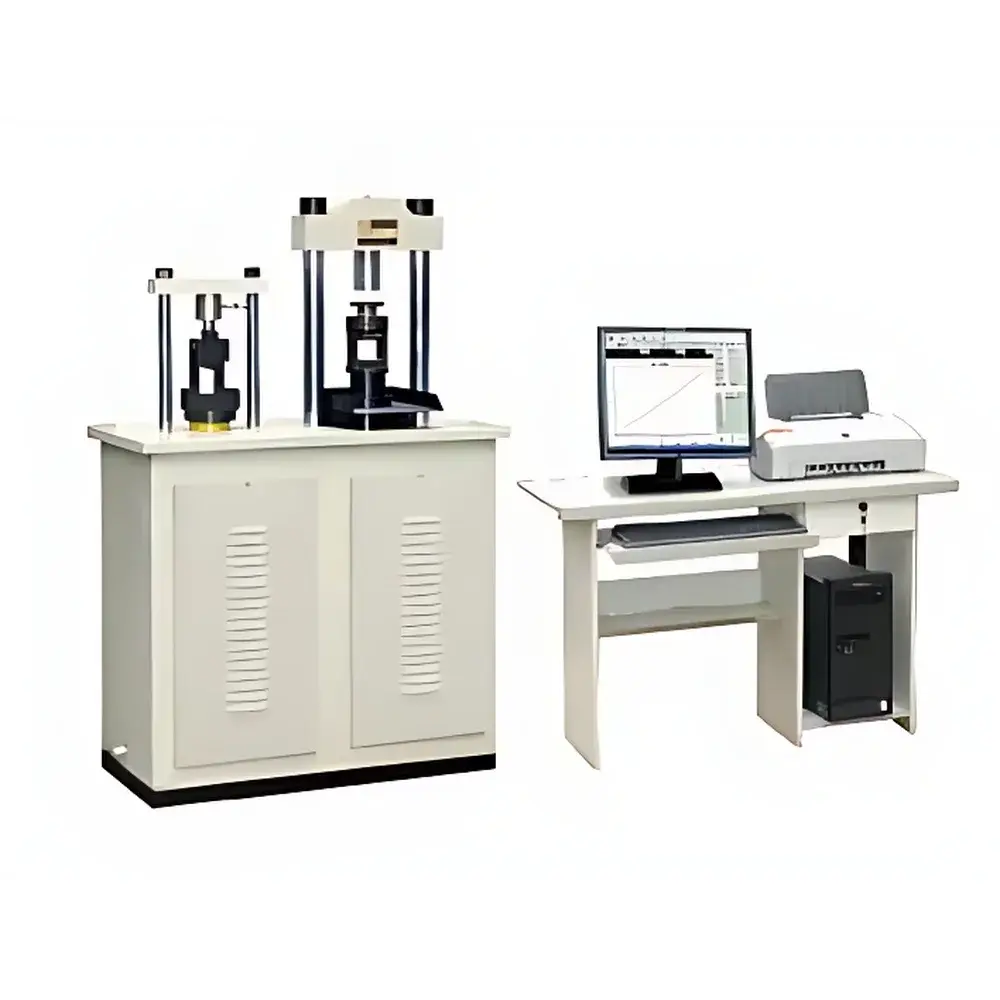
JB Instruments JB/YAW-300C Fully Automated Flexural and Compressive Testing Machine
| Brand | JB Instruments |
|---|---|
| Origin | Shanghai, China |
| Model | JB/YAW-300C |
| Max. Compressive Load | 300 kN |
| Max. Flexural Load | 10 kN |
| Force Measurement Range | 4–100% FS |
| Force Accuracy | ≤ ±1% of reading |
| Force Resolution | 0.01 kN |
| Loading Rate (Compression) | 0.3–10 kN/s |
| Loading Rate (Flexure) | 50 N/s |
| Loading Rate Accuracy | ±5% |
| Hydraulic Pump Rated Pressure | 25 MPa |
| Oil Flow Rate | 1.52 L/min |
| Compression Platen Diameter | φ155 mm |
| Flexure Support Span | 80 × 150 mm |
| Max. Platen Spacing | 260 mm |
| Piston Diameter (Compression) | φ130 mm |
| Piston Diameter (Flexure) | φ50 mm |
| Piston Stroke | 60 mm |
| Motor Power | 0.75 kW (3-phase) |
| Dimensions (W×D×H) | 820 × 450 × 1300 mm |
| Weight | 500 kg |
Overview
The JB Instruments JB/YAW-300C Fully Automated Flexural and Compressive Testing Machine is a dual-mode universal testing system engineered for high-precision mechanical characterization of construction materials under standardized uniaxial compression and three-point bending conditions. It operates on a servo-controlled hydraulic actuation principle, integrating a digitally regulated electro-hydraulic servo valve, high-stability load cells with temperature-compensated strain-gauge technology, and a real-time closed-loop control architecture. Designed specifically for quality control laboratories in cement, concrete, masonry, and precast manufacturing facilities, the system delivers traceable, repeatable force application aligned with static mechanical test protocols defined in ISO 679, ASTM C109/C39/C78, GB/T 17671, GB/T 50081, and EN 12390 series standards. Its dual-range force transduction (300 kN for compression, 10 kN for flexure) enables seamless transition between high-load structural integrity verification and low-force modulus-of-rupture evaluation—without manual sensor swapping or recalibration.
Key Features
- Servo-hydraulic dual-circuit actuation system with independent pressure regulation for compression and flexural modes
- Force-controlled closed-loop feedback using digital PID algorithm, supporting both constant-rate loading (kN/s or MPa/s) and stress-rate control per ASTM E4 and ISO 5893
- High-resolution force measurement: 0.01 kN resolution across full scale, validated to ≤ ±1% indication error per ISO 7500-1 Class 1
- Automated test sequencing with programmable ramp-hold-dwell-unload profiles and real-time load-displacement curve acquisition
- Integrated safety interlocks including overpressure relief valves, emergency stop circuitry compliant with IEC 60204-1, and mechanical overload protection
- Modular platen configuration: interchangeable φ155 mm compression platens and 80 × 150 mm flexural support fixtures with precise alignment guides
- Self-diagnostic firmware with event logging and hardware status monitoring accessible via front-panel LCD and host software
Sample Compatibility & Compliance
The JB/YAW-300C accommodates standard-sized specimens per international cementitious material testing protocols: 40 × 40 × 160 mm mortar prisms (flexure), 150 × 150 × 150 mm concrete cubes (compression), and 240 × 115 × 53 mm clay bricks. Specimen height adjustment is facilitated by motorized crosshead positioning within a 260 mm usable stroke range. All mechanical components—including load train, piston assemblies, and platens—are manufactured to ISO 26203-1 geometric tolerances for parallelism and surface flatness. The system supports full audit trail generation required for GLP-compliant environments and includes optional 21 CFR Part 11–ready electronic signature modules for regulated QC labs. Calibration certificates are traceable to NIM (National Institute of Metrology, China) and compatible with external third-party accreditation per ISO/IEC 17025.
Software & Data Management
Control and analysis are executed via JB-TestSuite v4.2—a Windows-based application built on .NET Framework with native support for SQL Server Express database backend. The interface provides real-time graphical display of load vs. time, load vs. displacement, and stress-strain curves with auto-scaling and overlay capabilities. Test parameters—including target load, rate, hold duration, and failure criteria—are configured through intuitive wizards adhering to template-driven method definitions. Raw data export is available in CSV, XML, and native .jbt binary formats; report templates are fully customizable using Microsoft Report Builder and support direct export to Excel (.xlsx) with embedded formulas for strength calculation (e.g., fc = P/A, fr = 3PL/2bd²). Audit logs record user actions, calibration events, and system errors with timestamps and operator IDs—enabling full traceability for internal audits or regulatory inspections.
Applications
- Compressive strength determination of Portland cement mortars (ISO 679), concrete cylinders (ASTM C39), and autoclaved aerated concrete blocks (EN 772-1)
- Flexural strength (modulus of rupture) testing of cementitious beams per ASTM C78 and GB/T 2542
- Quality conformance verification for ready-mix concrete batches prior to site delivery
- R&D evaluation of admixture efficacy on early-age strength development
- Third-party certification testing for CE marking of masonry units (EN 771-1) and structural tiles
- Educational use in civil engineering laboratories for hands-on mechanics of materials instruction
FAQ
What standards does the JB/YAW-300C comply with for cement testing?
It meets ISO 679, ASTM C109 (mortar), ASTM C39 (concrete), ASTM C78 (flexure), GB/T 17671, GB/T 50081, and EN 12390-3/EN 12390-4 requirements.
Can the system perform both compression and flexure tests without hardware reconfiguration?
Yes—the dual-piston design and quick-change fixture system allow mode switching in under 90 seconds with automatic sensor range recognition.
Is the software validated for use in FDA-regulated environments?
The base software supports 21 CFR Part 11 compliance when deployed with optional electronic signature and audit trail modules, subject to site-specific validation protocols.
What maintenance intervals are recommended for the hydraulic system?
Hydraulic oil replacement every 1,500 operating hours or biannually; filter cartridge replacement every 500 hours; annual load cell verification against certified deadweight standards.
Does the system support remote diagnostics or firmware updates?
Yes—via secure HTTPS-based remote access module (optional), enabling technician-assisted troubleshooting and over-the-air firmware patch deployment with version rollback capability.



