
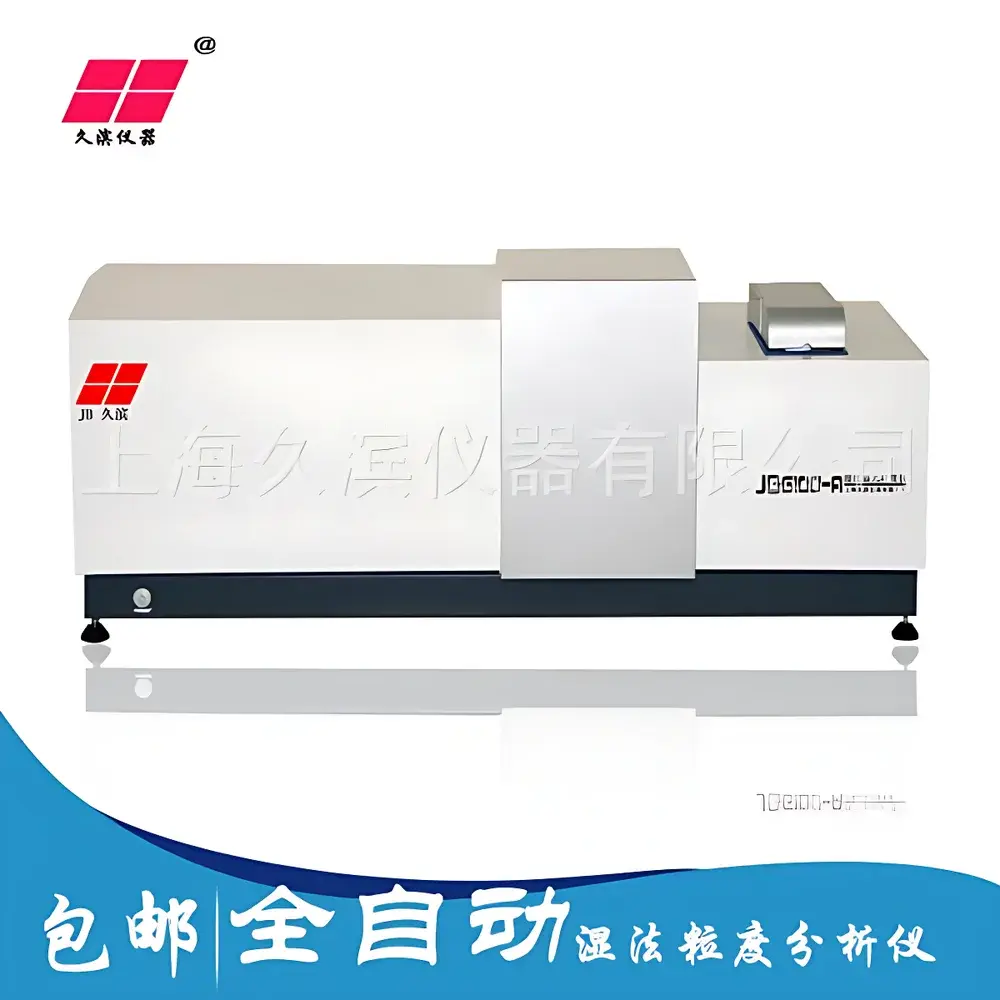
JB5100-H Wet-Dispersed Fully Automated Laser Particle Size Analyzer
| Brand | Jiubin Instruments |
|---|---|
| Origin | Shanghai, China |
| Model | JB5100-H |
| Dispersion Method | Wet Dispersion |
| Measurement Range | 0.1 µm – 600 µm |
| Repeatability | ≤0.5% (D50 of NIST-traceable standard reference material) |
| Measurement Time | <10 s per run (excluding dispersion conditioning) |
| Compliance | ISO 13320:2020, GB/T 19077–2016 |
| Laser Source | Fiber-coupled semiconductor laser, λ = 635 nm, output power >10 mW |
| Detector Channels | 70-channel high-density photodiode array |
| Optical Alignment | Motorized auto-centering system (0.2 µm step resolution, full alignment in ≤15 s) |
| Ultrasonic Dispersion | Frequency 40 kHz, power adjustable 0–80 W, dry-run protection integrated |
| Circulation System | Flow rate 0–10 L/min, variable speed pump (100–33950 rpm), sample volume ≥120 mL (optional micro-mode: ≥10 mL) |
| Sample Cell | Boiling-type dispersion cell (190–600 mL capacity), quick-release quartz window, dew-point monitoring sensor, bubble-free optical path design |
| Enclosure | Sealed dust- and shock-resistant chassis |
| Optional Configurations | Chemical-resistant wetted parts (acid/alkali/solvent compatible), GLP-compliant audit trail module |
Overview
The JB5100-H Wet-Dispersed Fully Automated Laser Particle Size Analyzer is an engineered solution for high-precision, routine particle size distribution (PSD) analysis in industrial quality control and R&D laboratories. It operates on the Mie scattering theory—rigorously validated for spherical and near-spherical particles—and employs a convergent beam Fourier transform optical architecture. This configuration enables optimal signal-to-noise ratio across the full dynamic range while minimizing focal length constraints. The instrument integrates a 70-channel high-density photodetector array with seamless channel overlap, ensuring continuous sensitivity from sub-micron to coarse particulates (0.1 µm – 600 µm). Its optical path is actively stabilized via a motor-driven auto-alignment system with 0.2 µm positional resolution, guaranteeing consistent beam centrality through the detection plane—a critical factor for reproducible D10/D50/D90 reporting under ISO 13320:2020 and GB/T 19077–2016 compliance requirements.
Key Features
- Fully automated measurement sequence: From sample introduction to report generation, minimal operator intervention is required—only loading the dispersed slurry into the circulation cell initiates a standardized protocol including ultrasonication, stirring, flow stabilization, and data acquisition.
- Intelligent ultrasonic dispersion module: Adjustable power (0–80 W) and duration; integrated dry-run prevention logic halts operation if liquid level falls below safe threshold, protecting transducer integrity.
- Boiling-type dispersion cell: Engineered for turbulent, uniform suspension without vortex formation; accommodates volumes from 190 mL to 600 mL, supporting both high-throughput batch analysis and low-volume screening (with optional 10 mL micro-circulation kit).
- Bubble-free optical path design: Fluidic geometry and inlet orientation eliminate air entrapment at the measurement zone, preventing spurious scattering artifacts that compromise sub-1 µm resolution.
- Dew-point monitoring system: Real-time humidity and temperature sensing at the quartz flow cell interface triggers software alerts when condensation risk exceeds calibration thresholds—ensuring optical clarity during ambient or chilled dispersion conditions.
- Chemical resistance options: Selectable wetted-path materials include PTFE-lined pumps, Hastelloy C-276 valves, and fused silica windows, enabling compatibility with aggressive media such as concentrated HCl, NaOH, acetone, phenol, and n-hexane.
- Robust mechanical architecture: Fully sealed enclosure with vibration-damping mounts and EMI-shielded electronics ensures stable operation in shared lab environments subject to floor-borne mechanical noise or electromagnetic interference.
Sample Compatibility & Compliance
The JB5100-H is validated for aqueous and organic dispersions of inorganic oxides (e.g., SiO₂, TiO₂), pharmaceutical actives (APIs), catalysts, pigments, battery cathode precursors, and polymer latexes. Its wet dispersion system supports surfactant-assisted deagglomeration and pH-controlled stabilization protocols. All hardware and firmware comply with ISO 13320:2020 for laser diffraction methodology, and measurement accuracy is traceable to NIST SRM 1963 (D50 = 10.02 ± 0.12 µm) and SRM 2800 (D50 = 52.8 ± 0.5 µm). For regulated environments, optional 21 CFR Part 11-compliant software adds electronic signatures, role-based access control, and immutable audit trails meeting GLP/GMP documentation standards.
Software & Data Management
Jiubin’s proprietary ParticleSight™ v4.2 software provides ISO-standard PSD calculation (volume-, number-, and surface-area-weighted distributions), multi-sample statistical comparison (ANOVA, t-test), and customizable report templates exportable to PDF, CSV, or XML. Raw scattering intensity data is stored in HDF5 format for third-party reprocessing. The platform supports scheduled calibration verification, automatic outlier rejection based on obscuration stability (real-time %T monitoring), and method locking to prevent unauthorized parameter modification. Data backups synchronize automatically to network drives or cloud storage with configurable retention policies.
Applications
- Pharmaceutical manufacturing: Monitoring micronization efficiency of APIs, verifying blend uniformity of dry powder inhalers, and characterizing nanoparticle drug carriers.
- Advanced materials R&D: Quantifying primary particle size and agglomerate breakdown behavior in ceramic slurries, carbon black dispersions, and quantum dot suspensions.
- Coatings & inks: Controlling pigment fineness-of-grind (FOG), assessing rheological impact of particle size distribution on gloss and settling resistance.
- Battery electrode development: Validating slurry homogeneity prior to coating, correlating cathode/anode particle size with electrochemical performance metrics.
- Environmental testing labs: Analyzing sediment grain size distributions in water quality studies per ASTM D422 and ISO 14688–1 protocols.
FAQ
What international standards does the JB5100-H comply with?
ISO 13320:2020, GB/T 19077–2016, and ASTM D7927–19 for laser diffraction particle sizing methodologies.
Can the instrument operate unattended for extended batch runs?
Yes—equipped with programmable autosampler integration capability (optional) and thermal-stable laser source (>10,000 h lifetime), it supports overnight sequential analysis of up to 96 samples with no manual intervention.
Is method validation support available for regulated industries?
Yes—Jiubin provides IQ/OQ documentation packages, installation qualification checklists, and on-site operational qualification assistance aligned with FDA and EU GMP Annex 11 expectations.
How is optical alignment maintained over time?
The motorized auto-centering system performs self-calibration before each measurement cycle using embedded reference photodiodes; alignment status is logged in every data file for traceability.
What maintenance intervals are recommended?
Quarterly verification using SRM 1963 and SRM 2800; annual inspection of pump seals, ultrasonic transducer coupling gel, and flow cell window cleanliness—no user-serviceable optics require replacement within first 5 years under normal use.



