
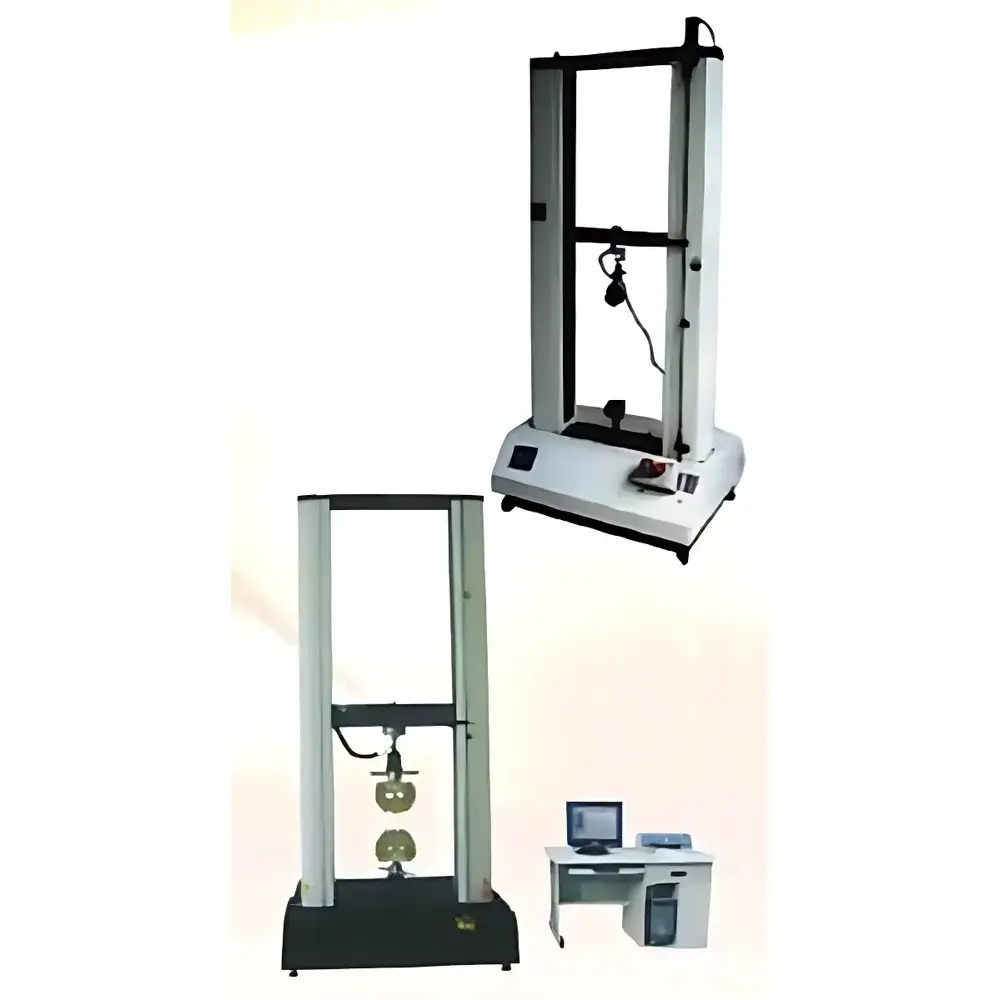
JByq JB-119B Three-Point Bending Tester
| Brand | JByq |
|---|---|
| Model | JB-119B |
| Origin | Taiwan |
| Load Capacity | 0–5 kN (user-selectable) |
| Force Sensing | High-precision load cell (USA-made) |
| Force Accuracy | ±0.5% of full scale |
| Effective Test Width | 380 mm |
| Max. Crosshead Travel | 1000 mm |
| Drive System | Servo motor (Japan-made) + AC motor (Taiwan-made) |
| Mechanical Transmission | Precision ball screw (Taiwan-made) + High-strength backlash-free screw (Korea-made) |
| Test Speed Range | 0.001–500 mm/min (infinitely variable) |
| Displacement Resolution | 1/200,000 |
| Displacement Accuracy | ±0.005% of reading |
| Safety Features | Upper/lower mechanical limits, emergency stop button |
| Display Interface | Dual-mode — PC-based software + embedded microcomputer display |
| Power Supply | 220 V / 380 V, 50 Hz |
| Net Weight | 1080–1180 kg |
| Dimensions (W×D×H) | 1280 × 950 × 1800 mm |
| Compliance | ASTM D790, ISO 178, GB/T 9341, GB/T 2567 |
Overview
The JByq JB-119B Three-Point Bending Tester is a floor-standing universal testing machine engineered for high-reproducibility flexural property evaluation of rigid and semi-rigid materials. It operates on the principle of three-point bending per ASTM D790 and ISO 178, where a rectangular or circular specimen is supported at two lower points while a centrally applied load induces pure bending moment distribution across the mid-span region. This configuration enables precise determination of flexural modulus, flexural strength, and stress–strain behavior under controlled displacement or load control modes. The system integrates a modular electromechanical architecture—featuring a servo-driven crosshead, high-rigidity frame, and calibrated load cell—to ensure mechanical stability and measurement fidelity across extended test cycles. Designed for laboratory and QC environments, the JB-119B delivers traceable mechanical performance in accordance with international standards for plastics, composites, ceramics, laminates, and structural polymers.
Key Features
- Modular dual-display operation: Simultaneous real-time monitoring via embedded microcomputer interface and Windows-based PC software—enabling both standalone use and networked data acquisition.
- High-fidelity force measurement: USA-sourced precision load cell with ±0.5% full-scale accuracy and 1/200,000 internal resolution ensures consistent quantification of bending loads up to 5 kN.
- Wide dynamic speed range: Infinitely variable crosshead velocity from 0.001 to 500 mm/min supports quasi-static flexural testing as well as rate-dependent characterization required by ISO 178 Annex A (strain-rate sensitivity assessment).
- Rigid mechanical architecture: Dual-screw transmission system—comprising Taiwan-manufactured precision ball screws and Korea-sourced zero-backlash lead screws—minimizes axial deflection and maintains alignment integrity during high-load bending tests.
- Comprehensive safety integration: Dual mechanical limit switches (upper/lower), redundant emergency stop circuitry, and automatic overload protection safeguard operator and equipment during unattended operation.
- Configurable test environment: Standardized support span and loading nose geometry comply with ASTM D790 (16:1 span-to-depth ratio) and ISO 178 (20:1 or 16:1 options); optional fixtures enable adaptation for flat, tubular, or irregular specimens.
Sample Compatibility & Compliance
The JB-119B accommodates specimens up to 380 mm wide and 1000 mm in maximum travel length, supporting standard test bars per ASTM D790 (e.g., 80 × 10 × 4 mm), ISO 178 (e.g., 80 × 10 × 4 mm or 120 × 15 × 10 mm), and GB/T 9341. It is routinely deployed for quality assurance of thermoplastics (PP, ABS, PC), fiber-reinforced composites, epoxy resins, ceramic substrates, and structural adhesives. All force, displacement, and timing parameters are traceable to national metrological standards. The system meets mechanical design requirements of ISO 7500-1 (Class 1 verification) and supports audit-ready documentation for GLP and GMP-regulated laboratories. Optional software modules provide 21 CFR Part 11-compliant electronic signatures, audit trails, and user-access controls.
Software & Data Management
The bundled Windows-based testing software offers full I/O control, real-time curve plotting (load vs. displacement, stress vs. strain), and automated report generation in PDF, Excel, and XML formats. Users may define multi-step test protocols—including preload conditioning, ramp-hold sequences, and fracture detection thresholds—via intuitive graphical programming. Data export supports statistical analysis (mean, SD, CV%) across batched samples. Raw datasets include timestamped metadata (operator ID, environmental conditions, calibration status), ensuring full traceability. Software validation documentation is available upon request for regulated environments requiring IQ/OQ/PQ protocols.
Applications
- Flexural property certification of engineering plastics per ASTM D790 and ISO 178 for automotive interior components and medical device housings.
- Quality conformance testing of fiber-reinforced polymer (FRP) laminates used in aerospace secondary structures.
- Evaluation of brittle material failure modes (e.g., ceramics, graphite) under bending stress to determine Weibull modulus and characteristic strength.
- Process validation of thermoset curing profiles through comparative flexural modulus tracking across post-cure timepoints.
- Comparative analysis of composite layup configurations (e.g., unidirectional vs. woven carbon fiber) under identical bending boundary conditions.
- Research-grade mechanical mapping of bio-based polymer blends for packaging sustainability initiatives.
FAQ
What standards does the JB-119B support for three-point bending tests?
ASTM D790, ISO 178, GB/T 9341, GB/T 2567, and EN 2562 are fully supported through preconfigured test templates and compliant fixture geometries.
Can the system perform both load-controlled and displacement-controlled bending tests?
Yes—the controller supports closed-loop operation in either mode, with seamless switching between them during a single test sequence.
Is the load cell factory-calibrated and NIST-traceable?
Each unit ships with a certificate of calibration referencing NIST-traceable standards; annual recalibration services are available via authorized service centers.
Does the software support multi-user permissions and electronic signatures?
Yes—role-based access control, audit trail logging, and 21 CFR Part 11-compliant electronic signature functionality are included in the enterprise license option.
What maintenance intervals are recommended for long-term accuracy?
Biannual verification of load cell linearity and displacement encoder resolution is advised; full mechanical inspection (screw lubrication, belt tension, sensor mounting torque) is recommended every 12 months or after 5,000 test cycles.



