
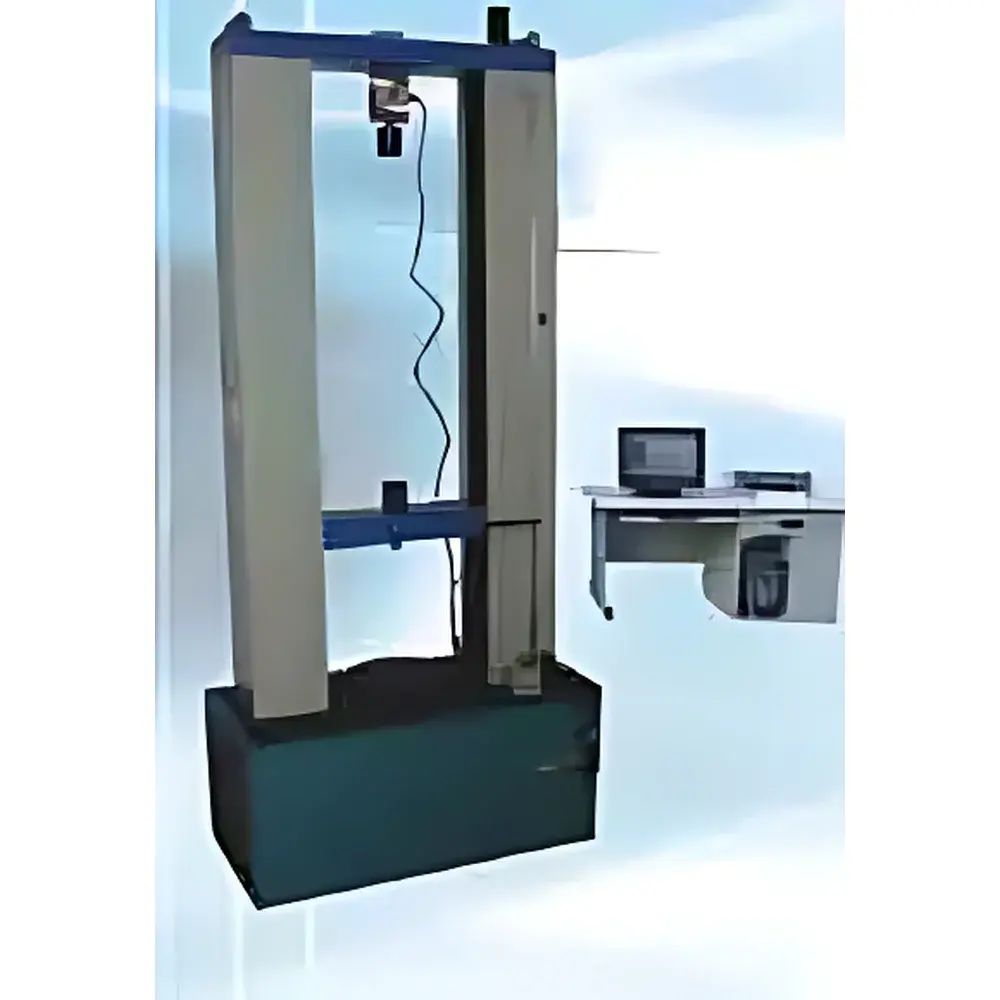
JByq JB-124 Servo-Controlled Universal Testing Machine
| Brand | JByq |
|---|---|
| Origin | Taiwan |
| Model | JB-124 |
| Load Capacity | 0–5 kN (user-selectable) |
| Force Sensing | High-Precision Load Cell (USA-made) |
| Force Accuracy | ±0.5% of full scale |
| Effective Test Width | 380 mm |
| Max. Stroke | 1000 mm |
| Drive System | Servo Motor (Japan-made) + AC Motor (Taiwan-made) |
| Mechanical Transmission | Precision Ball Screw (Taiwan-made) + High-Strength Zero-Backlash Screw (Korea-made) |
| Test Speed Range | 0.001–500 mm/min (infinitely variable) |
| Displacement Resolution | 1/200,000 |
| Displacement Accuracy | ±0.005% of reading |
| Safety Features | Upper/Lower Mechanical Limits, Emergency Stop Button |
| Display Interface | Dual-mode (PC + Microcomputer Controller) |
| Power Supply | 220 V / 380 V, 50 Hz |
| Net Weight | 1080–1180 kg |
| Dimensions (W×D×H) | 1280 × 950 × 1800 mm |
| Unit Options | g, kg, N, kN, lbf, lb |
Overview
The JByq JB-124 Servo-Controlled Universal Testing Machine is an electromechanically integrated materials testing system engineered for precision mechanical property evaluation across R&D laboratories, quality control departments, and production environments. It operates on the principle of controlled uniaxial force application—using a servo-driven actuator to apply tensile, compressive, flexural, or shear loads while synchronously measuring load, displacement, and strain in real time. The machine complies with fundamental mechanical testing standards including ASTM E4 (Standard Practices for Force Verification of Testing Machines), ASTM E8/E8M (Tension Testing of Metallic Materials), ASTM D638/D638M (Tensile Properties of Plastics), ISO 6892-1 (Metallic Materials – Tensile Testing), and ISO 527-1 (Plastics – Determination of Tensile Properties). Its modular architecture supports seamless integration into GLP- and GMP-aligned workflows, with hardware-level traceability and software audit trails compatible with FDA 21 CFR Part 11 requirements when configured with validated test software.
Key Features
- High-fidelity force measurement using a certified USA-manufactured load cell, delivering ±0.5% accuracy over the full 0–5 kN range—calibration-certified per ISO 376 and traceable to NIST standards.
- Dual-drive configuration: A high-response Japanese servo motor enables precise low-speed control (down to 0.001 mm/min), while a robust Taiwan-sourced AC motor ensures stable high-load operation at speeds up to 500 mm/min.
- Mechanical transmission system combines a preloaded Taiwan ball screw and a zero-backlash Korean lead screw—minimizing hysteresis and ensuring repeatable positioning accuracy within ±0.005% of measured displacement.
- Modular safety architecture includes dual mechanical end-limit switches, a redundant emergency stop circuit, and programmable software-based overload protection—meeting CE Machinery Directive (2006/42/EC) and ISO 13857 requirements.
- Dual-display interface: A dedicated microcomputer controller provides real-time parameter monitoring and manual mode operation; simultaneously, a Windows-based PC interface enables advanced test sequencing, curve overlay analysis, and automated report generation.
- Resolution of 1 part in 200,000 ensures detection of minute deformation events—critical for evaluating yield onset, creep behavior, and fracture initiation in polymers, composites, and thin metallic foils.
Sample Compatibility & Compliance
The JB-124 accommodates a broad spectrum of specimen geometries and material classes—including metals, elastomers, thermoplastics, textiles, leather, rubber, adhesives, laminates, and electrical insulation components. Standard test configurations include tensile (ASTM D638, ISO 527), compression (ASTM D695, ISO 604), three-point bend (ASTM D790, ISO 178), peel (ASTM D903), and shear (ASTM D5868). Optional accessories—such as extensometers (contact or non-contact), environmental chambers (-70°C to +300°C), and pneumatic wedge grips—extend compliance to USP , ISO 1099, and IEC 60811 test protocols. All mechanical subsystems are manufactured to RoHS-compliant specifications, and structural frames meet ISO 14001 environmental design criteria.
Software & Data Management
The system ships with JByq TestSuite™ v4.x—a Windows 10/11-compatible application supporting multi-channel data acquisition at up to 1 kHz sampling rate. Software features include customizable test method templates (pre-loaded with ASTM/ISO/GB standards), real-time stress-strain curve plotting, automatic yield point detection (0.2% offset, tangent, or secant methods), statistical batch reporting (mean, SD, CV%, Cp/Cpk), and export to CSV, PDF, XML, and Excel formats. Audit trail functionality logs all user actions—including method edits, calibration events, and result modifications—with timestamps, operator IDs, and IP addresses. When deployed in regulated environments, the software can be qualified per IQ/OQ/PQ protocols and configured for electronic signatures under 21 CFR Part 11 Annex 11 compliance.
Applications
This universal tester serves as a primary validation tool in electronics manufacturing (e.g., solder joint shear strength, connector retention force), automotive component QA (gasket compression set, seat belt webbing elongation), medical device development (catheter tensile integrity, suture breaking strength), and packaging R&D (peel adhesion of laminated films, seal strength of thermoformed trays). It is routinely employed for incoming raw material verification (e.g., copper strip tensile properties per ASTM B152), process capability studies (e.g., injection-molded part consistency), and failure analysis root-cause investigations—supporting ISO 9001:2015 clause 8.5.1 (Control of Production and Service Provision) and IATF 16949 section 8.5.1.2 (Statistical Tools).
FAQ
What load capacity options are available for the JB-124 series?
The JB-124 is configurable for maximum loads of 1 kN, 2.5 kN, or 5 kN—selected at time of order based on anticipated application requirements and specimen stiffness.
Is third-party calibration certification included with delivery?
Yes—each unit ships with a factory-issued calibration certificate traceable to NIST or NML (Taiwan), covering force (0–100% FS), displacement (0–1000 mm), and speed (0.001–500 mm/min) axes.
Can the system be integrated into an existing MES or LIMS environment?
Yes—the test software supports OPC UA and TCP/IP communication protocols, enabling bidirectional data exchange with Siemens Opcenter, LabVantage, or Thermo Fisher SampleManager via custom API modules.
What maintenance intervals are recommended for long-term accuracy retention?
Load cell recalibration every 12 months; ball screw lubrication every 6 months; mechanical limit switch verification before each shift; annual full-system metrological verification per ISO/IEC 17025 requirements.
Does the system support dynamic testing modes such as cyclic loading or fatigue?
The base JB-124 is optimized for quasi-static tests. For cyclic or high-cycle fatigue applications, JByq recommends the JB-2000 Series electrodynamic testing system—compatible with the same software platform and夹具 ecosystem.



