
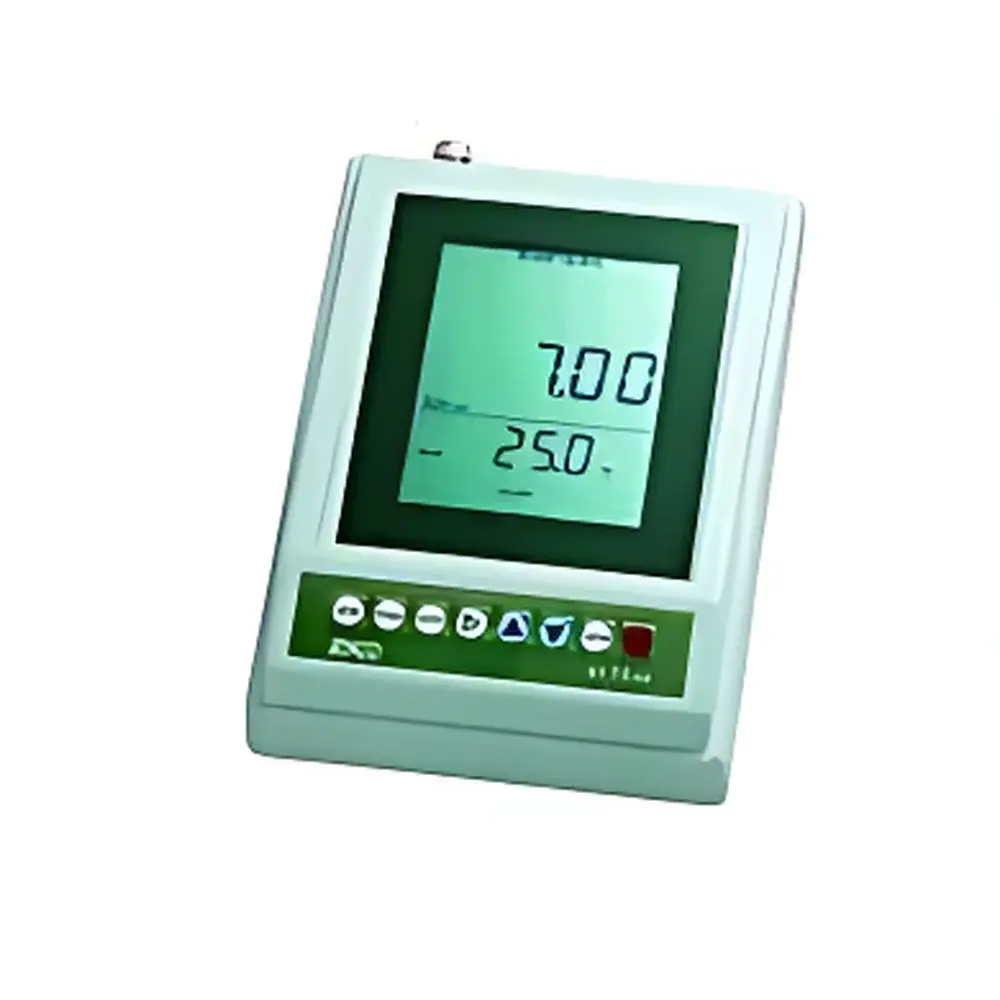
JENCO 6173/6173R Benchtop pH/ORP Meter
| Brand | JENCO |
|---|---|
| Origin | USA |
| Model | 6173 / 6173R |
| pH Range | –6.00 to 20.00 pH |
| pH Resolution | 0.01 pH |
| pH Accuracy | ±0.01 pH |
| ORP Range | –2000 to +2000 mV |
| ORP Resolution | 1 mV |
| ORP Accuracy | ±0.05% FS |
| Temperature Range | –10.0 to 120.0 °C |
| Temperature Resolution | 0.1 °C |
| Temperature Accuracy | ±0.5 °C |
| Calibration Points | 2-point (user-selectable buffers: 4.01/7.00/10.01 or 4.00/6.86/9.18) |
| Temperature Compensation | Automatic or Manual (–10.0 to 120.0 °C) |
| Electrode Slope Compensation | ±30% |
| Zero Offset Compensation | ±90 mV at pH 7.00/6.86 |
| Endpoint Detection & Hold Function | Yes |
| Data Storage | Calibration history retained |
| Communication Interface | RS-232C (6173R only) |
| Power Supply | 6 × AA batteries (1.5 V) or optional AC adapter |
| Dimensions | 230 × 165 × 80 mm |
| Weight | ~650 g (battery-free) |
| Environmental Rating | 0–50 °C, <95% RH non-condensing |
| Certifications | CE compliant |
Overview
The JENCO 6173 and 6173R are precision benchtop pH/ORP meters engineered for reproducible electrochemical measurements in academic research laboratories, quality control environments, and regulatory-compliant analytical workflows. These instruments operate on the fundamental principle of potentiometric measurement: a stable reference electrode and a pH-sensitive glass electrode generate a voltage differential proportional to hydrogen ion activity in aqueous solution, converted to pH units via the Nernst equation. Simultaneous redox potential (ORP) measurement is performed using a platinum or combination ORP electrode, enabling monitoring of oxidation-reduction equilibria critical in water treatment, fermentation, electroplating, and environmental monitoring. The dual-channel capability—pH and temperature displayed concurrently—supports real-time thermal compensation without manual recalibration. Designed with ISO/IEC 17025-aligned metrological rigor, the 6173 series delivers traceable accuracy suitable for method validation under GLP and GMP frameworks.
Key Features
- Large-format LCD display (21 × 16 mm character height) optimized for readability in shared lab environments and glove-box applications.
- Intelligent electrode diagnostics: real-time slope (% recovery) and zero offset (mV at pH 7.00/6.86) indicators support proactive electrode maintenance and qualification.
- Auto-temperature compensation (ATC) with built-in buffer temperature coefficient tables for NIST-traceable calibration standards (e.g., 4.00, 6.86, 9.18 at 25 °C).
- Endpoint detection algorithm with automatic hold function ensures stable reading capture prior to data logging or printout.
- Low-power architecture enables >200 hours of continuous operation on six AA alkaline cells; battery level indicator displays remaining capacity as a percentage.
- Tactile audio feedback on all keypad presses improves operational confidence during gloved handling or high-noise settings.
- CE-marked construction complies with EU Electromagnetic Compatibility (2014/30/EU) and Low Voltage (2014/35/EU) directives.
Sample Compatibility & Compliance
The 6173 series accommodates standard BNC-input pH and ORP electrodes—including refillable double-junction, gel-filled, and low-ionic-strength variants—for use across aqueous samples ranging from deionized water (low conductivity) to concentrated brines and biological buffers. Temperature probe input accepts Pt100 or thermistor-based sensors. Calibration supports both IUPAC-recommended buffer sets (4.01, 7.00, 10.01) and USP/EP-defined alternatives (4.00, 6.86, 9.18), facilitating cross-laboratory comparability. All measurement protocols align with ASTM D1293 (pH of water), ISO 10523 (water quality), and USP (pH measurement). Device firmware maintains audit-ready calibration logs, satisfying FDA 21 CFR Part 11 requirements when paired with compliant data acquisition software.
Software & Data Management
The 6173R variant integrates a full RS-232C serial interface compliant with EIA/TIA-232-F standards, enabling bidirectional communication with LIMS, Excel, or custom LabVIEW applications. ASCII-formatted output includes timestamped pH, mV, °C, electrode status, and calibration metadata. No proprietary drivers required—standard COM port configuration suffices. Calibration history is retained in non-volatile memory and can be recalled locally for verification. While the instrument itself does not store measurement datasets, endpoint-hold values may be manually recorded or transmitted in real time for integration into electronic lab notebooks (ELN) supporting ALCOA+ principles.
Applications
- Academic teaching labs: Demonstrating acid-base titration endpoints, buffer capacity, and Nernstian response kinetics.
- Pharmaceutical QC: Monitoring pH of injectables, ophthalmic solutions, and dissolution media per USP monographs.
- Environmental testing: Field-deployable verification of wastewater effluent pH and redox potential in compliance with EPA Method 150.1.
- Food & beverage R&D: Tracking fermentation pH drift in yogurt, beer, and kombucha production.
- Electrochemistry education: Correlating ORP trends with Fe²⁺/Fe³⁺, I⁻/I₂, or Cl₂/Cl⁻ redox couples.
FAQ
Does the 6173 support automatic calibration recognition (Auto-Buffer Recognition)?
No—calibration buffers must be manually selected by the user from the two supported triple-buffer sets. Auto-recognition is not implemented.
Can the meter perform temperature compensation without a connected temperature probe?
Yes—manual temperature entry is supported, though ATC is strongly recommended for accuracy in variable-temperature assays.
Is the RS-232 interface available on both models?
Only the 6173R includes RS-232C hardware; the base 6173 model lacks serial connectivity.
What electrode types are compatible with the 6173 series?
Any standard BNC-output pH or ORP electrode meeting IEC 60068-2-1/2 environmental specifications; double-junction reference electrodes are advised for samples containing sulfides, proteins, or heavy metals.
How often should calibration be performed?
Per ISO/IEC 17025, calibration frequency must be risk-assessed: typically before each analytical batch, after electrode replacement, or following exposure to extreme pH or temperature conditions.






