
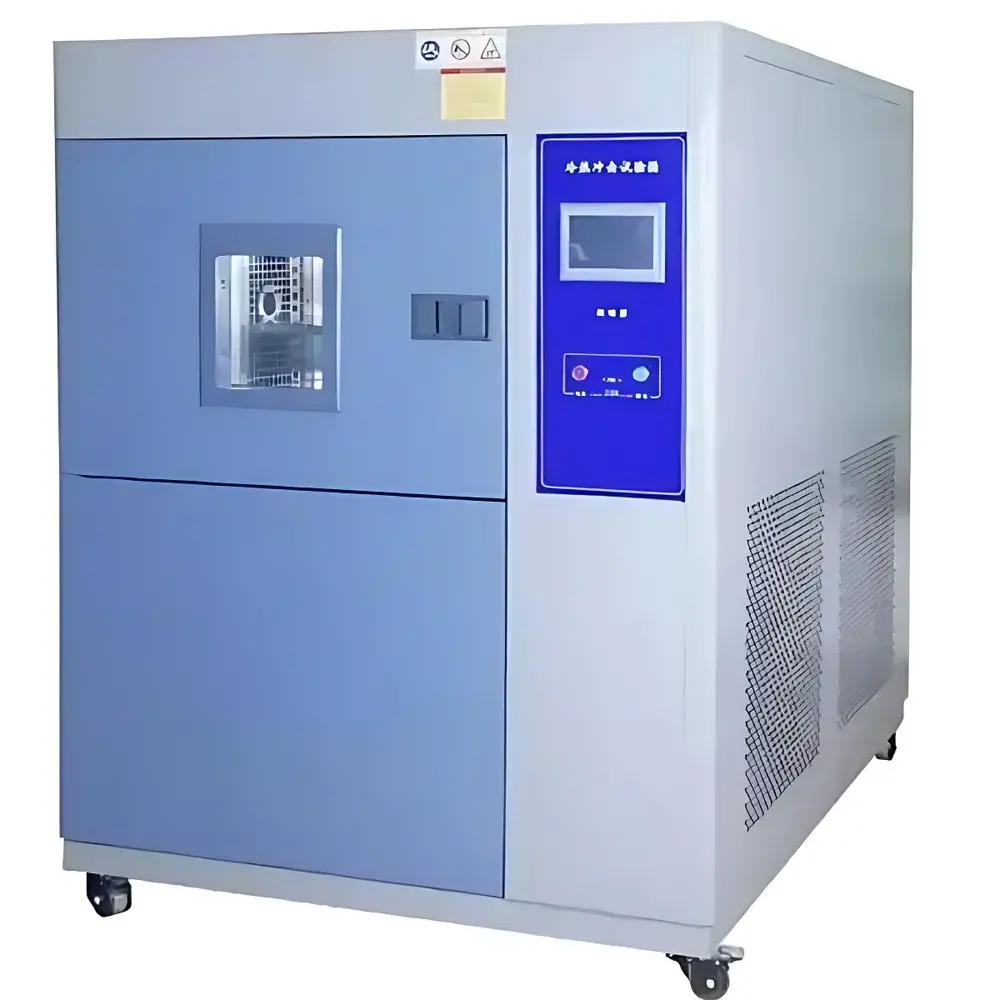
JH-SCIE Ice-Water Thermal Shock Test Chamber
| Brand | JH-SCIE |
|---|---|
| Origin | Shanghai, China |
| Manufacturer Type | Authorized Distributor |
| Product Category | Domestic |
| Model | JH-SCIE Ice-Water Thermal Shock Test Chamber |
| Price Range | USD 850 – 85,000 |
Overview
The JH-SCIE Ice-Water Thermal Shock Test Chamber is an engineered environmental reliability testing system designed to replicate combined thermal stress and mechanical impact conditions encountered in real-world low-temperature operational environments. It operates on the principle of controlled dual-phase thermal shock—rapid cycling between sub-zero refrigerated chambers and precisely metered ice-water spray delivery—enabling standardized evaluation of material integrity, sealing performance, and structural resilience under simultaneous cryogenic exposure and dynamic liquid impact. Unlike conventional cold chambers or standalone water spray systems, this chamber integrates programmable cryogenic cooling (down to –40 °C), high-fidelity ice-water generation (0–5 °C slurry with suspended micro-ice particles), and synchronized impact actuation to emulate field-relevant failure modes such as thermal contraction-induced seal leakage, ice-lens formation at interfaces, and shock-induced solder joint fatigue. Its architecture complies with fundamental test logic defined in IEC 60068-2-14 (change of temperature), ISO 16750-4 (road vehicles — environmental conditions), and ASTM D3418 (thermal transitions of polymers), forming a traceable basis for qualification testing across automotive, aerospace, and outdoor electronics sectors.
Key Features
- Integrated dual-zone thermal control: Independent high-efficiency cascade refrigeration system capable of stabilizing chamber temperature from –40 °C to +85 °C with ±0.5 °C uniformity over working volume
- Programmable ice-water delivery subsystem: Stainless-steel nozzles with adjustable pressure (0.1–1.0 MPa), flow rate (5–50 L/min), and angular orientation (±30° horizontal, ±15° vertical) to simulate road-splash, de-icing runoff, or glacial melt impact scenarios
- Thermal transition rate: Achieves –40 °C ↔ +60 °C transitions within ≤5 minutes (typical, 15 L internal volume), meeting accelerated thermal shock requirements per MIL-STD-810H Method 503.6
- Automated multi-step test sequencing: Up to 99 programmable cycles combining soak, ramp, dwell, and impact phases; user-defined trigger logic for initiating spray upon reaching target temperature thresholds
- Robust stainless-steel chamber construction with insulated double-wall design and anti-condensation heating jacket to prevent external frosting and ensure long-term calibration stability
- Compliance-ready data logging: Embedded timestamped acquisition of chamber temperature, spray pressure, ambient humidity, and cycle count with exportable CSV/Excel reports
Sample Compatibility & Compliance
The chamber accommodates test specimens up to 600 × 600 × 600 mm (W × D × H) and supports mounting fixtures for automotive under-hood components (e.g., ECUs, sensors, brake calipers), IP67-rated enclosures, polymer gaskets, battery modules, and optical housings. All operational parameters adhere to functional safety boundaries outlined in EN 61000-4-2 (ESD immunity) and EN 60529 (IP rating verification protocols). While not certified to UL or CE as a complete system, its subsystems meet RoHS 2011/65/EU material restrictions and operate within electromagnetic compatibility limits per CISPR 11 Group 1 Class A. For GLP/GMP-regulated laboratories, optional audit-trail firmware enables 21 CFR Part 11-compliant electronic signatures and user-access logs.
Software & Data Management
The embedded controller runs JH-SCIE TestSuite v3.2—a deterministic real-time OS platform supporting ISO/IEC 17025-aligned test method documentation. Users define test profiles via intuitive graphical interface with drag-and-drop phase sequencing, parameter validation rules (e.g., minimum dwell time ≥2 min before spray activation), and interlock safeguards (e.g., spray disabled if chamber door open or temperature deviation >±2 °C). Raw sensor data—including thermocouple readings (Type T, ±0.3 °C accuracy), pressure transducer outputs (0.05% FS), and cycle event timestamps—is stored locally on industrial-grade SD card with SHA-256 hash integrity verification. Export options include PDF test certificates with digital signature fields, XML for LIMS integration, and automated email alerts upon cycle completion or fault detection.
Applications
- Automotive: Validation of wheel hub assemblies, EV battery pack seals, and ADAS camera housings against winter road splash and thermal cycling per SAE J2334 and VW TL 226
- Electronics: Screening of conformal-coated PCBs for delamination, connector housing cracking, and moisture ingress pathways under repeated freeze-thaw impact
- Aerospace: Qualification of avionics enclosure gaskets and composite panel fasteners per DO-160G Section 24 (temperature shock) and Section 26 (rain and hail)
- Renewable Energy: Testing of solar inverter enclosures and wind turbine pitch control actuators for IPX5/IPX6 compliance under sub-zero wet conditions
- Academic Research: Controlled study of ice adhesion strength on hydrophobic coatings, frost propagation kinetics in porous media, and cryo-mechanical fatigue of polymer composites
FAQ
What temperature range does the chamber support?
The standard operating range is –40 °C to +85 °C, with optional extended low-temperature configuration down to –70 °C upon request.
Can the ice-water spray be deactivated while maintaining thermal cycling?
Yes—the thermal shock and spray functions are independently controllable via software or manual override.
Is calibration certification included with shipment?
A factory-as-built calibration report (traceable to NIM, China) is provided; accredited third-party calibration (e.g., CNAS) is available as an add-on service.
What maintenance intervals are recommended?
Refrigerant oil and filter replacement every 2,000 operating hours; nozzle inspection and cleaning every 500 spray cycles; annual full-system verification per ISO/IEC 17025 Annex A.3.
Does the system support remote monitoring?
Standard Ethernet (TCP/IP) and optional RS-485 Modbus RTU interfaces enable integration with building management systems or centralized lab monitoring platforms.
Related Products



