
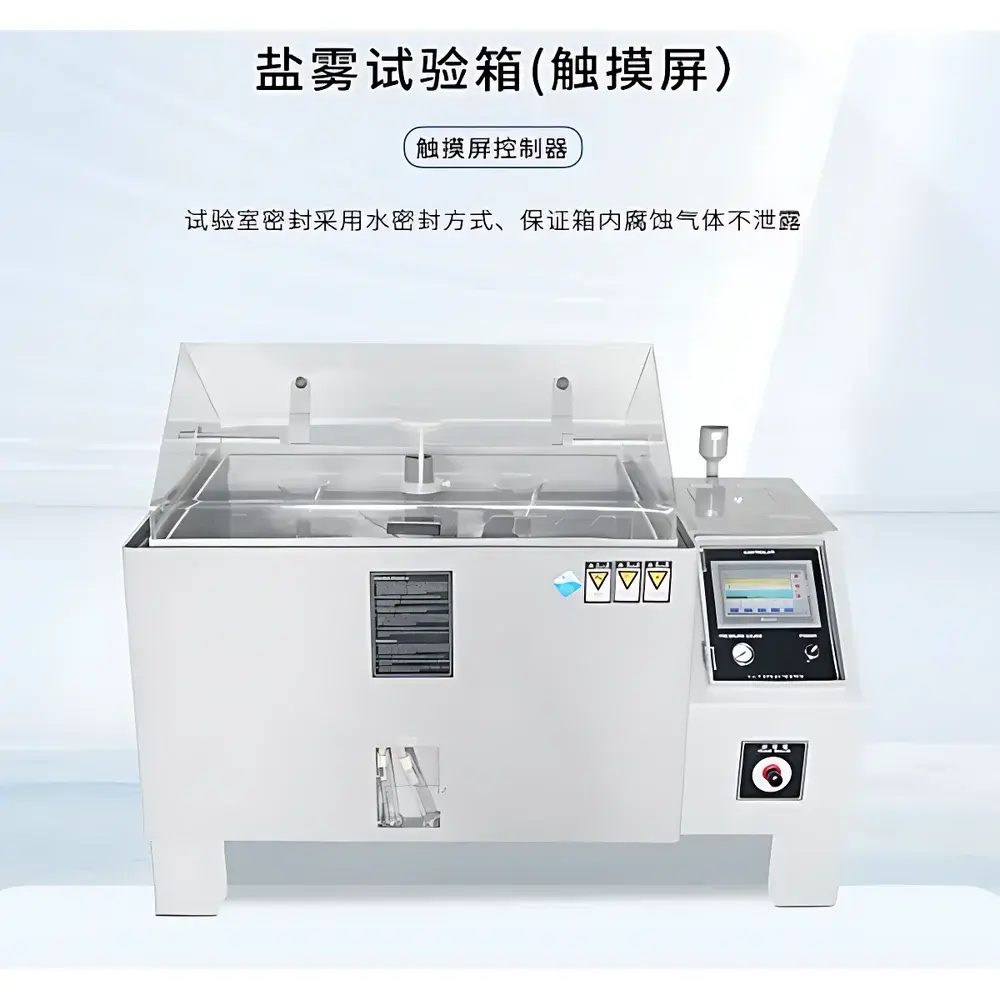
Jianhu Composite Salt Spray Test Chamber with Temperature & Humidity Control
| Brand | Jianhu |
|---|---|
| Origin | Shanghai, China |
| Model | Composite Salt Spray Test Chamber |
| Price Range | USD 700 – 7,000 |
| Manufacturer Type | OEM/ODM Manufacturer |
| Spray Method | Continuous Atomization |
| Spray Rate | 1–2 mL / 80 cm²·h |
| Nozzle Pressure | 0.7–1.0 kgf/cm² |
| De-misting Method | Air-Pressure Exhaust |
| Salt Fog Deposition Rate | 1 mL / 80 cm²·h |
| Temperature Range | RT + 5°C to 55°C |
| Humidity Control Range | 30–98% RH (at ≥25°C) |
| Compliance | ASTM B117, ISO 9227, GB/T 2423.17, JIS Z2371 |
Overview
The Jianhu Composite Salt Spray Test Chamber with Temperature & Humidity Control is an engineered environmental test system designed for accelerated corrosion evaluation under multi-stress conditions. Unlike conventional single-mode salt spray chambers operating solely per ASTM B117, this chamber integrates precise thermal regulation, dynamic humidity control, and continuous saline aerosol generation within a unified test volume—enabling true synergistic exposure profiles. Its core measurement principle relies on controlled nebulization of sodium chloride solution (typically 5% w/w NaCl) via calibrated air-pressure nozzles, followed by uniform fog deposition onto vertically oriented test specimens under regulated ambient temperature and relative humidity. The chamber’s architecture supports both static salt fog testing and composite cycling protocols—such as alternating salt spray, drying, and high-humidity conditioning phases—as defined in ISO 9227 Annex C (Cyclic Corrosion Testing) and GMW 14872. This capability allows laboratories to replicate real-world degradation mechanisms observed in coastal, industrial, or automotive under-hood environments where thermal gradients, moisture condensation, and chloride ion transport interact dynamically.
Key Features
- Integrated dual-climate control: Independent PID-regulated heating and humidification systems maintain temperature stability within ±2°C and humidity accuracy within ±3% RH (at ≥25°C), ensuring reproducible boundary conditions across test cycles.
- Calibrated continuous spray system: Stainless steel nozzles operate at 0.7–1.0 kgf/cm² pressure, delivering consistent fog deposition of 1.0–2.0 mL per 80 cm² per hour—verified per ISO 9227 section 6.3 and traceable to NIST-traceable volumetric standards.
- Air-pressure de-misting mechanism: Eliminates residual fog post-test without thermal shock or mechanical agitation, preserving specimen surface integrity and enabling rapid transition between test phases.
- Corrosion-resistant internal construction: Chamber walls and support structures fabricated from PP (polypropylene) and PVC-coated stainless steel (AISI 316L), certified per ASTM G101 for long-term resistance to chloride-induced pitting and stress corrosion cracking.
- OEM-configurable cycle programming: Supports up to 99 programmable steps with variable dwell times, temperature/humidity setpoints, and spray activation logic—compatible with IEC 61508 SIL2-compliant safety interlocks.
Sample Compatibility & Compliance
The chamber accommodates flat-panel, cylindrical, and irregularly shaped samples up to 600 mm × 450 mm × 400 mm (W×D×H). Fixtures are non-metallic (PP or PTFE) to prevent galvanic coupling. All operational parameters comply with internationally recognized corrosion testing standards including ASTM B117 (neutral salt spray), ISO 9227 (acetic acid and copper-accelerated variants), GB/T 2423.17, JIS Z2371, and VW PV1210. For regulated industries, the system supports audit-ready documentation: full calibration logs (traceable to CNAS-accredited labs), alarm event history, and configurable user access levels aligned with GLP and ISO/IEC 17025 requirements. Optional 21 CFR Part 11-compliant software modules provide electronic signatures, audit trails, and data integrity safeguards for pharmaceutical and medical device validation.
Software & Data Management
Equipped with embedded 7-inch HMI touchscreen interface running real-time Linux OS, the chamber records temperature, humidity, spray status, and chamber pressure at 1-second intervals. Raw data exports to CSV or XML formats; optional PC-based JianhuTestSuite v4.2 enables advanced analysis—including deposition rate trending, cycle deviation mapping, and statistical process control (SPC) charting per ISO 7870-2. All firmware updates are digitally signed and verified; configuration backups support version-controlled restoration. Data storage complies with IEC 62443-3-3 for industrial cybersecurity, with TLS 1.2 encryption for remote diagnostics and cloud sync (optional).
Applications
This chamber serves R&D, QC, and reliability engineering teams across sectors requiring rigorous corrosion validation: automotive component suppliers validating brake calipers, fasteners, and EV battery enclosures per SAE J2334; electronics manufacturers assessing conformal coating performance on PCBAs under IPC-CC-830B; aerospace Tier-1s qualifying titanium alloy fasteners per AMS 2700; and biomedical device firms evaluating stainless steel surgical instruments per ISO 13485 Annex C. Academic users apply it for fundamental studies on atmospheric corrosion kinetics, inhibitor efficacy screening, and electrochemical impedance spectroscopy (EIS) sample pre-conditioning.
FAQ
What standards does this chamber fully support out-of-the-box?
ASTM B117, ISO 9227 (NSS, AASS, CASS), GB/T 2423.17, JIS Z2371, and DIN 50021—all verified during factory acceptance testing (FAT) with third-party calibration certificates.
Can the chamber perform cyclic corrosion tests with automated phase transitions?
Yes. The built-in controller supports multi-step cycling (e.g., 2h salt spray → 4h drying → 2h high-humidity soak) with programmable ramp rates and hold tolerances per ISO 11997-1.
Is remote monitoring and data export compliant with FDA 21 CFR Part 11?
Optional Part 11 add-on module provides electronic signatures, role-based access control, immutable audit trails, and encrypted data archives—validated per IQ/OQ protocols.
What maintenance intervals are recommended for long-term accuracy?
Nozzle inspection every 200 operational hours; humidity sensor recalibration annually; full system verification per ISO/IEC 17025 every 12 months using traceable reference standards.
Does Jianhu provide installation qualification (IQ) and operational qualification (OQ) documentation?
Yes. Standard delivery includes FAT report, IQ/OQ templates, and commissioning support—customizable to client-specific validation SOPs.



