
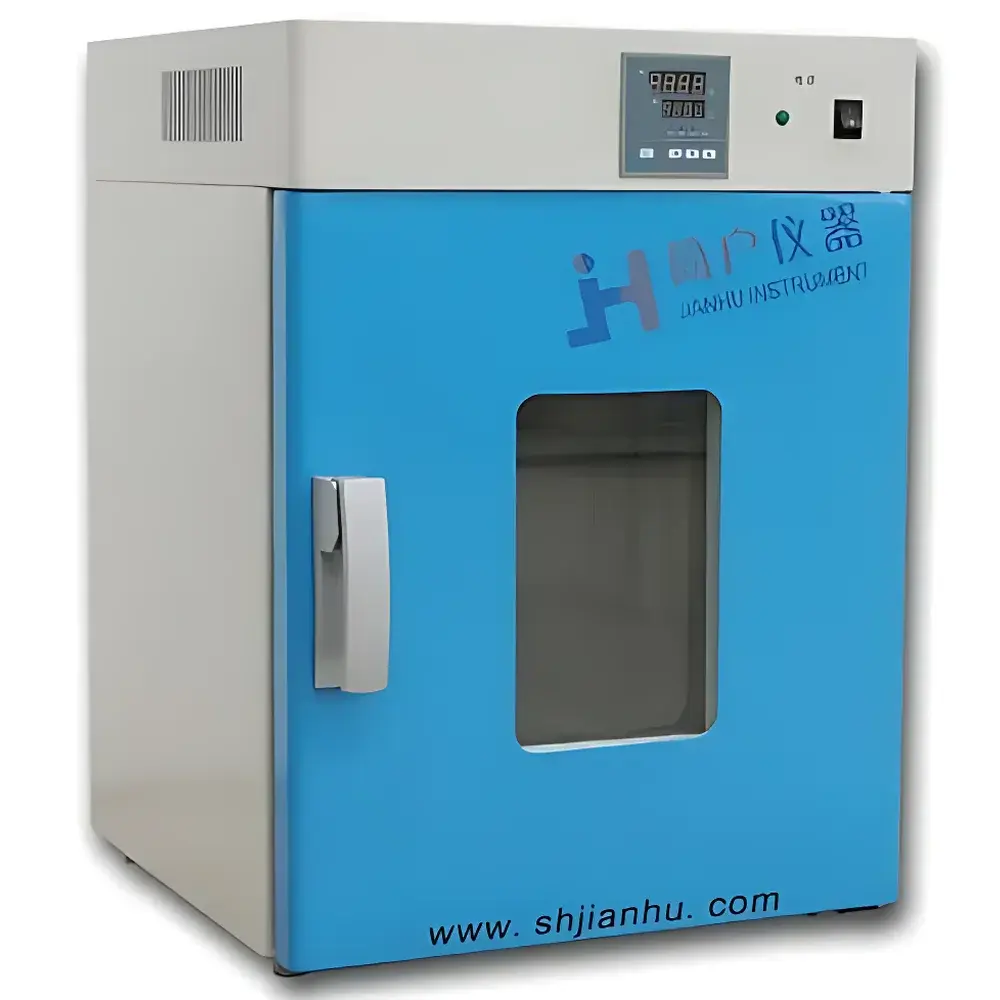
Jianhu DJH-30L-L High-Temperature Aging Test Chamber (Up to 500 °C)
| Brand | Jianhu |
|---|---|
| Model | DJH-30L-L |
| Origin | Hunan, China |
| Temperature Range | 100–500 °C |
| Temperature Resolution | 0.1 °C |
| Temperature Uniformity | ±1 °C |
| Interior Dimensions (W×D×H) | 350×350×400 mm |
| Capacity | 50 L |
| Power Supply | 220 V / 50 Hz |
| Input Power | 2800 W |
| Interior Material | Mirror-finish (brushed) stainless steel |
| Control System | PID-based digital temperature controller |
| Optional Features | Independent over-temperature protection alarm, 4–20 mA analog output, RS485 communication interface, Φ50 mm side access port |
Overview
The Jianhu DJH-30L-L High-Temperature Aging Test Chamber is an industrial-grade thermal processing system engineered for precise, repeatable, and safe operation at elevated temperatures up to 500 °C. Designed in accordance with fundamental principles of convective heat transfer and thermal equilibrium control, this chamber employs forced-air circulation with optimized airflow distribution to ensure uniform temperature distribution across the working volume. Its primary function is to accelerate thermal aging, stress relief, moisture removal, wax melting, sterilization, and material conditioning under controlled ambient conditions. Unlike general-purpose ovens, the DJH-30L-L integrates structural and control-level safeguards—such as dual-stage thermal monitoring and fail-safe cutoff logic—to meet baseline safety expectations for laboratory and light-industrial environments where prolonged exposure to extreme temperatures poses inherent operational risks.
Key Features
- Mirror-finish brushed stainless steel interior chamber with seamless, radius-rounded corners (R ≥ 25 mm) for enhanced thermal reflectivity, corrosion resistance, and ease of decontamination.
- Microprocessor-based PID temperature controller with adaptive tuning algorithm—enabling rapid setpoint attainment (<15 min from ambient to 400 °C) and stable regulation (±1 °C fluctuation at steady state).
- Independent mechanical over-temperature cut-off circuit (optional), physically isolated from the main controller, providing redundant thermal safety per IEC 61000-4-2 compliance requirements.
- Standard 50 mm diameter access port on left sidewall, fitted with high-temp silicone gasket and threaded cap—designed for real-time thermocouple insertion or sensor feedthrough without compromising chamber integrity.
- Modular shelf support system with tool-free, slide-in/out stainless steel trays (2 included); load capacity per shelf: ≤15 kg; maximum total payload: 30 kg.
- Integrated analog (4–20 mA) output and RS485 serial interface (Modbus RTU protocol)—enabling direct integration with SCADA systems, data loggers, or LIMS platforms for audit-ready thermal process documentation.
Sample Compatibility & Compliance
The DJH-30L-L accommodates a broad range of solid-state samples—including metal components, polymer specimens, ceramic substrates, powder compacts, and glassware—provided they remain dimensionally stable below 500 °C and do not outgas volatile organics exceeding 10−4 mbar partial pressure. The chamber complies with GB/T 5170.1–2018 (Chinese national standard for environmental testing equipment) and meets essential safety clauses of IEC 61010-1:2010 (Safety requirements for electrical equipment for measurement, control, and laboratory use). While not certified to UL or CE for standalone sale in North America/EU, its architecture supports customization to meet ASTM E145 Class II or ISO 17025-compliant validation protocols when deployed within accredited quality management systems (e.g., ISO 9001:2015, GMP Annex 15).
Software & Data Management
The unit operates autonomously via its embedded controller but supports external data acquisition through its RS485 port using open Modbus RTU registers. Users may configure time-stamped temperature logging at user-defined intervals (1 s to 60 min) via third-party software such as LabVIEW, MATLAB, or custom Python scripts leveraging PyModbus. Analog output enables connection to strip-chart recorders or PLC analog inputs for continuous analog traceability. All parameter settings—including ramp rate, soak duration, and alarm thresholds—are non-volatile and retained after power interruption. Audit trail functionality (e.g., change history, operator ID tagging) requires external middleware and is compatible with FDA 21 CFR Part 11–compliant electronic record systems when paired with appropriate authentication and electronic signature modules.
Applications
- Thermal aging studies of aerospace alloys and automotive brake components per ASTM D3045.
- Pre-baking of PCB assemblies and solder paste stencils prior to reflow processing.
- Drying and curing of ceramic green bodies and refractory coatings in R&D laboratories.
- Residue ashing of organic matrices in metallurgical sample preparation workflows.
- Calibration verification of high-temperature thermocouples (Type K, N, S) using fixed-point reference blocks.
- Accelerated life testing of elastomeric seals and gasket materials under sustained thermal load.
FAQ
What is the maximum recommended continuous operating temperature?
The chamber is rated for continuous operation at 450 °C; operation at 500 °C is limited to intermittent cycles not exceeding 2 hours per session to preserve heating element longevity and insulation integrity.
Can this chamber be validated for GLP or GMP compliance?
Yes—when equipped with calibrated Class A PT100 sensors, external data loggers, and documented IQ/OQ/PQ protocols, it supports qualification under ISO/IEC 17025 and FDA guidance for laboratory equipment.
Is the interior volume fully usable at 500 °C?
Yes—the specified 50 L working volume remains thermally homogeneous across the full 100–500 °C range, verified by 9-point mapping per GB/T 5170.1.
Does the unit include calibration certificates?
Factory calibration is performed at 200 °C and 400 °C; NIST-traceable calibration certificates are available upon request (additional charge applies).
What maintenance intervals are recommended?
Heating element resistance checks every 6 months; door gasket inspection and cleaning every 3 months; airflow path inspection annually—especially if used with particulate-laden or hygroscopic samples.



