
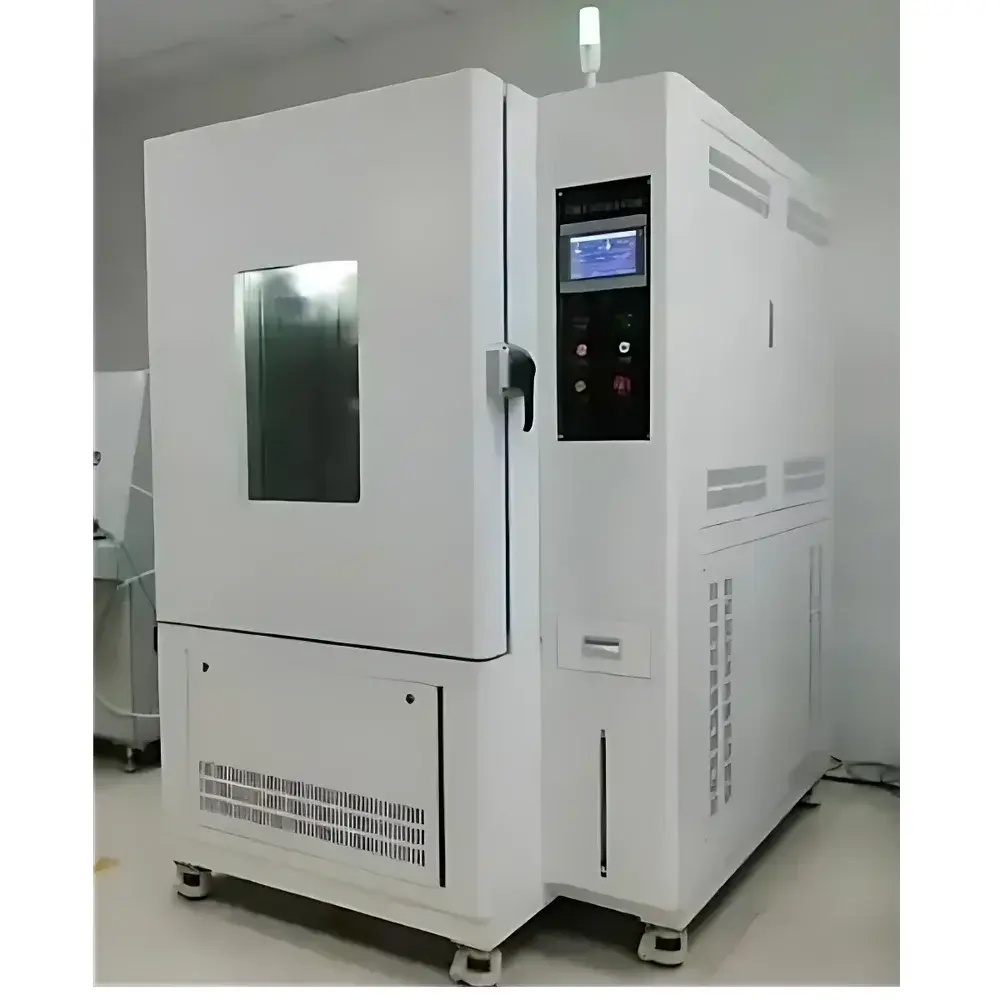
Jianhu DV-TC2 Two-Zone Thermal Shock Test Chamber
| Brand | Jianhu |
|---|---|
| Origin | Shanghai, China |
| Model | DV-TC2 |
| High Temperature Range | +60°C to +200°C |
| Low Temperature Range | −78°C to 0°C |
| Thermal Shock Range | −55°C to +125°C |
| Temperature Stability | ±0.5°C |
| Heating Rate | +60°C → +200°C (typical) |
| Cooling Rate | +20°C → −75°C (typical) |
Overview
The Jianhu DV-TC2 Two-Zone Thermal Shock Test Chamber is an engineered solution for accelerated reliability assessment of electronic components, automotive modules, aerospace assemblies, and medical devices under extreme temperature transitions. Based on the dual-chamber (hot/cold) principle, it eliminates internal air mixing and enables rapid, repeatable thermal transitions—critical for simulating real-world environmental stress such as power-on cold starts, battery thermal cycling, or solder joint fatigue in PCBs. The system complies with core international test standards including IEC 60068-2-14 (Change of Temperature), GB/T 2423.22–2022 (Environmental Testing – Part 2: Test Methods – Test N: Change of Temperature), and MIL-STD-810H Method 503.7 (Temperature Shock). Its architecture features independent hot and cold chambers with pneumatically actuated transfer mechanisms, minimizing thermal lag and ensuring traceable transition times per cycle.
Key Features
- Two-zone physical separation: Dedicated high-temperature (+60°C to +200°C) and low-temperature (−78°C to 0°C) chambers eliminate cross-contamination and ensure precise boundary control.
- High-stability temperature regulation: ±0.5°C stability maintained across both zones using PID-controlled solid-state relays, platinum RTD sensors (Class A, IEC 60751), and insulated chamber walls with multi-layer vacuum-sealed panels.
- Rapid thermal transition capability: Achieves typical transfer times <15 seconds between zones; supports programmable dwell times (1 min–999 h) and up to 999 cycles per test profile.
- Robust mechanical design: Stainless steel 304 interior, reinforced aluminum alloy frame, and industrial-grade pneumatic transfer arm rated for >500,000 cycles without maintenance.
- Compressor redundancy-ready configuration: Optional dual-circuit refrigeration system (not standard) enables uninterrupted operation during scheduled maintenance—aligned with GMP/GLP lab continuity requirements.
Sample Compatibility & Compliance
The DV-TC2 accommodates samples up to 300 mm × 300 mm × 300 mm (W×D×H) and supports standardized test fixtures for PCBs, battery cells, connectors, and encapsulated optoelectronic packages. It meets dimensional and operational criteria for ASTM D5229/D5229M (low-temperature impact resistance of composites), ISO 16750-4 (road vehicles – environmental conditions), and USP (pharmaceutical packaging thermal stability). All temperature profiles are fully configurable via embedded controller and exportable in CSV format for audit trails. The chamber’s thermal mapping validation protocol follows IEC 60068-3-5 and includes 9-point sensor placement per zone (per GB/T 5170.2–2016), with calibration certificates traceable to CNAS-accredited laboratories.
Software & Data Management
The integrated touch-panel controller supports multi-step profile programming, real-time graphing of chamber temperatures, and automatic logging of cycle count, dwell time, transition duration, and deviation alerts. Data export complies with FDA 21 CFR Part 11 requirements when paired with optional PC-based software (Jianhu LabLink v3.2), which provides role-based user access, electronic signatures, audit trail generation, and report templates aligned with ISO/IEC 17025 documentation needs. Raw temperature logs include timestamps with millisecond resolution and are stored locally (SD card) and optionally synchronized to network drives via Ethernet. Remote monitoring via Modbus TCP is supported for integration into centralized MES or LIMS environments.
Applications
- Electronics reliability screening: Solder joint integrity testing per JEDEC JESD22-A104 (Temperature Cycling) and failure mode analysis of BGA packages under repeated −55°C/+125°C transitions.
- EV battery module qualification: Simulating fast-charge thermal shock scenarios (e.g., +55°C charging → −20°C storage) per GB/T 31467.3 and UN 38.3 Section 5.4.
- Aerospace component validation: Testing avionics enclosures against MIL-STD-810H Method 503.7 for survivability in stratospheric-to-ground thermal gradients.
- Medical device sterilization packaging: Evaluating seal integrity of Tyvek®-laminated pouches after repeated exposure to −40°C/+85°C cycles per ISO 11607-2.
- LED lighting thermal endurance: Accelerated aging of phosphor coatings and silicone encapsulants under high-heat soak followed by cryogenic shock.
FAQ
What is the minimum recommended sample volume for valid thermal shock testing?
For compliance with IEC 60068-2-14, the total sample volume should not exceed 10% of the cold chamber’s internal volume to avoid thermal mass interference. For the DV-TC2, this corresponds to ≤2.7 L.
Does the DV-TC2 support humidity coupling?
No—the DV-TC2 is a dry thermal shock system. Humidity-integrated variants (e.g., DV-TC2-H) require separate specification and are compliant with IEC 60068-2-30 (damp heat cycling).
How often must the system undergo metrological verification?
Per ISO/IEC 17025, quarterly verification using NIST-traceable reference thermometers is recommended. Full thermal mapping per GB/T 5170.2–2016 is required annually or after major maintenance.
Is the controller firmware upgradable in-field?
Yes—firmware updates are delivered via USB stick and retain all user-defined profiles and calibration offsets without reset.
Can the DV-TC2 be integrated into an automated test line?
Yes—RS-485 (Modbus RTU) and Ethernet (Modbus TCP) interfaces support PLC-level integration for start/stop commands, status polling, and alarm forwarding to SCADA systems.



