
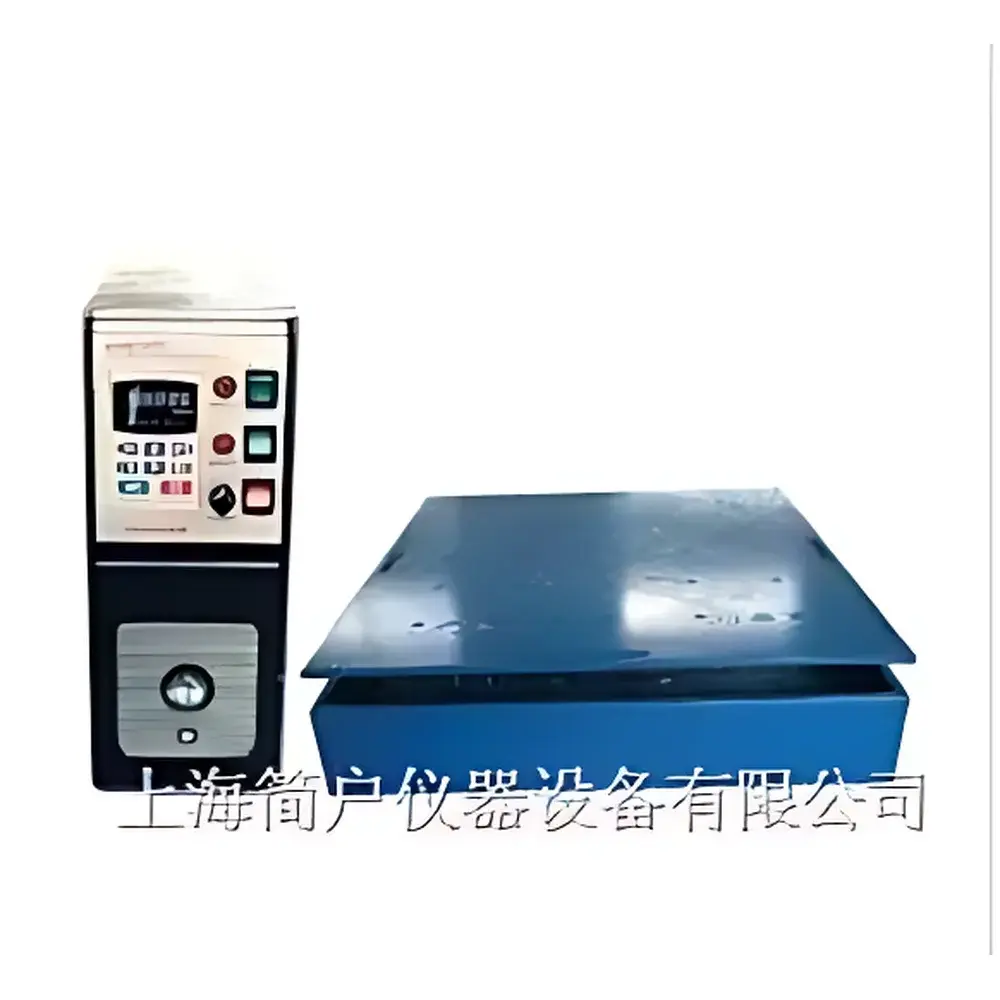
Jianhu JDZD-XPTP Quad-Axis Electrodynamic Vibration Shaker System with Integrated PC Control
| Brand | Jianhu |
|---|---|
| Origin | Shanghai, China |
| Manufacturer Type | Authorized Distributor |
| Instrument Type | Electrodynamic Vibration Shaker |
| Rated Thrust | 2000 kgf |
| Frequency Range | 1–600 Hz / 1–3000 Hz / 1–5000 Hz (±0.1%) |
| Max Test Load | 0–100 kg |
| Table Dimensions | 500 × 6 × 500 mm |
| Max Acceleration | 0–20 g (0–196.2 m/s²) |
| Peak Sine Force | 2000 kgf |
| Displacement (p-p) | 0–5 mm |
| Programmable Segments | 15 |
| Precision | 0.01 Hz frequency resolution |
| Power Supply | 220 V ±20%, 50/60 Hz |
| Input Current | ≤10 A |
| Motor Power | 2.2 kW |
| Cooling | Natural Air Cooling |
| Operating Environment | –10 °C to +60 °C, 10–95% RH |
| Sound Pressure Level | ≤60 dB(A) |
| Magnetic Field Emission | ≤110 mG at 1 m |
| Communication Interface | RS-485 |
| Optional Accessories | Acceleration/Displacement Sensor Kit, Full PC Control Software Suite |
Overview
The Jianhu JDZD-XPTP is a fully integrated quad-axis electrodynamic vibration shaker system engineered for rigorous physical property testing under multi-directional dynamic loading conditions. Unlike conventional single- or dual-axis shakers, this system enables synchronized or independent excitation across four orthogonal degrees of freedom—vertical (up/down), lateral (left/right), and longitudinal (front/back)—all operating from a single rigid test table. Its core actuation principle relies on high-fidelity electromagnetic force generation, delivering precise sinusoidal, swept-sine, random, and road-simulation waveforms compliant with international vibration test standards including ISO 2041, IEC 60068-2-6, MIL-STD-810H Method 514.8, and ASTM D999. Designed for laboratory-grade reproducibility and long-term stability, the JDZD-XPTP incorporates patented mechanical resonance optimization and reinforced structural damping, resulting in a 100% improvement in base rigidity compared to prior-generation platforms. The system supports both open-loop and closed-loop control modes, with real-time waveform fidelity maintained across its full operational bandwidth.
Key Features
- Quad-axis motion capability: simultaneous or sequential excitation in vertical, left-right, and front-back axes—enabling true 4D spatial vibration profiles.
- Three selectable frequency ranges: 1–600 Hz (standard), 1–3000 Hz (high-frequency option), and 1–5000 Hz (ultra-high-frequency option), all calibrated to ±0.1% accuracy.
- Dual independent output channels: allows concurrent operation of two distinct vibration profiles—for example, vertical sine sweep while applying horizontal random vibration.
- High-thrust electrodynamic actuator: rated at 2000 kgf peak sine force, supporting maximum accelerations up to 20 g (196.2 m/s²) and displacement amplitudes up to ±2.5 mm (5 mm p-p).
- Standard 500 × 500 mm stainless steel test table with 25 × M10 threaded mounting holes and four reinforced hook-mounting points (175 mm center-to-center spacing).
- RS-485 interface as standard; optional full PC integration package includes real-time data logging, waveform synthesis, spectral analysis, and report generation.
- Comprehensive waveform library: sine (half/full), swept-sine (linear/logarithmic), programmable step sequences (15 segments), octave-based sweep, random PSD synthesis, and user-defined road profile emulation.
- Real-time parameter control: amplitude, acceleration, frequency, dwell time, and sweep rate are adjustable on-the-fly with 0.01 Hz frequency resolution.
Sample Compatibility & Compliance
The JDZD-XPTP accommodates test specimens weighing up to 100 kg without requiring external mass compensation or auxiliary support fixtures. Its low-noise (<60 dB(A)) and low-EMI (<110 mG at 1 m) design ensures compatibility with sensitive instrumentation such as laser interferometers, MEMS sensors, and optical metrology systems mounted adjacent to the shaker. The system meets CE marking requirements for electromagnetic compatibility (EN 61326-1) and safety (EN 61000-6-2/-6-4). It supports GLP/GMP-aligned test execution when paired with optional audit-trail-enabled PC software compliant with FDA 21 CFR Part 11 requirements for electronic records and signatures. Calibration certificates traceable to NIM (National Institute of Metrology, China) are available upon request.
Software & Data Management
The optional PC control suite provides a Windows-based graphical interface for test definition, real-time monitoring, and post-test analysis. Users can construct complex multi-segment vibration profiles—including mixed-mode sequences combining sine sweeps, random spectra, and transient shocks—with full parameter locking and version-controlled project saving. All acquired data—including acceleration, displacement, drive voltage, and thermal status—are timestamped and stored in IEEE-compliant .tdms or ASCII CSV format. Built-in FFT analysis, PSD estimation, and transmissibility calculation modules support immediate verification of resonant behavior and structural damping characteristics. Data export functions comply with LIMS integration protocols, and automated report templates generate PDF outputs with embedded metadata, calibration history, and pass/fail annotations per ISO/IEC 17025 guidelines.
Applications
This system serves critical validation needs across aerospace component qualification (e.g., avionics housing durability), automotive electronics reliability testing (ECU, ADAS sensor mounts), consumer electronics drop-and-vibration simulation (smartphones, wearables), packaging integrity assessment (ASTM D4169), and materials fatigue characterization under combined-axis loading. Its ability to replicate multi-axial road profiles makes it particularly valuable for Tier-1 supplier testing of suspension bushings, battery enclosures, and infotainment modules. Academic researchers utilize the platform for experimental modal analysis, nonlinear dynamics studies, and validation of finite element models subjected to coupled translational excitations.
FAQ
What does “quad-axis” mean in this context?
It refers to the system’s capacity to generate controlled mechanical vibration simultaneously along four orthogonal directions—vertical (Z), lateral (Y), longitudinal (X), and their vector combinations—using a single unified actuation architecture.
Is the 5000 Hz frequency range available as standard or optional?
The 1–5000 Hz range is an optional high-frequency configuration requiring upgraded armature assembly and feedback sensor calibration; it must be specified at time of order.
Can the system perform closed-loop control using external accelerometers?
Yes—when equipped with the optional sensor interface module, the system accepts analog inputs from triaxial accelerometers and dynamically adjusts drive signals to maintain target response spectra.
Does the system support MIL-STD-810H vibration test methods?
All standard waveform modes—including swept-sine, random, and shock response spectrum (SRS) synthesis—meet Method 514.8 requirements; custom test profiles can be imported via CSV or MATLAB-generated scripts.
What is included in the “full PC control” option?
The package comprises dedicated acquisition hardware, USB/RS-485 interface converter, pre-installed software with unlimited node licensing, electronic calibration certificate, and one year of technical support and firmware updates.



