
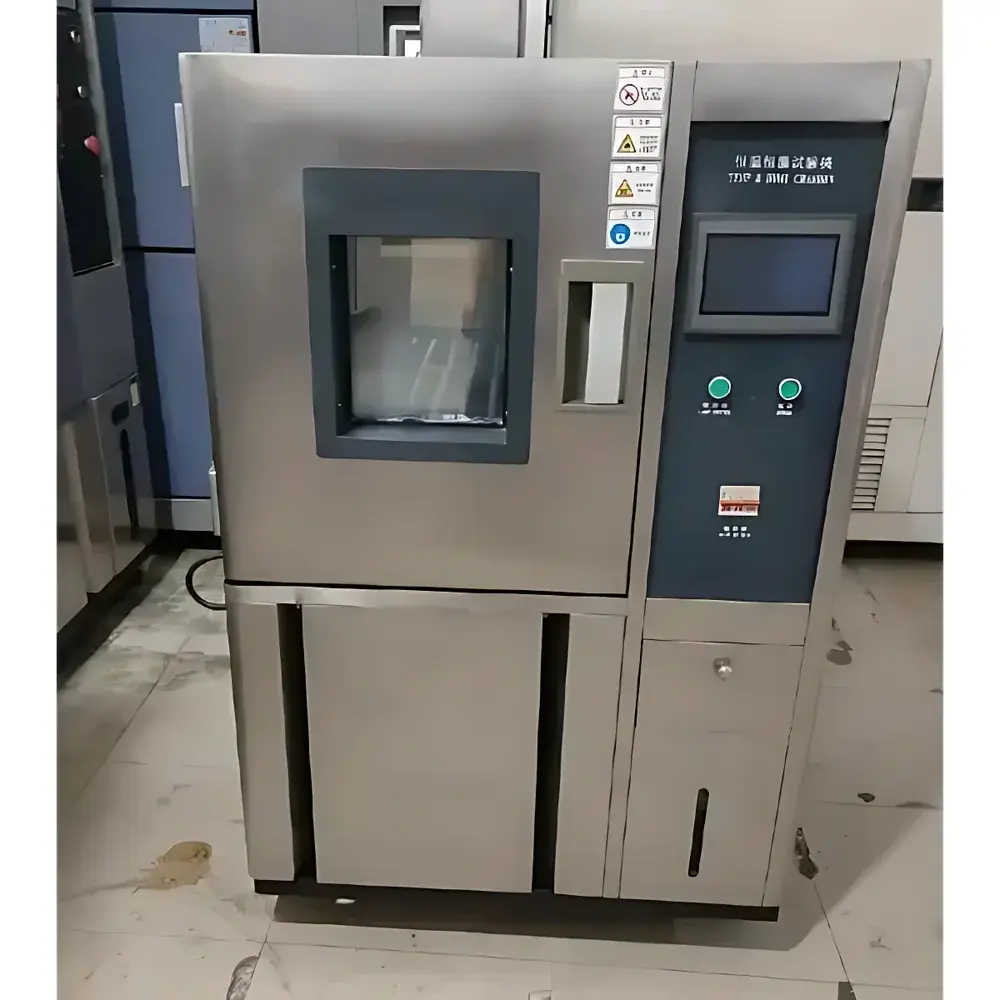
Jianhu JH-Battery Dual-Chamber High-Low Temperature Environmental Test Chamber
| Brand | Jianhu |
|---|---|
| Origin | Shanghai, China |
| Manufacturer Type | Authorized Distributor |
| Product Category | Domestic |
| Model | Jianhu JH-Battery Dual-Chamber High-Low Temperature Test Chamber |
| Price Range | USD 1,100 – 11,000 |
| Temperature Range | −70 °C to +150 °C |
| Refrigeration Method | Compressor-Based Cooling |
| Explosion-Proof Design | Yes |
| Temperature Fluctuation | ±0.5 °C |
| Temperature Uniformity | ±2.0 °C |
| Temperature Deviation | ±2.0 °C |
| Heating Rate | ≤60 min (−40 °C to +85 °C) |
| Cooling Rate | ≤45–80 min (room temp to −40 °C) |
| Interior Dimensions | Customizable (Standard Options: Upper Chamber 200 L / Lower Chamber 300 L) |
Overview
The Jianhu JH-Battery Dual-Chamber High-Low Temperature Environmental Test Chamber is an engineered solution for accelerated battery performance validation under controlled thermal stress conditions. Designed specifically for lithium-ion and solid-state battery developers and quality assurance laboratories, this dual-zone chamber employs independent, microprocessor-controlled thermal environments—physically isolated yet operationally synchronized—to enable concurrent testing of two distinct battery chemistries, cell formats, or aging protocols. Its core measurement principle is not analytical but *environmental stimulus delivery*: precise, reproducible temperature conditioning per IEC 62619, GB/T 31484–2015, and UN 38.3 Annex A requirements. Unlike single-chamber systems constrained by sequential test scheduling, the JH platform supports parallel execution of high-temperature cycle life evaluation (e.g., 85 °C storage or charge/discharge cycling) in one zone while simultaneously conducting low-temperature discharge characterization (e.g., −30 °C or −40 °C) in the other—eliminating inter-test thermal stabilization delays and enabling statistically robust cross-batch comparison within identical environmental baselines.
Key Features
- Dual independent thermal chambers with vacuum-insulated partition wall—ensuring inter-chamber thermal crosstalk <2 °C under maximum differential setpoints (e.g., +85 °C vs. −40 °C)
- Shared high-efficiency compressor-based refrigeration system with intelligent load balancing—reducing total energy consumption by up to 30% versus two standalone units
- Programmable synchronous or asynchronous operation modes: chambers may run identical profiles for repeatability verification, or fully independent profiles for comparative R&D
- Explosion-proof construction compliant with IEC 60079-0 and GB 3836.1–2010, including intrinsically safe internal wiring, non-sparking fan motors, and pressure-relief venting
- High-resolution PID control with 10 Hz data logging capability—capturing transient thermal responses critical for BMS algorithm validation
- Side-sliding access doors with quick-release latches—enabling full sample exchange in <5 minutes without thermal soak interruption to the opposite chamber
- AI-assisted thermal path optimization engine—recommends ramp-rate adjustments based on historical chamber inertia and load mass to minimize overshoot and stabilize faster
Sample Compatibility & Compliance
The JH chamber accommodates cylindrical (18650, 21700), prismatic, and pouch-format cells—up to 300 mm × 200 mm × 50 mm per chamber—with configurable mounting fixtures and integrated terminal access ports. All thermal profiles are traceable to NIST-traceable RTDs calibrated per ISO/IEC 17025. The system meets mandatory compliance requirements for battery safety certification workflows, including IEC 62619 (industrial batteries), UL 1642 (cell-level), and UN 38.3 Section 38.3.4 (thermal abuse). Optional integration with external DC load banks enables real-time electrochemical monitoring during thermal stress—supporting GLP-compliant test reports with full audit trails per FDA 21 CFR Part 11 when paired with validated software.
Software & Data Management
Equipped with Jianhu’s proprietary TCS-Link™ control suite (v4.2+), the chamber provides a secure web-based interface supporting role-based user permissions, electronic signatures, and automated report generation in PDF/XLSX format. All temperature setpoints, actual readings, alarm logs, and chamber status events are timestamped and stored locally with redundant SD-card backup. Data export complies with ASTM E2911–21 for environmental test data interchange. The software includes built-in statistical process control (SPC) tools—calculating Cp/Cpk for thermal uniformity across batches—and supports direct integration with LabVantage LIMS and Siemens Opcenter Quality via OPC UA. Audit trail functionality records all parameter changes, user logins, and firmware updates with immutable timestamps—fully satisfying GMP documentation requirements for battery qualification in automotive and medical device supply chains.
Applications
- Production QA throughput scaling: Enables simultaneous testing of incoming raw cells (upper chamber) and finished modules (lower chamber), reducing daily QC cycle time from 200 to <100 hours for 500-unit batches
- Chemistry benchmarking: Direct side-by-side comparison of Ni-rich NMC, LFP, and solid-state sulfide electrolyte cells under identical thermal transients—quantifying capacity fade, impedance rise, and gas evolution differentials
- BMS validation: Stress-testing battery management algorithms under rapid thermal transitions (5 °C/min ramp) while correlating voltage sag, SOC drift, and thermal runaway onset thresholds
- Accelerated aging studies: Running calendar aging at 60 °C/60% RH in one chamber while performing cycle aging at 25 °C in the other—accelerating lifetime modeling without cross-contamination of degradation mechanisms
- Supply chain qualification: Validating consistency across multiple electrode suppliers using identical thermal protocols—detecting subtle variations in binder thermal stability or SEI growth kinetics
FAQ
Does the dual-chamber design compromise temperature uniformity compared to single-chamber units?
No. Each chamber maintains ±2.0 °C uniformity per IEC 60068-3-5, verified independently using 9-point thermocouple mapping per test cycle.
Can the system be integrated with third-party battery cyclers or impedance analyzers?
Yes. Standard analog (0–10 V) and digital (Modbus TCP) I/O interfaces support bidirectional synchronization with Arbin, BioLogic, or Keysight systems for hybrid electro-thermal testing.
Is remote monitoring and alarm notification supported?
Yes. SMS/email alerts trigger on deviation >±1.0 °C, door open >30 s, or refrigerant pressure anomaly—configurable via TLS-secured cloud portal.
What calibration documentation is provided upon shipment?
NIST-traceable calibration certificates for all internal sensors, plus as-found/as-left reports for controller PID loops and safety interlocks—valid for 12 months.
How is explosion risk mitigated during overcharge or thermal runaway tests?
Chambers feature Class II, Division 1 explosion-proof rating with reinforced borosilicate viewing windows, flame-arresting ventilation ducts, and automatic nitrogen purge activation upon internal pressure spike detection.



