
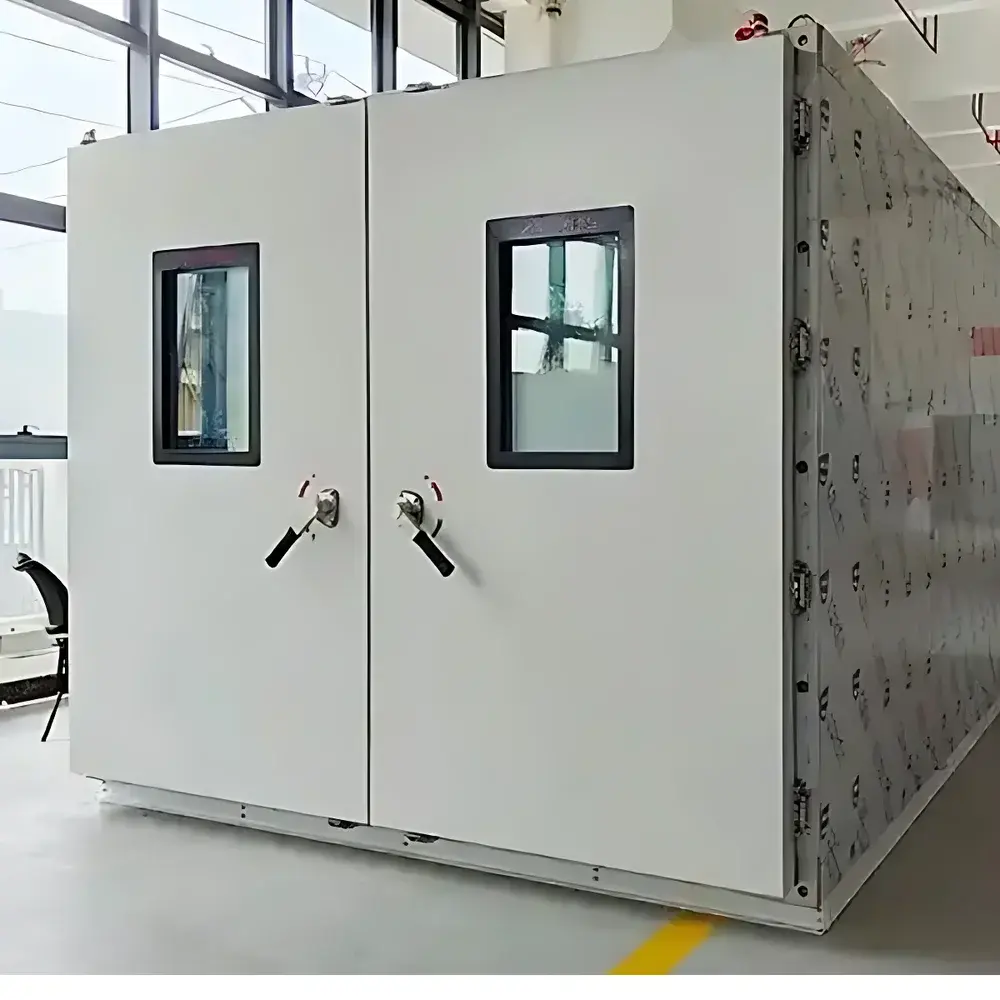
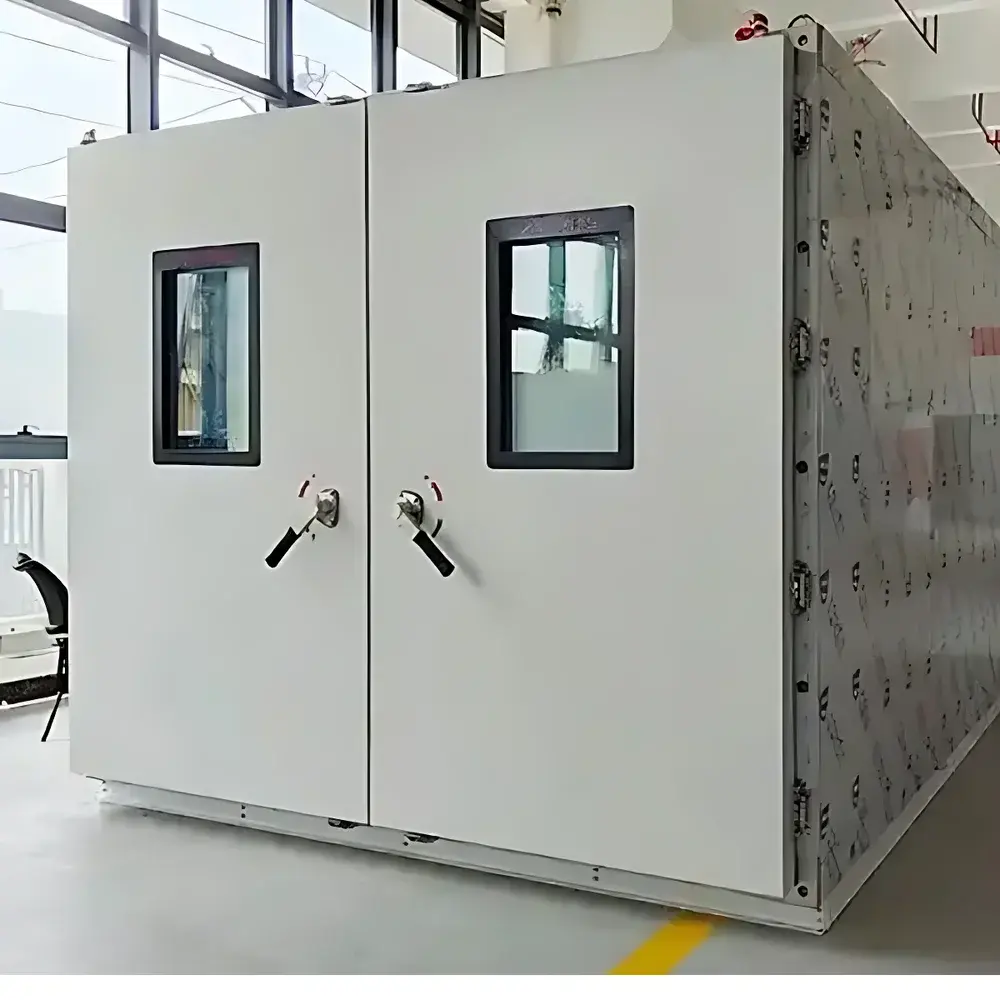
JianHu JH-Nylon Conditioning & Hydrothermal Treatment Chamber
| Brand | JianHu |
|---|---|
| Origin | Shanghai, China |
| Model | JH-Nylon Conditioning & Hydrothermal Treatment Chamber |
| Temperature Range | −70 °C to +150 °C |
| Refrigeration Method | Compressor-based |
| Explosion-Proof Design | Yes |
| Temperature Fluctuation | ±0.5 °C |
| Temperature Uniformity | ±2.0 °C |
| Temperature Deviation | ±2.0 °C |
| Heating Rate | ≤60 min (−70 °C → +150 °C) |
| Cooling Rate | ≤45 min / ≤60 min / ≤80 min (varies by setpoint and load) |
| Construction | Insulated chamber with vapor-tight sealing, corrosion-resistant epoxy flooring, and integrated air recirculation system |
Overview
The JianHu JH-Nylon Conditioning & Hydrothermal Treatment Chamber is an engineered environmental test system designed specifically for controlled hygrothermal conditioning of polyamide (nylon) materials in industrial and R&D settings. Unlike generic climate chambers, this unit integrates precise temperature regulation (−70 °C to +150 °C), high-fidelity humidity control (up to 95% RH), and robust air circulation architecture to meet the stringent requirements of nylon’s moisture equilibration kinetics. Nylon—particularly PA6, PA66, and reinforced grades—exhibits strong hygroscopic behavior; its dimensional stability, tensile strength, impact resistance, and dielectric properties are highly dependent on equilibrium moisture content (EMC). This chamber enables standardized, repeatable, and scalable conditioning per ASTM D5229/D5229M (moisture absorption of plastics), ISO 62 (determination of water absorption), and ISO 291 (standard atmospheres for conditioning and testing). Its explosion-proof construction further permits safe operation when processing nylon components exposed to solvent vapors or during post-molding hydrothermal stabilization in automotive or electronics manufacturing.
Key Features
- Explosion-Proof Certified Enclosure: Designed and tested to IEC 60079-0 / GB 3836.1 standards for use in classified hazardous locations where flammable vapors (e.g., from cleaning solvents or residual monomers) may be present during nylon part handling.
- High-Stability Dual-Control System: Independent PID-controlled heating (electric/steam hybrid options) and ultrasonic/steam-based humidification ensure simultaneous precision in temperature (±0.5 °C fluctuation, ±2.0 °C uniformity) and relative humidity (±3% RH typical accuracy).
- Optimized Air Recirculation Architecture: Multi-directional, low-turbulence airflow with adjustable velocity profiles ensures uniform exposure across large-volume loads—critical for consistent EMC attainment in heterogeneous batches of injection-molded parts, extruded profiles, or textile fibers.
- Thermally Isolated Chamber Construction: Double-wall structure with high-density polyurethane foam (≥30 kg/m³) or mineral wool insulation minimizes thermal bridging and external ambient interference, maintaining setpoint integrity under variable lab conditions.
- Corrosion-Resistant Interior: Epoxy-coated steel floor and stainless-steel interior surfaces withstand prolonged exposure to condensate, mild alkaline solutions, or process water residues—common in hydrothermal aging protocols.
Sample Compatibility & Compliance
The chamber accommodates a wide range of nylon geometries—from bulk polymer pellets and filament spools to finished automotive interior trim (e.g., instrument panel substrates, HVAC ducts), electronic housings, and industrial gears. Its modular shelving and customizable racking support both static and dynamic loading configurations. All operational parameters—including ramp rates, dwell times, and humidity hold profiles—are programmable and auditable to satisfy GLP, GMP, and ISO/IEC 17025 documentation requirements. The system complies with key international standards relevant to material conditioning: ASTM D618 (standard practice for conditioning plastics), ISO 291 (standard atmospheres), ISO 62 (water absorption testing), and EN 60068-1 (environmental testing—general and guidance). Optional data logging meets FDA 21 CFR Part 11 requirements for electronic records and signatures when paired with validated software.
Software & Data Management
Equipped with a touchscreen HMI running embedded Linux-based firmware, the chamber supports up to 100 programmable test profiles with multi-segment ramps, holds, and conditional logic (e.g., “hold at 65 °C/65% RH until internal sensor reads stable for 30 min”). Real-time graphs of chamber temperature, humidity, and dew point are displayed alongside alarm history and event logs. USB export and optional Ethernet/Wi-Fi connectivity enable CSV report generation and integration into enterprise LIMS or MES platforms. Audit trails record all user actions—including parameter changes, door openings, and calibration events—with timestamps and operator IDs. Firmware updates are performed via secure OTA protocol, ensuring long-term regulatory alignment without hardware modification.
Applications
- Automotive Component Stabilization: Pre-conditioning nylon 66 engine covers, intake manifolds, and fasteners to achieve dimensional stability prior to final assembly and leak testing.
- Electronics Manufacturing: Equilibrating PA-based PCB substrates and connector housings to prevent warpage, solder joint stress, or dielectric drift during reflow or functional testing.
- Fiber & Textile Processing: Controlled hydration of nylon 6 filament prior to texturing or dyeing to improve color uptake uniformity and reduce fiber breakage.
- R&D Material Characterization: Supporting DMA, TMA, and mechanical testing by delivering specimens at defined moisture states per ISO 11359 and ASTM D7028.
- Accelerated Aging Studies: Simulating long-term service exposure through cyclic hygrothermal profiles aligned with SAE J2527 or ISO 4892-2 for durability validation.
FAQ
What is the primary purpose of this chamber in nylon manufacturing?
It provides standardized, reproducible hygrothermal conditioning to stabilize nylon parts’ moisture content—directly influencing mechanical performance, dimensional accuracy, and long-term reliability.
Can this chamber be used for non-nylon polymers?
Yes—it is suitable for other hygroscopic thermoplastics (e.g., PET, PBT, PC) and composites requiring controlled moisture equilibration per ASTM D5229 or ISO 62.
Is remote monitoring supported?
Standard Ethernet interface enables integration with SCADA systems; optional cloud telemetry modules provide real-time status alerts and historical trend access via web dashboard.
How often does the humidity sensor require recalibration?
Annual traceable recalibration is recommended; built-in sensor diagnostics flag drift >±2% RH deviation automatically.
Does the system include validation documentation?
Factory IQ/OQ documentation is provided; PQ protocols and templates are available upon request to support user-specific qualification under ISO 13485 or ICH Q9 frameworks.



