
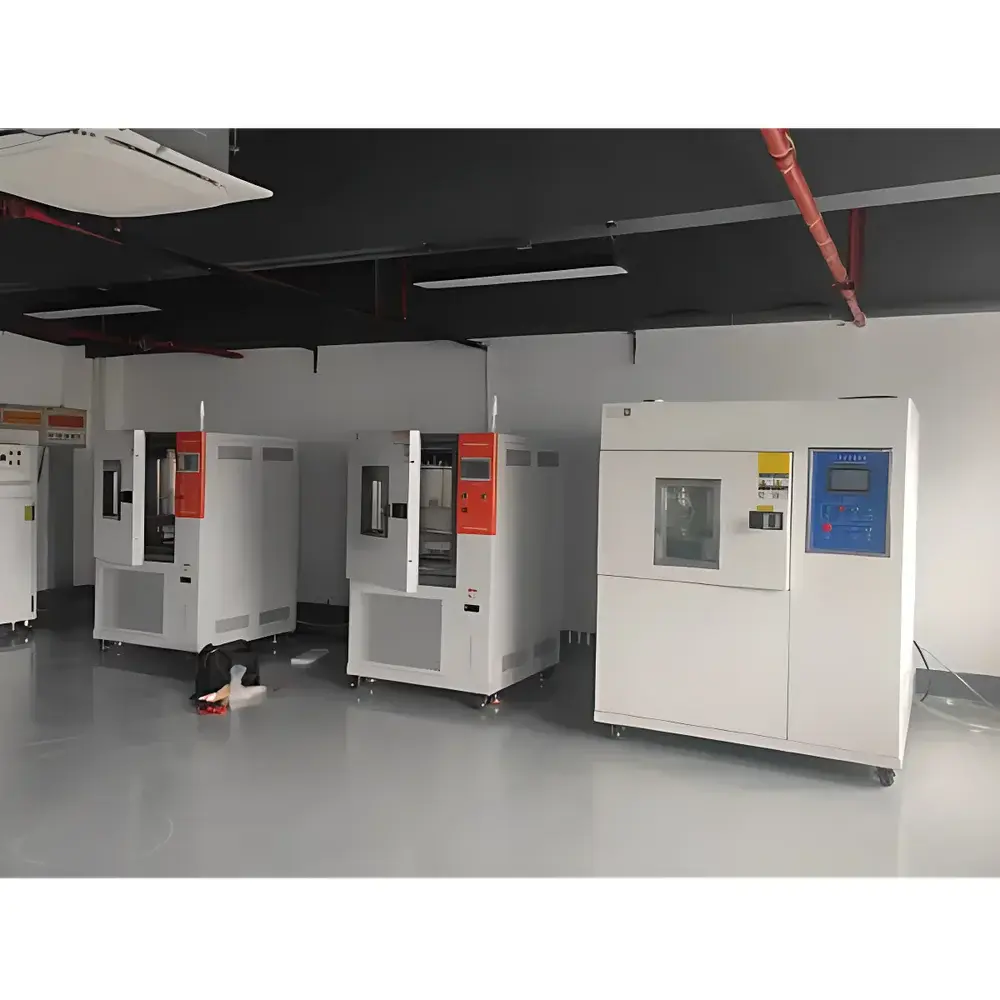
Jianhu JH-Series Dual-Layer Explosion-Proof Battery Short-Circuit Test Chamber with Temperature Control
| Brand | Jianhu |
|---|---|
| Origin | Shanghai, China |
| Model | JH-Series |
| Temperature Range | -70 °C to +150 °C |
| Refrigeration Method | Compressor-Based Cooling |
| Explosion-Proof Design | Dual-Layer Reinforced Steel Enclosure with Anti-Spall Coating |
| Temperature Uniformity | ±2.0 °C |
| Temperature Fluctuation | ±0.5 °C |
| Temperature Deviation | ±2.0 °C |
| Heating Rate | ≤60 min (from –40 °C to +85 °C) |
| Cooling Rate | ≤45–80 min (depending on setpoint and load) |
| Internal Chamber Dimensions | Customizable |
| Compliance | Designed per IEC 62133, UN 38.3, GB/T 31241, and aligned with ISO/IEC 17025 laboratory environmental control requirements |
Overview
The Jianhu JH-Series Dual-Layer Explosion-Proof Battery Short-Circuit Test Chamber is an integrated environmental test system engineered for rigorous safety evaluation of electrochemical energy storage devices under controlled thermal and electrical stress conditions. It combines precise temperature regulation—enabled by dual-stage compressor refrigeration and PID-controlled heating—with a certified explosion-resistant enclosure designed to contain catastrophic thermal runaway events during forced short-circuit testing. The chamber operates on the principle of controlled Joule heating under defined current loads (typically up to 500 A DC, configurable per battery format), while maintaining stable ambient thermal conditions per IEC 62133 Clause 7.2.2 and UN 38.3 Section 38.3.4. Unlike generic environmental chambers, this system integrates real-time voltage/current monitoring, programmable short-circuit duration (10 ms–30 s), and fail-safe interlock logic between thermal subsystems and electrical actuation modules—ensuring test repeatability and operator protection across R&D, QC, and certification workflows.
Key Features
- Dual-layer structural containment: Inner chamber constructed from 8 mm thick 304 stainless steel; outer shell reinforced with 12 mm AR400 ballistic-grade steel and proprietary spall-suppressing epoxy coating.
- Temperature-controlled short-circuit testing: Independent thermal stabilization (–70 °C to +150 °C) concurrent with high-current DC short activation—enabling evaluation of thermal runaway propagation at defined SOC and ambient states.
- Real-time parameter logging: Synchronized acquisition of cell voltage, surface temperature (via 4-channel K-type thermocouples), chamber air temperature, and short-circuit current at ≥1 kHz sampling rate.
- Fail-safe architecture: Redundant pressure relief vents with burst discs (rated at 200 kPa), automatic nitrogen purge initiation upon thermal anomaly detection (>120 °C sustained for >5 s), and hardware-level emergency power cutoff.
- Modular chamber configuration: Standard internal volumes range from 120 L to 500 L; custom dimensions support pouch, cylindrical (18650–32140), and prismatic cells—including multi-cell module testing with independent thermal zoning.
- Compressor-based cooling with cascade staging: Achieves –70 °C without liquid nitrogen dependency; maintains ±0.5 °C stability over 24-hour dwell periods per ISO 16750-4 Annex B.
Sample Compatibility & Compliance
The JH-Series accommodates single cells (Li-ion, Li-metal, solid-state prototypes), multi-cell packs (up to 24 V / 100 Ah), and small-format battery modules (≤300 mm × 200 mm footprint). All configurations comply with mechanical and thermal boundary conditions specified in IEC 62133-2:2017, UL 1642, and GB/T 31241–2014. The dual-layer enclosure meets Class I, Division 1 hazardous location requirements per NEC Article 500 when installed with certified purge systems. Ventilation pathways are engineered to meet NFPA 68 vent sizing guidelines for deflagration mitigation. Data traceability supports GLP/GMP-aligned validation protocols, including IQ/OQ documentation templates compliant with FDA 21 CFR Part 11 electronic record requirements.
Software & Data Management
Control and analysis are managed via Jianhu’s proprietary TestMaster v4.2 software—deployed on embedded industrial PC with touchscreen HMI. The interface supports ASTM E2077-compliant test method scripting, automated pass/fail evaluation against user-defined thresholds (e.g., ΔT > 20 °C in <60 s), and export of raw binary data in IEEE C37.118-compliant .dat format. Audit trails record all parameter changes, operator logins, calibration events, and alarm histories with SHA-256 hashing for integrity verification. Optional integration with LabArchives ELN or Siemens Opcenter Quality enables direct ingestion into enterprise quality management systems (QMS). Firmware updates are digitally signed and validated prior to installation.
Applications
- R&D validation of next-generation cathode/anode materials under accelerated thermal-electrical stress.
- Production line screening of cell-to-cell consistency in short-circuit response time and peak temperature rise.
- UN 38.3 T4 (short-circuit) and T5 (thermal cycling + short-circuit) certification pre-testing.
- Failure mode analysis (FMEA) of battery management system (BMS) fault-response latency using synchronized current injection and thermal imaging triggers.
- Thermal runaway propagation studies in stacked or parallel-connected cell arrays under controlled ambient gradients.
- Validation of fire suppression efficacy in enclosed battery storage cabinets per UL 9540A.
FAQ
What standards does the JH-Series chamber reference for explosion containment?
It conforms to EN 14460:2016 (explosion-resistant equipment design principles) and incorporates vent sizing calculations per NFPA 68–2023. Structural integrity is verified via hydrostatic pressure testing to 1.5× maximum expected deflagration pressure.
Can the chamber operate continuously at –70 °C during short-circuit testing?
Yes—continuous operation at –70 °C is supported with optional low-temp lubricants and cryo-rated current shunts. Cooling capacity remains sufficient to offset Joule heating from 300 A/10 ms pulses without exceeding ±1.0 °C chamber deviation.
Is remote monitoring and control available?
Standard Ethernet/IP and Modbus TCP interfaces enable integration with SCADA or MES platforms. Optional 4G/LTE module provides encrypted cloud telemetry for off-site oversight of chamber status and alarm events.
How is calibration traceability maintained?
Each unit ships with NIST-traceable calibration certificates for temperature sensors (±0.2 °C at 25 °C), current transducers (±0.5% FS), and pressure relief valves (ASME BPVC Section VIII stamped verification). Onboard self-diagnostics run daily sensor drift checks.
Does the system support automated test sequences per IEC 62133 Annex D?
Yes—preloaded test templates include Annex D short-circuit profiles (e.g., 10 ms pulse at 10× rated current), with configurable dwell times, recovery intervals, and pass criteria based on voltage rebound and thermal decay slope.



