
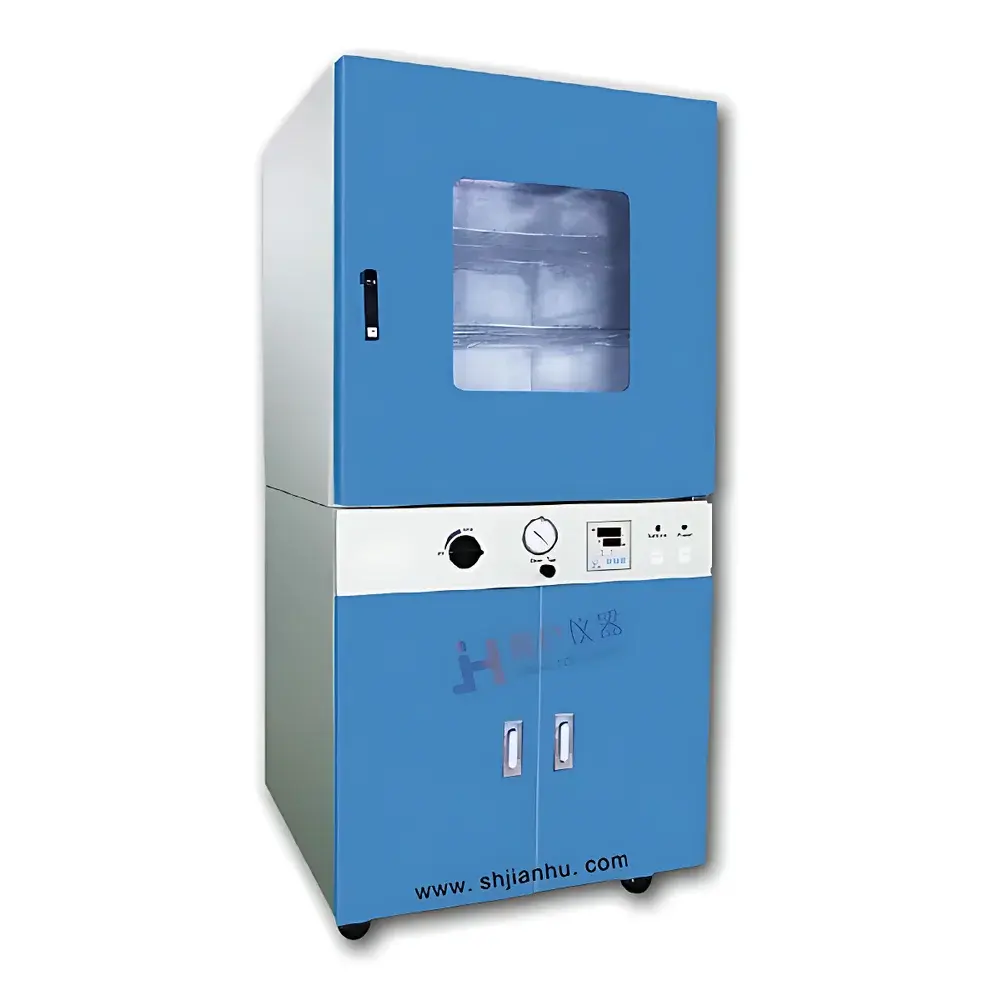
Jianhu JH Series Environmental Test Chambers – Low-Temperature Circulating Bath, Steam Aging Chamber, Precision Forced-Air Oven, and Class 1000 Vacuum Oven
| Brand | Jianhu |
|---|---|
| Origin | Shanghai, China |
| Manufacturer Type | Authorized Distributor |
| Country of Origin | China |
| Model | JH |
| Quotation | Upon Request |
| Max Operating Temperature | 300–400 °C |
| Vacuum Performance | ≤5×10⁻² Torr |
| Temperature Uniformity | ±2.0% |
| Voltage | 220 V AC |
| Power Rating | 12 kW |
| Internal Construction | SUS304 Stainless Steel |
| External Construction | SECC Steel with Powder-Coated Finish |
| Filtration | Integrated ISO Class 1000 (1,000 particles/ft³ ≥0.5 µm) Clean Air Recirculation |
| Control System | PID Microprocessor with PV/SV Dual Display, SSR-Driven Heating |
| Safety Systems | Independent Over-Temperature Cut-Off, Self-Diagnostic Routine, Overload Auto-Disconnection |
Overview
The Jianhu JH Series comprises four functionally distinct yet architecturally unified environmental test chambers engineered for precision thermal management in R&D laboratories, quality assurance facilities, and electronics manufacturing environments. Each unit adheres to a common design philosophy emphasizing material integrity, thermal stability, contamination control, and regulatory traceability. The series includes: (1) a low-temperature circulating bath operating via vapor-compression refrigeration with PT-100 platinum resistance thermometry and delayed restart logic; (2) a steam aging chamber compliant with MIL-STD-202F and MIL-STD-208F for accelerated moisture resistance evaluation of soldered electronic interconnects; (3) a forced-air convection oven featuring horizontal airflow distribution, class 1000 clean recirculation, and inert atmosphere compatibility; and (4) a compact vacuum oven integrating dual-stage vacuum sequencing, programmable purge cycles, and radiation/natural convection heating under high-vacuum conditions (≤5×10⁻² Torr). All units utilize SUS304 stainless steel internal chambers and are constructed to meet structural and operational requirements aligned with ISO/IEC 17025 laboratory infrastructure guidelines.
Key Features
- Uniform thermal performance validated per ASTM E2209–22: temperature uniformity maintained within ±2.0% across working volume under steady-state conditions.
- Corrosion-resistant construction: full SUS304 stainless steel interior; external SECC steel housing with electrostatic powder coating for durability and cleanroom compatibility.
- Intelligent thermal control architecture: PID microprocessor controller with dual-line PV/SV display, SSR-based power modulation, and programmable ramp-soak profiles.
- Class 1000 clean air recirculation (for forced-air models): fully welded internal ductwork, multi-wing centrifugal blower, and integrated HEPA-grade filtration ensuring zero particulate shedding from heater elements.
- Vacuum automation sequence: one-touch operation initiates automatic evacuation, preset cycle count execution, timed heating initiation post-evacuation, temperature hold, vacuum release, and audible/visual alarm on completion or fault.
- Safety redundancy: independent mechanical over-temperature cut-off switch, real-time self-diagnostic firmware checks, and current-sensing overload protection interrupting power at >110% rated load.
Sample Compatibility & Compliance
The JH Series accommodates diverse sample geometries and material classes—including PCB assemblies, passive components, optical substrates, polymer films, and biological assay carriers—without compromising thermal fidelity or atmospheric integrity. Steam aging units conform to MIL-STD-202F Method 103 (humidity resistance) and MIL-STD-208F (condensation testing), supporting qualification per IPC-J-STD-001 and JEDEC JESD22-A101. Forced-air ovens support nitrogen-purged operation for oxide-sensitive processes and align with USP dry heat sterilization validation prerequisites. Vacuum ovens meet vacuum integrity benchmarks specified in ASTM E595 for outgassing-critical aerospace applications. All systems support GLP/GMP documentation workflows via optional RS-485 Modbus RTU interface for audit-ready data logging.
Software & Data Management
While standalone operation is fully functional via front-panel keypad, optional communication modules enable integration into centralized lab management platforms. The embedded controller logs timestamped temperature/vacuum readings at user-defined intervals (1–600 sec), stores up to 100 program profiles with 20 segments each, and retains runtime diagnostics for ≥30 days. Data export is supported via USB flash drive in CSV format, compatible with LIMS systems and statistical process control (SPC) software. Firmware supports 21 CFR Part 11–compliant user access levels (Operator, Supervisor, Administrator) with password-protected parameter modification and electronic signature capture for critical settings changes.
Applications
- Electronics reliability testing: solder joint fatigue assessment under cyclic steam exposure; conformal coating adhesion validation under thermal-humidity stress.
- Materials science: solvent removal from nanocomposite precursors under vacuum; thermal desorption kinetics studies of adsorbed species on catalyst surfaces.
- Pharmaceutical development: residual solvent profiling in lyophilized APIs using controlled vacuum drying protocols.
- Optics manufacturing: stress-relief annealing of fused silica substrates without surface oxidation or particle deposition.
- Automotive component qualification: thermal cycling endurance of EV battery module housings under inert gas purge.
FAQ
What standards does the steam aging chamber comply with?
It meets MIL-STD-202F Method 103 and MIL-STD-208F for humidity-induced failure mode analysis of electronic connectors and soldered assemblies.
Can the vacuum oven operate under inert gas backfill?
Yes—equipped with standard gas inlet port and pressure-regulated purge valve for controlled N₂ or Ar backfill after vacuum cycles.
Is class 1000 cleanliness verified per ISO 14644-1?
Internal airflow filtration achieves ≤1,000 particles/ft³ ≥0.5 µm under continuous recirculation; certification requires third-party airborne particle counting per ISO 14644-1 Annex B.
Does the system support remote monitoring?
Optional Ethernet or RS-485 interface enables SCADA integration and real-time parameter viewing via browser-based HMI.
What maintenance is required for long-term vacuum integrity?
Annual inspection of O-rings, vacuum gauge calibration, and pump oil replacement (if internal pump option is installed) are recommended per manufacturer’s service schedule.



