
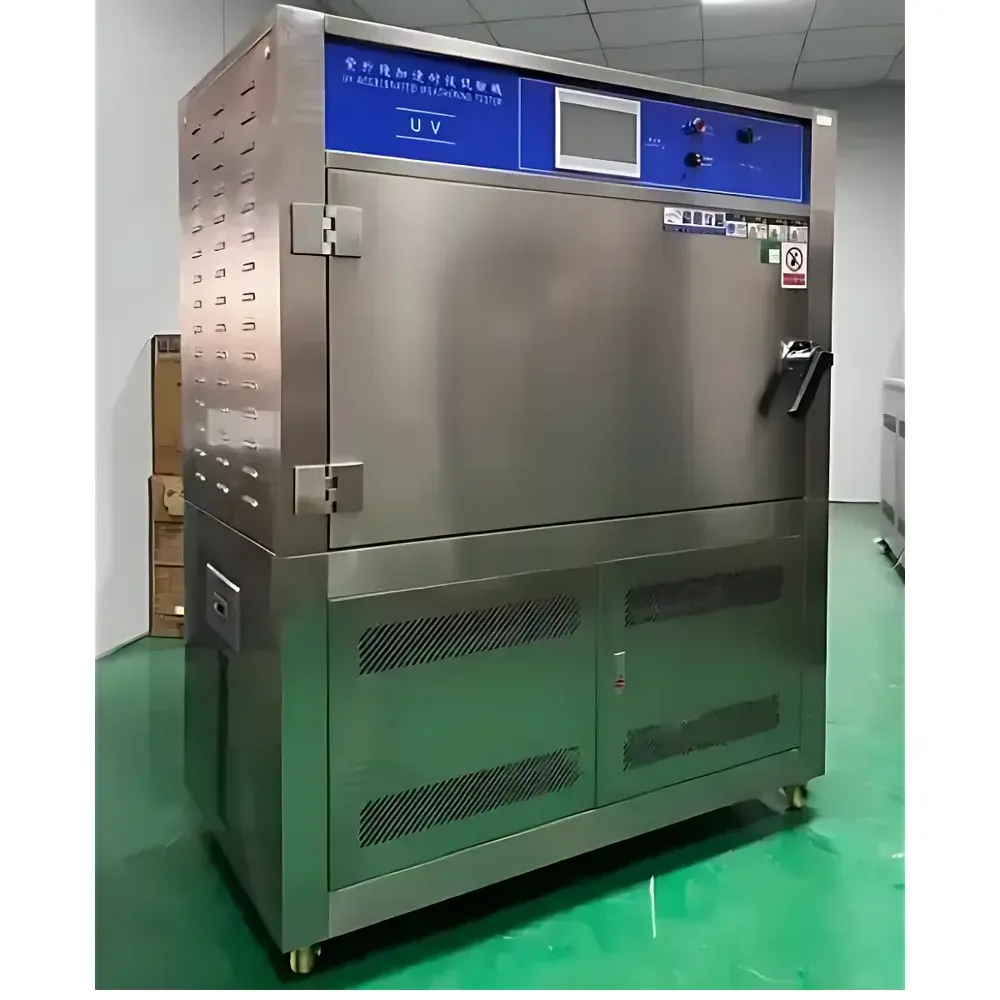
JianHu JH-Series UV Aging Test Chamber
| Brand | JianHu |
|---|---|
| Origin | Shanghai, China |
| Model | JH-Series UV Aging Test Chamber |
| Price Range | USD 280–11,000 (FOB) |
| Humidity Range | ≥95% RH (in-chamber actual value) |
| UV Lamp Power | 40 W per lamp |
| Irradiance Range | 0.72 W/m² (typically at 340 nm) |
| Exposure Time Setting | 1–9999 hours (adjustable) |
Overview
The JianHu JH-Series UV Aging Test Chamber is an engineered environmental simulation system designed to accelerate photochemical degradation of polymeric, coated, and composite materials under controlled ultraviolet (UV) radiation exposure. Based on the fundamental principles of photodegradation kinetics—where UV photons induce bond scission, oxidation, and crosslinking in organic matrices—the chamber replicates key spectral components of terrestrial sunlight (primarily UV-A: 315–400 nm and UV-B: 280–315 nm) using fluorescent UVA-340 or UVB-313 lamps. Unlike natural outdoor exposure—which may require months or years to produce measurable deterioration—this chamber enables reproducible, time-compressed aging cycles while maintaining traceable irradiance control, thermal regulation, and humidity conditioning. It complies with internationally referenced test standards including ASTM G154 (Standard Practice for Operating Fluorescent Ultraviolet (UV) Lamp Apparatus for Exposure of Non-Metallic Materials), ISO 4892-3 (Plastics—Methods of Exposure to Laboratory Light Sources—Part 3: Fluorescent UV Lamps), and GB/T 14522 (Chinese national standard for mechanical properties of plastics after UV exposure).
Key Features
- Stable UV Irradiance Control: Equipped with calibrated UVA-340 lamps delivering consistent 0.72 W/m² irradiance at 340 nm wavelength—aligned with solar spectral intensity at ground level—ensuring high inter-laboratory reproducibility.
- High-Humidity Conditioning: Maintains ≥95% RH within the test chamber during condensation cycles, simulating dew formation critical for hydrolytic degradation mechanisms in coatings and elastomers.
- Precise Exposure Timing: Digital timer supports programmable exposure durations from 1 hour to 9999 hours, enabling both short-term qualification tests and long-term durability assessments.
- Robust Thermal Management: Integrated air-circulated heating system ensures uniform temperature distribution (typically 40–70°C range, depending on lamp configuration and test protocol) across the working volume.
- Modular Sample Configuration: Standard chamber accommodates multiple flat-panel or 3D specimens on adjustable stainless-steel sample racks; optional rotating turntable available for enhanced irradiance uniformity.
- Human-Centered Interface: 7-inch capacitive touchscreen controller with multilingual UI (English default), real-time monitoring of UV intensity, chamber temperature, and relative humidity, plus password-protected parameter locking for GLP/GMP environments.
Sample Compatibility & Compliance
The JH-Series accommodates rigid and flexible substrates up to 50 mm thickness, including thermoplastics (e.g., ABS, PC, PP), painted metal panels, textile laminates, automotive interior trim, optical films, and architectural sealants. Specimen mounting follows ASTM D6675 and ISO 4892-3 requirements for specimen orientation and spacing. All chambers are manufactured in accordance with ISO 9001:2015 quality management systems and meet CE marking requirements for electromagnetic compatibility (EMC) and low-voltage directive compliance. Optional calibration certificates (NIST-traceable UV radiometer) and IQ/OQ documentation packages are available for regulated industries requiring FDA 21 CFR Part 11–compliant validation records.
Software & Data Management
Standard firmware includes data logging at user-defined intervals (minimum 1-minute resolution) for UV irradiance, chamber temperature, and humidity—exportable via USB to CSV format for post-test analysis in Excel or statistical software (e.g., JMP, Minitab). For integrated laboratory informatics, optional RS-485 Modbus RTU or Ethernet TCP/IP interface enables connection to LIMS or MES platforms. Audit trail functionality logs all operator actions—including parameter changes, start/stop events, and alarm acknowledgments—with timestamp and user ID—supporting GLP and GMP audit readiness. Firmware updates are delivered via secure HTTPS portal with version-controlled release notes and change history.
Applications
- Evaluation of color stability, gloss retention, chalking, and microcracking in automotive clearcoats per SAE J2527 and GMW14124.
- Accelerated weathering validation of photovoltaic encapsulants (EVA, POE) per IEC 61215-2 MQT03.
- UV resistance screening of medical device polymer housings (e.g., polycarbonate, PBT) under ISO 10993-12 biological evaluation guidelines.
- Qualification testing of aerospace-grade adhesives and composites per Boeing BMS 8-269 and Airbus AITM 1-0003.
- Research-grade aging studies in academic polymer science labs investigating structure–property relationships under simulated subtropical or desert UV/humidity profiles.
FAQ
What UV spectral output does the JH-Series lamp provide?
The standard configuration uses UVA-340 fluorescent lamps, which closely match the solar UV spectrum from 295 nm to 365 nm—particularly critical for predicting real-world degradation of most organic materials.
Can the chamber perform cyclic UV/condensation tests?
Yes—programmable cycles alternate between UV irradiation (with controlled temperature) and dark condensation phases (with elevated humidity and no UV), conforming to ASTM G154 Cycle 1 and ISO 4892-3 Method A.
Is NIST-traceable irradiance calibration included?
Calibration is optional but recommended annually; certified UV radiometers with NIST-traceable certificates (±3% uncertainty at 340 nm) are available as accessories.
What maintenance is required for long-term operational reliability?
Lamp replacement every 1600–2000 hours of operation; periodic cleaning of reflectors and chamber interior with isopropyl alcohol; annual verification of temperature/humidity sensor accuracy using reference probes.
Does the system support remote monitoring or integration into a centralized lab network?
Yes—via optional industrial Ethernet module supporting Modbus TCP or HTTP-based REST API for integration with SCADA, LabVIEW, or enterprise QA systems.



