
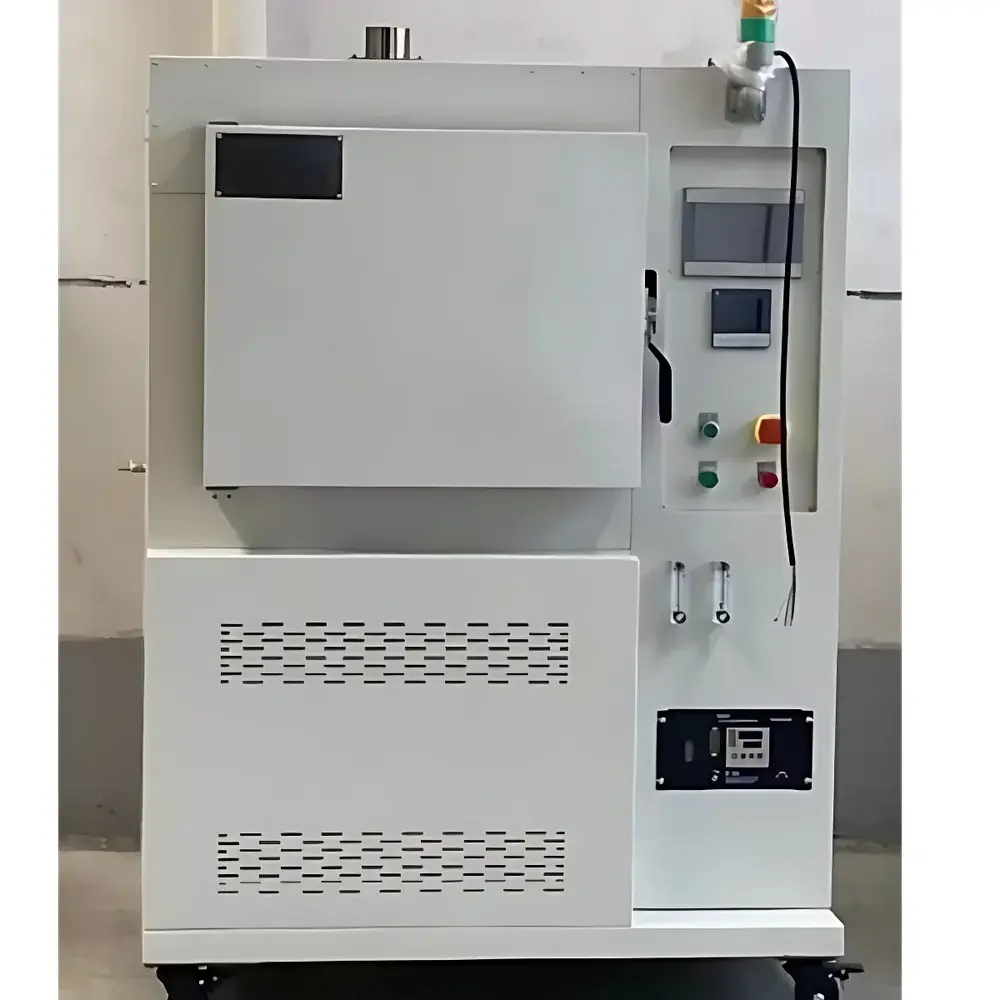
Jianhu JH-Series Vacuum Oxygen-Free High-Temperature Aging Test Chamber for Photosensitive PSPI Polyimide Processing
| Brand | Jianhu |
|---|---|
| Origin | Shanghai, China |
| Model | JH-Vacuum Oxygen-Free Oven |
| Temperature Range | 150–260 °C |
| Max Operating Temperature | <150 °C (for PSPI process window) |
| Temperature Uniformity | ±0.3 °C |
| Temperature Fluctuation | ±0.2–±0.5 °C |
| Temperature Deviation | ≤±2 °C |
| Heating Rate | 1–3 °C/min |
| Cooling Rate | ≤45 min (150 °C to −40 °C) |
| Chamber Dimensions | Customizable (from tens of liters to several cubic meters) |
| Vacuum Capability | <10⁻³ Pa (optional configuration) |
| Oxygen Control | ≤5 ppm (with integrated N₂ purge & laser O₂ sensor) |
Overview
The Jianhu JH-Series Vacuum Oxygen-Free High-Temperature Aging Test Chamber is an application-specific thermal processing system engineered for the precise post-application curing and thermal stabilization of photosensitive polyimide (PSPI) films used in advanced semiconductor lithography, flexible display substrates, and MEMS packaging. Unlike generic high-temperature ovens, this chamber integrates vacuum capability, dynamic oxygen suppression, and multi-point temperature field control to address the fundamental material science constraints of PSPI processing: oxidative degradation of imide rings, solvent entrapment-induced void formation, and thermally induced stress gradients that compromise film adhesion, dimensional stability, and optical fidelity. The system operates on a dual-mode principle—either under inert nitrogen atmosphere (≤5 ppm O₂) or under vacuum (<10⁻³ Pa)—to suppress radical-mediated oxidation pathways while enabling controlled solvent outgassing. Its architecture complies with the thermal management requirements defined in ASTM D3418 (thermal transitions of polymers) and ISO 2137 (heat aging of elastomers), adapted for thin-film polyimide systems.
Key Features
- Vacuum-compatible stainless-steel chamber with double-walled insulation and welded seams to ensure leak integrity below 1×10⁻⁴ Pa/min (helium leak tested)
- Dual-stage oxygen control: real-time laser-based paramagnetic O₂ sensor (±0.1 ppm resolution) coupled with programmable high-purity nitrogen (99.9995%) purge logic
- Multi-zone heating system with silicon carbide (SiC) heating elements and 32-point Pt100 RTD array for spatial temperature mapping and closed-loop uniformity correction
- Programmable ramp-soak-cool profiles with up to 99 segments per recipe; temperature overshoot limited to <0.5 °C via adaptive PID+FF control
- Integrated vacuum pump interface (turbo-molecular + dry scroll) with pressure regulation down to 10⁻⁴ Pa (optional)
- Touchscreen HMI with audit-trail-enabled operation logging compliant with FDA 21 CFR Part 11 requirements for electronic records
Sample Compatibility & Compliance
The chamber accommodates wafers (up to 300 mm), glass substrates (Gen 6–Gen 8), and flexible polymer carriers (e.g., PI, PET, PEN) without mechanical distortion. Sample trays are configured with low-outgassing ceramic or quartz supports to prevent catalytic surface reactions. All internal surfaces undergo electropolishing and passivation to minimize metal ion contamination—a critical requirement for semiconductor-grade PSPI processing. The system meets IEC 60068-2-2 (dry heat testing), UL 61010-1 (safety), and GB/T 10589 (Chinese national standard for high-temperature test chambers). Optional validation packages include IQ/OQ documentation aligned with GLP and GMP environments, supporting qualification for use in Class 100 cleanroom-integrated fabrication lines.
Software & Data Management
Jianhu’s proprietary JH-ControlSuite v4.2 provides full recipe management, real-time thermal profiling, and cross-parameter correlation (O₂ concentration vs. chamber pressure vs. temperature gradient). Raw sensor data—including 32-channel temperature logs, O₂ ppm traces, vacuum decay curves, and heater power consumption—is timestamped and exported in CSV/Excel format. The software supports automated report generation per ISO/IEC 17025 requirements, including uncertainty budgeting for temperature uniformity measurements. Audit trails record all user actions, parameter changes, and alarm events with digital signature support. Remote monitoring via secure HTTPS API enables integration into factory MES platforms (e.g., Siemens Opcenter, Rockwell FactoryTalk) for SPC-driven process control.
Applications
- Semiconductor front-end: PSPI hard-bake and post-exposure bake (PEB) for 28 nm node and beyond, reducing line edge roughness (LER) and improving CD uniformity
- Flexible OLED backplanes: stress-relief annealing of PSPI planarization layers to achieve <1 μm thickness variation over 150 mm × 150 mm areas
- MEMS encapsulation: controlled pyrolysis of PSPI sacrificial layers with residual carbon content <0.5 wt%, verified by TGA-FTIR coupling
- Advanced packaging: thermal cycling preconditioning of PSPI-based redistribution layers (RDLs) prior to copper electroplating
- Materials R&D: accelerated aging studies per JEDEC JESD22-A108 for PSPI dielectric reliability prediction
FAQ
What vacuum level is achievable with standard configuration?
Standard units reach ≤1×10⁻³ Pa with optional turbo-molecular pumping achieving ≤5×10⁻⁴ Pa.
Can the chamber be validated for ISO 17025-compliant calibration?
Yes—NIST-traceable temperature mapping and oxygen sensor calibration certificates are available upon request.
Is nitrogen purge flow rate adjustable per recipe step?
Yes—mass flow controllers support programmable setpoints from 0.5 to 20 L/min (N₂, 99.9995%).
Does the system support remote diagnostics and firmware updates?
Yes—via encrypted Ethernet connection with TLS 1.2 and role-based access control.
What is the maximum recommended continuous operating temperature for PSPI processes?
For photolithographic PSPI formulations, the optimal range is 150–260 °C; prolonged exposure above 260 °C may accelerate imide ring scission.
Related Products



